How to Choose an eCommerce SEO Agency in 2026
What to look for in an eCommerce SEO agency, what red flags to avoid, and how to evaluate agencies for Philippine online stores. A practical decision guide for 2026.

Hiring an eCommerce SEO agency is one of the highest-leverage decisions a growing online store can make — and one of the easiest to get wrong. The wrong agency burns budget for months without moving revenue, while the right one builds a compounding organic traffic asset that outlasts any ad campaign.
This guide gives you a practical framework for evaluating agencies: what competencies actually matter, what red flags indicate a bad fit, how to compare agency versus other options, and what to ask before signing anything.
What an eCommerce SEO Agency Actually Does
Before evaluating agencies, it helps to be clear on what you are buying. A competent eCommerce SEO agency should deliver across three core areas:
Technical SEO management: Identifying and resolving crawlability issues, structured data implementation, Core Web Vitals optimization, URL architecture, and platform-specific technical work (Shopify, WooCommerce, headless stacks). This is infrastructure work — it creates the foundation everything else depends on.
On-page and content optimization: Product page optimization at scale, category page content, buying guide and blog content strategy, keyword research, and internal linking architecture. This is where organic traffic and topical authority are built over time.
Off-page authority building: Earning editorial backlinks, digital PR, and managing the store's overall domain authority relative to competitors.
A full-service agency handles all three. Some agencies specialize in one area and partner or subcontract the others. Know which model you are evaluating.
For context on what these activities involve, the eCommerce SEO guide covers each component in detail.
What Good eCommerce SEO Agencies Have in Common
Demonstrated eCommerce Experience
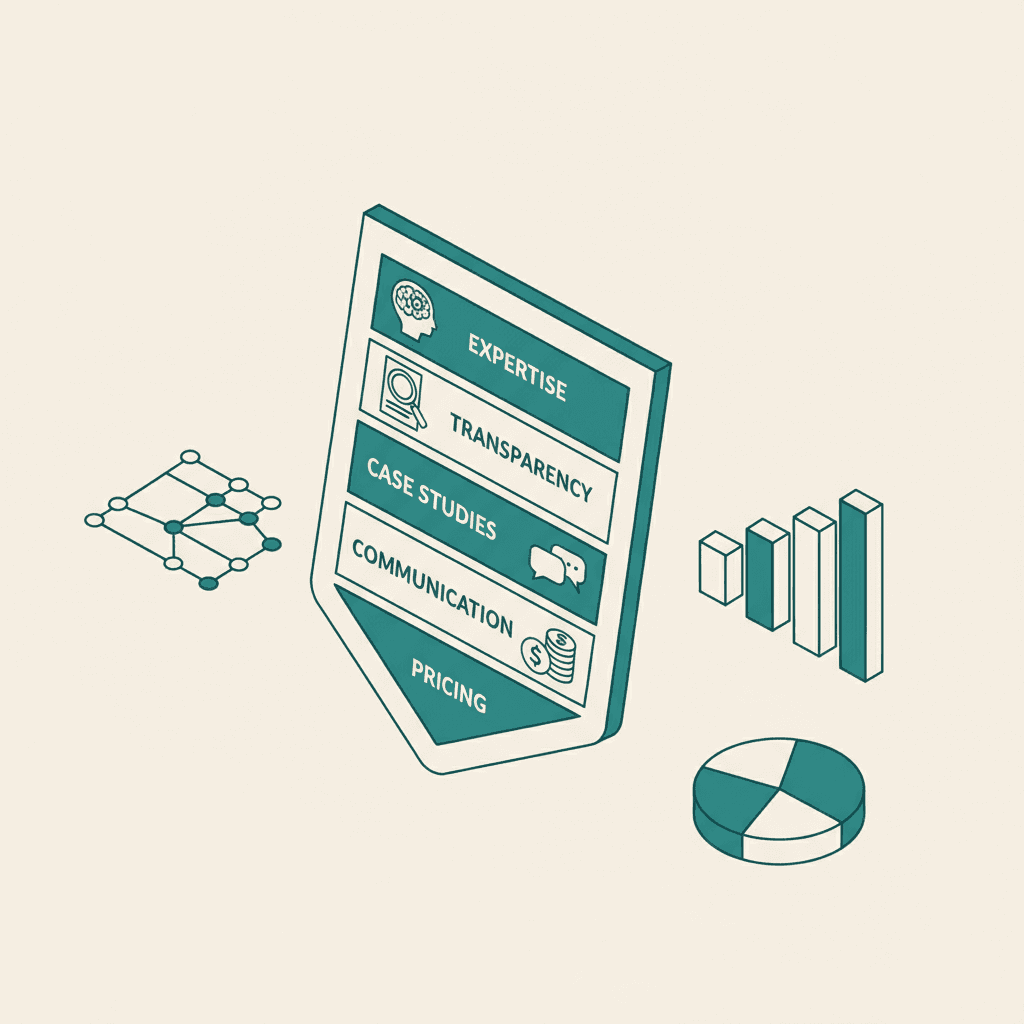
Generic SEO experience does not transfer cleanly to eCommerce. An agency that primarily works with service businesses, law firms, or B2B clients will approach product catalog optimization, faceted navigation, and product schema very differently — and often incorrectly.
Ask to see case studies from eCommerce clients specifically. Look for:
- Revenue growth attributed to organic search, not just traffic growth
- Evidence of technical problem-solving (crawl budget, structured data, platform migration)
- Category and product page rankings, not just blog traffic
Traffic without revenue attribution is a vanity metric. Any agency presenting only traffic growth as success evidence is telling you something important about how they measure their own work.
Platform Expertise Relevant to Your Stack
If you run Shopify, your agency should have deep Shopify SEO experience — not just familiarity. Shopify has specific quirks: the `/collections` and `/products` URL structure, canonical tag behavior, the limitations of the built-in Shopify blogging platform, and the performance implications of third-party app installations.
WooCommerce requires a different skill set: database optimization, plugin interaction management, hosting-level performance work, and WordPress-specific crawl issues.
Headless commerce stores (Shopify Hydrogen, Next.js Commerce, custom composable stacks) require specialized technical SEO knowledge that most agencies do not yet have. If your store is headless or planning to go headless, verify JavaScript SEO capabilities explicitly during the evaluation.
Transparent Reporting Tied to Revenue
Monthly reports should connect SEO activity to business outcomes. At minimum, expect to see:
- Organic traffic trends by page type (product, category, blog)
- Keyword ranking movement for target terms
- Organic revenue and organic-attributed conversions
- Technical health indicators: indexation errors, Core Web Vitals, crawl stats
An agency unwilling to report organic revenue — or that deflects to traffic as the primary success metric — is avoiding accountability for the outcome that actually matters to your business.
A Clear Process for the First 90 Days
The first 90 days reveal how an agency actually operates. A professional agency should describe:
- A technical audit in weeks 1-3
- A keyword research and architecture review in weeks 2-4
- A prioritized remediation roadmap presented before implementation begins
- Clear communication about what will be done in each period and why
If an agency cannot articulate its first 90-day process before you sign, that uncertainty will characterize the entire engagement.
eCommerce SEO Agency vs. Freelancer vs. In-House
Choosing between an agency, a freelancer, and building in-house is a separate decision that depends on your budget, timeline, and organizational capacity.
Agency — Freelancer — In-House
Cost — Higher monthly retainer — Lower per-project or hourly — Salary + benefits (highest long-term)
Expertise breadth — Full team: technical, content, links — Often one specialty — Depends on hire
Scalability — Scales with scope — Limited to one person's capacity — Limited without additional hires
Speed to start — Weeks (onboarding, audit) — Days to weeks — Months (hiring process)
Accountability — Contractual, managed — Variable — Internal management required
Best for — Stores doing ₱5M+ monthly, needing full-service execution — Specific projects: audit, technical fixes, content — Large stores ready to build an internal SEO function
For most Philippine eCommerce stores in the ₱500K–₱5M monthly revenue range, an agency or a senior freelancer with agency-level capabilities is the most practical option. The SEO cost guide provides detailed pricing benchmarks for context on what to budget.
Red Flags: When to Walk Away
Guaranteed Number One Rankings
No legitimate SEO agency can guarantee specific rankings. Google's algorithm is not for sale, and anyone claiming guaranteed positions is either lying or planning to use tactics (paid links, cloaking, private blog networks) that will eventually result in a manual penalty.
Heavy Focus on Backlink Volume Without Quality Context
"500 backlinks per month" sounds impressive until you learn those are directory submissions, forum spam, and low-quality guest posts on irrelevant sites. Quality and relevance of linking domains matters far more than quantity. Ask where the links will come from and how they will be earned.
No Audit Before Recommendations
An agency that presents a proposal before conducting even a basic technical review is selling a package, not a service. Every eCommerce store has a unique technical situation. Recommendations made without diagnosis are guesses.
Opaque Reporting or Locked Reporting Access
You should own your data. Agencies should be working in your Google Search Console, your Analytics account, and your Ahrefs account — not keeping data in proprietary systems you cannot access if you leave. Any agency that will not give you direct access to your own performance data is a risk.
Promising Results Without Asking About Your Products, Margins, or Customers
Good eCommerce SEO requires business context. An agency that skips questions about your product categories, target customers, competitive landscape, and business goals is not building a strategy — they are applying a template.
Questions to Ask in a Discovery Call
Before committing to any agency, get clear answers to these:
- "Can you show me a case study from an eCommerce client on a similar platform to ours, with organic revenue data?"
- "Walk me through your first 90-day process for a new eCommerce client."
- "How do you handle technical SEO for large product catalogs with many variants?"
- "What does your monthly reporting include, and will we have direct access to our own analytics data?"
- "How do you approach link building — can you give specific examples of links you earned for eCommerce clients?"
- "What AI tools do you use, and how do you ensure content quality at scale?"
- "What does success look like at 6 months and 12 months for a store like ours?"
How an agency answers these questions is more revealing than what is in their pitch deck.
Choosing an eCommerce SEO Agency in the Philippines
The Philippine eCommerce market has matured significantly. Brands that relied entirely on Shopee and Lazada for visibility are now investing in owned organic channels as marketplace competition and platform fees have intensified.
What to look for when evaluating Philippine eCommerce SEO agencies specifically:
- Familiarity with the local buyer journey (COD preference, GCash/PayMaya checkout optimization, localized trust signals)
- Experience with bilingual keyword strategies (English + Filipino search intent)
- Understanding of local link-building opportunities: Philippine media outlets, local review sites, regional business directories
- Track record with Philippine logistics and delivery-related keywords that drive local purchase intent
Not every international agency template translates to the Philippine market. Local context — in keyword strategy, in content voice, and in understanding what drives Philippine buyer trust — genuinely matters.
Our AI-powered SEO services are built specifically for the Philippine digital market, combining international SEO best practices with local market expertise. If you are evaluating agencies and want to understand what a strategy for your specific store would look like, professional SEO services team is happy to walk through it without obligation.
What to Expect in Terms of Results and Timeline
Realistic eCommerce SEO timelines:
- Months 1-2: Technical audit and fixes, initial keyword mapping, structured data implementation. Minimal traffic movement — this is foundation work.
- Months 3-4: Initial ranking movement on long-tail and lower-competition terms. First organic revenue attribution.
- Months 5-6: Meaningful traffic growth on target keywords. Compounding effect of content program begins.
- Month 12+: Significant organic revenue contribution. Category-level competitive keywords coming into range.
Stores that expect ranking changes in 30 days are either working in a completely uncompetitive niche or will be disappointed. Set expectations accordingly, and be wary of agencies that promise otherwise.
The best agencies also understand how website design and UX affect conversion, not just traffic.
Look for agencies that can handle both organic growth and paid search campaigns when evaluating partners.
Frequently Asked Questions
How much does an eCommerce SEO agency cost in the Philippines?+
Philippine-based eCommerce SEO agencies typically charge between ₱30,000 and ₱150,000 per month depending on scope, catalog size, and service depth. International agencies with Philippine market expertise can charge more. The [SEO cost guide](/blog/seo-cost) covers pricing ranges in detail across different service tiers.
What should an eCommerce SEO agency deliver each month?+
At minimum: a monthly progress report covering organic traffic, keyword rankings, and organic revenue; a list of completed optimization activities; and a clear plan for the following month. Quarterly, expect a deeper strategic review. Ad hoc communication on technical issues should happen when they arise, not only at reporting intervals.
How do I know if my eCommerce SEO agency is performing?+
Track organic revenue as the primary KPI. Secondary indicators: target keyword ranking movement (not just traffic), new referring domains earned each month, and indexation health in Search Console. If organic revenue is not growing after six months of solid technical and content work, a strategy conversation is warranted.
What is the difference between an eCommerce SEO agency and a general SEO agency?+
An eCommerce-specialist agency has experience with the specific challenges of online stores: large-scale product page optimization, faceted navigation, product schema implementation, and platform-specific technical SEO (Shopify, WooCommerce, headless). A general SEO agency may be excellent at blog-driven or lead-gen SEO but lack the catalog management and technical eCommerce expertise your store needs.
How long before I see results from an eCommerce SEO agency?+
Expect initial ranking movement on long-tail keywords within three to four months. Meaningful organic revenue contribution typically becomes visible at five to seven months. Category-level competitive keywords in established niches can take twelve months or more. Timeline depends heavily on your site's current technical health, your domain's existing authority, and the competitiveness of your product categories.