What Is eCommerce SEO? A Complete Guide for 2026
eCommerce SEO is how online stores attract buyers through organic search. Learn the fundamentals, what's changed in 2026, and how to build a strategy that drives revenue.

Every time someone types "buy running shoes Philippines" or "best wireless earbuds under 3000 pesos" into Google, a race is underway. The online stores that win that race are not always the ones with the biggest ad budgets. They are the ones that invested in eCommerce SEO.
This guide breaks down exactly what eCommerce SEO is, why it matters more than ever in 2026, and what a working strategy looks like for Philippine online stores competing in an increasingly crowded market.
What Is eCommerce SEO?
eCommerce SEO is the practice of optimizing an online store so that its product pages, category pages, and supporting content rank prominently in organic search results. The goal is straightforward: attract buyers who are actively searching for what you sell, and convert that search traffic into revenue — without paying for every click.
At its core, eCommerce SEO applies the same principles as general SEO, but with a specific focus on the structural and content challenges unique to online stores: large product catalogs, duplicate content across variants, faceted navigation, product schema, and the commercial intent of shoppers rather than just readers.
A well-optimized eCommerce store ranks for three types of queries:
- Navigational: "Nike Philippines store," "Shopify checkout tutorial"
- Informational: "how to clean leather shoes," "best laptop for college students"
- Transactional: "buy Sony WH-1000XM6 Philippines," "noise cancelling headphones free shipping"
Most of the revenue opportunity lives in transactional and high-intent informational queries. Getting those pages right is what separates stores that grow through organic search from those that are permanently dependent on paid traffic.
eCommerce SEO vs. Traditional SEO
The principles overlap, but the execution differs in several important ways.
Factor — Traditional SEO — eCommerce SEO
Page types — Blog posts, landing pages — Product pages, category pages, blogs
Primary intent — Informational, navigational — Transactional, commercial investigation
Content volume — Dozens to hundreds of pages — Thousands of SKUs and variants
Duplicate content risk — Low to moderate — High (variants, filters, sorting)
Schema requirements — Article, FAQ, HowTo — Product, Offer, Review, BreadcrumbList
Conversion focus — Lead gen, contact — Add to cart, checkout
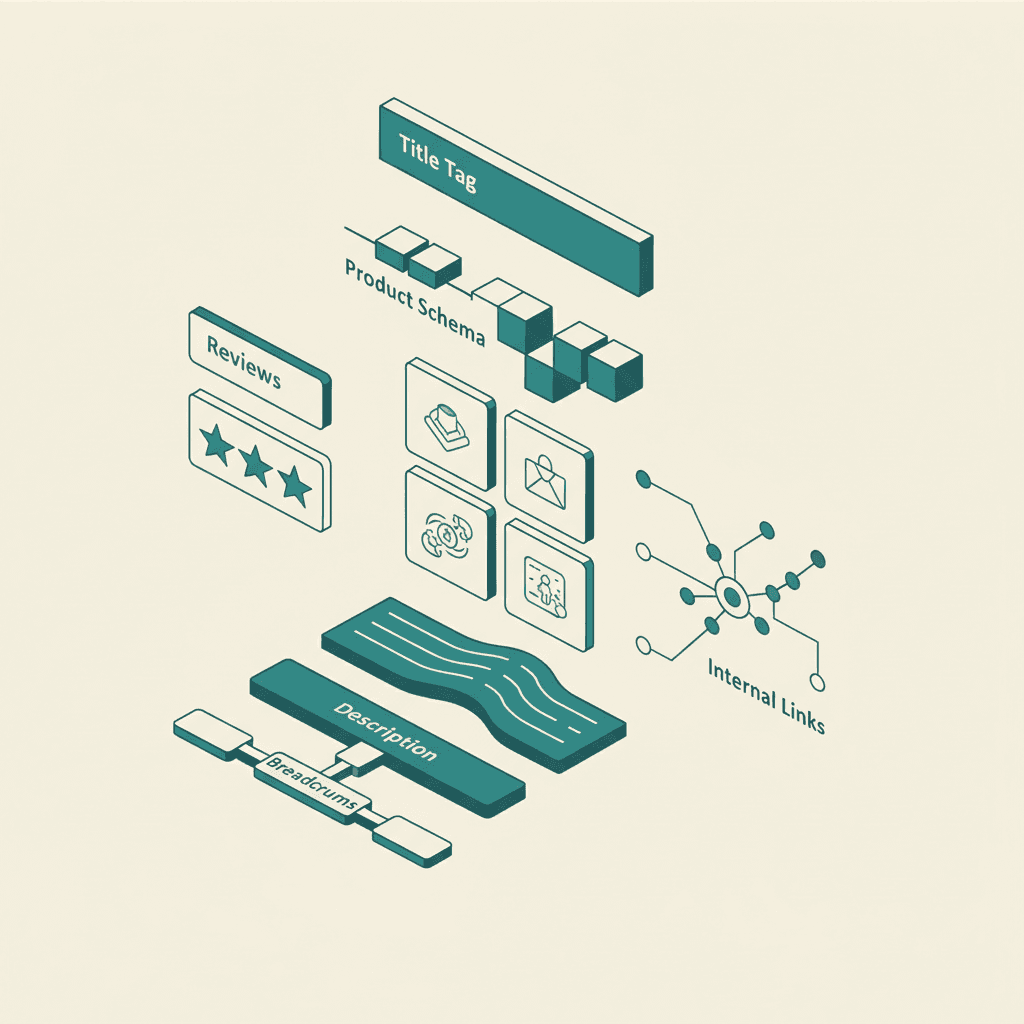
For on-page SEO, the product page is the equivalent of a blog article: it needs a keyword-optimized title, a compelling description, structured data, internal links, and a clear path to conversion. At scale across thousands of SKUs, this becomes a systems and process challenge as much as a content challenge.
The Core Components of eCommerce SEO
1. Keyword Research for Product and Category Pages
Effective eCommerce keyword research maps buyer language onto your store's architecture. You are looking for:
- Category-level keywords: "women's running shoes," "wireless gaming headsets"
- Product-level keywords: brand + model searches, "best [product] under [price]" queries
- Long-tail transactional queries: "buy [product] free delivery Manila," "[product] vs [product] Philippines"
The mistake most stores make is targeting only high-volume head terms. A category page for "running shoes" competes with Nike, Adidas, Zalora, and every major retailer. But a well-optimized page for "trail running shoes for women Philippines" has far less competition and far higher purchase intent.
2. Technical SEO for Online Stores
Technical issues are the most common reason eCommerce sites underperform in search, even when their products are excellent. The major areas to address:
Crawlability and indexation: Large catalogs create crawl budget issues. Faceted navigation (filters by size, color, price) can generate thousands of near-duplicate URLs that waste crawl budget and dilute authority. Proper use of `rel="canonical"`, `robots.txt` directives, and URL parameter handling in Google Search Console is essential.
Site speed and Core Web Vitals: Google's page experience signals directly affect rankings. Largest Contentful Paint (LCP), Cumulative Layout Shift (CLS), and Interaction to Next Paint (INP) all matter — and eCommerce sites, with their image-heavy product pages and JavaScript-heavy cart functionality, often fail these benchmarks. If your store's infrastructure is contributing to slow load times, investing in web design and performance optimization is a prerequisite, not an optional extra.
Product schema markup: Structured data tells search engines exactly what your product is, what it costs, whether it is in stock, and what customers think of it. Properly implemented Product schema unlocks rich results — star ratings, price ranges, availability badges — that dramatically improve click-through rates. In 2026, complete structured data is also a prerequisite for appearing in AI-powered shopping results and Google's AI Overviews.
HTTPS, mobile-first indexing, and crawl efficiency: These are baseline requirements. Google indexes the mobile version of your site first, meaning a poor mobile experience directly impacts your rankings.
3. On-Page Optimization for Product and Category Pages
Each product page should function as a standalone landing page for its target keyword. The key elements:
- Title tag: Include the product name, key attribute (color, size, model), and brand. Keep it under 60 characters.
- Meta description: Highlight a purchase motivator — price, availability, shipping, unique benefit. Under 155 characters.
- H1: Should match or closely mirror the title tag keyword.
- Product description: Unique, benefit-led copy that incorporates secondary keywords naturally. Avoid duplicating manufacturer descriptions — Google penalizes thin or duplicated content.
- Image alt text: Descriptive and keyword-relevant, not keyword-stuffed.
- Internal links: Link to related products, relevant categories, and supporting blog content.
Category pages follow the same logic at a higher level. They need unique introductory copy, clear taxonomy, breadcrumb navigation, and keyword-optimized headings.
4. Content Marketing and the SEO Blog
Buyers do research before they purchase. A well-executed content strategy captures that research traffic and funnels it toward your products.
"Best budget laptops for students Philippines 2026" → buyer reads your roundup → clicks through to your store → converts.
This top-of-funnel content also builds topical authority, which signals to Google that your store is a trusted resource in your niche — not just a product catalog.
5. Link Building for eCommerce Stores
Off-page authority still matters significantly. For eCommerce stores, the most effective link-building strategies include:
- Earning editorial mentions in review sites, gift guides, and buying guides
- Creating linkable assets: original data, comparison tools, buyer's guides
- Digital PR: product launches, brand stories, local Philippine media coverage
- Supplier and brand partner links
eCommerce SEO in 2026: What's Changed
The fundamentals of eCommerce SEO have not changed — search engines still reward relevance, authority, and great user experience. But the competitive landscape looks very different from even two years ago.
AI-powered product discovery: Google's AI Overviews now surface product recommendations for many shopping queries. Appearing in these results requires complete and accurate structured data, strong E-E-A-T signals, and well-written product copy. Stores that optimized only for the traditional blue-link results are finding themselves invisible to a growing share of shoppers.
Voice commerce: Smart speaker shopping and voice-assisted purchase flows are no longer niche. Optimizing for natural language queries — "what's the best noise-cancelling headphone under five thousand pesos" — means targeting long-tail conversational keywords and ensuring your product data is machine-readable.
Headless and composable commerce: Shopify, WooCommerce, and other platforms are increasingly deployed in headless configurations, decoupling the frontend from the commerce backend. This creates powerful performance opportunities but also introduces new technical SEO risks: JavaScript rendering issues, inconsistent canonical handling, and crawlability gaps. If your store is moving to a headless architecture, technical SEO needs to be part of the build specification from day one.
First-party data and personalization: With third-party cookies largely deprecated, stores are doubling down on owned SEO traffic as a privacy-safe acquisition channel that does not depend on advertising platform data.
eCommerce SEO in the Philippines
The Philippine eCommerce market reached ₱1.1 trillion in 2025 and continues to grow at double-digit rates. Lazada and Shopee dominate marketplace search, but the brands winning long-term are those building direct organic traffic to owned storefronts.
Philippine shoppers use a mix of English and Filipino search queries, and local intent matters: "free shipping Manila," "COD available," "trusted seller Philippines" are all real purchase-decision signals that smart eCommerce SEO strategies incorporate.
Competing purely on marketplaces means paying platform fees forever and owning no customer relationship. eCommerce SEO on your own domain builds an asset that compounds — traffic, brand recognition, and customer data — year over year.
If you are building or scaling that asset, consider professional SEO services to see how we approach eCommerce optimization for Philippine brands.
Building Your eCommerce SEO Strategy
A coherent eCommerce SEO strategy works from the ground up:
- Technical foundation first: Fix crawl issues, page speed, mobile UX, and structured data before investing in content.
- Architecture and keyword mapping: Build category and subcategory pages around how buyers actually search, not how your business is organized internally.
- Product page optimization at scale: Develop templates and processes that ensure every product page meets SEO standards, even as catalog size grows.
- Content program: Build a blog and buying guide program that captures research-stage traffic and builds topical authority.
- Link acquisition: Earn editorial links through great products, original content, and brand-building activity.
- Measurement and iteration: Track rankings, organic traffic, and organic revenue separately from paid. Optimize based on what is actually converting.
Starting with a thorough eCommerce SEO audit is the fastest way to identify where your store is losing ground and where the highest-impact opportunities lie. Once you have a clear picture of the gaps, the eCommerce SEO tips in our companion guide give you a prioritized action list.
Strong eCommerce SEO also depends on website performance and design — slow sites lose both customers and rankings.
Frequently Asked Questions
What is the difference between eCommerce SEO and regular SEO?+
eCommerce SEO applies the same ranking principles as traditional SEO but addresses challenges specific to online stores: large product catalogs, duplicate content from variants and filters, transactional keyword targeting, product schema markup, and the commercial intent of shoppers. The technical complexity and content scale are significantly higher.
How long does eCommerce SEO take to show results?+
Expect meaningful traffic movement within three to six months for well-funded efforts on a technically sound site. Category-level competitive keywords can take six to twelve months or longer. Quick wins are often available through technical fixes, product schema implementation, and long-tail product keyword optimization.
Does eCommerce SEO work for Philippine online stores?+
Yes — and it is particularly valuable in the Philippine market, where many brands are still over-reliant on Shopee and Lazada for visibility. Owning your organic search traffic builds a sustainable customer acquisition channel independent of marketplace fees and algorithm changes.
What are the most important eCommerce SEO ranking factors in 2026?+
Page experience (Core Web Vitals, mobile usability), complete product structured data, unique and high-quality product copy, topical authority through content, and strong backlink profiles from relevant sources. AI Overview eligibility — driven by accurate schema and strong E-E-A-T — is increasingly significant.
Is eCommerce SEO worth it compared to paid ads?+
Paid ads deliver immediate traffic but stop the moment you stop paying. eCommerce SEO builds compounding organic traffic that grows in value over time. For most stores, the optimal strategy combines both: paid ads for immediate revenue and new product launches, SEO for long-term sustainable growth and lower customer acquisition costs.