Google Review Management: Build a 5-Star Profile
Google reviews affect both your local rankings and how much customers trust you. Here's how to generate, monitor, and manage reviews to build a 5-star profile.

Google reviews are simultaneously a local SEO ranking factor, a trust signal, and a conversion driver. For any business with a physical location or a service area in the Philippines, they are among the highest-leverage elements of the digital presence — and among the most frequently mismanaged.
The businesses that appear in the top 3 positions of Google Maps (the local pack) for competitive queries almost always have more reviews, better average ratings, and more consistent review responses than those ranking lower. This is not coincidence. Google uses review signals — quantity, quality, recency, and business responsiveness — as inputs in its local ranking algorithm.
How Google Reviews Affect Local Rankings
Google's local ranking algorithm uses three primary factors: relevance (how well a business matches the query), distance (proximity to the searcher), and prominence (how well-known and reputable the business is). Review signals feed directly into prominence.
Specifically, Google's documentation indicates that the following review-related signals influence local rankings:
Number of reviews: More reviews signal that a business is actively serving customers and generating real interactions. A business with 200 reviews will generally outrank a comparable business with 15 reviews, all else being equal.
Average star rating: Higher average ratings correlate with better local rankings. The effect is most pronounced in the 3.0–4.5 range — moving from 3.5 to 4.2 stars can meaningfully shift local pack position.
Recency of reviews: A business that received 50 reviews two years ago and none since signals lower activity than one receiving consistent new reviews monthly. Google's algorithm weights recent reviews more heavily than old ones.
Business response rate: Google has confirmed that responding to reviews is a factor in local relevance assessment. Businesses that respond to reviews regularly perform better than those that don't.
Review content (keywords): When reviewers mention specific services, locations, or product names in their reviews, those terms become relevance signals. A consistent pattern of reviewers mentioning "best ramen in Makati" in reviews of a restaurant in Makati reinforces that restaurant's local relevance for related queries.
Understanding how reviews integrate with the broader local SEO strategy clarifies why review management isn't an isolated activity — it's one component of a local ranking system that also includes Google Business Profile optimization, local citations, and proximity signals.
The Star Rating Impact on CTR and Conversion
Star ratings affect behavior at two distinct stages: the search results click (whether someone clicks your listing) and the conversion decision (whether they contact or visit after clicking).
On click-through rate: Research from BrightLocal consistently shows that businesses with 4+ stars receive significantly more clicks from Google Maps listings than businesses with lower ratings. The visual prominence of star ratings in local pack results makes them one of the first signals a searcher evaluates.
On conversion: Conversion rate data from multiple sources indicates that businesses with average ratings between 4.2 and 4.8 convert at higher rates than those above 4.9 or below 4.0. A perfect 5.0 rating with very few reviews is actually trusted less than a 4.4 rating with hundreds of reviews — consumers interpret the lack of any negative reviews as suspicious when the sample size is small.
For Philippine businesses, this matters especially because Google Maps is the dominant local business discovery tool in urban areas. In Metro Manila and major provincial cities like Cebu, Davao, and Cagayan de Oro, consumers routinely use Google Maps to find restaurants, salons, medical clinics, and professional services — making Maps reviews a direct revenue driver.
Ethical Review Generation Strategies
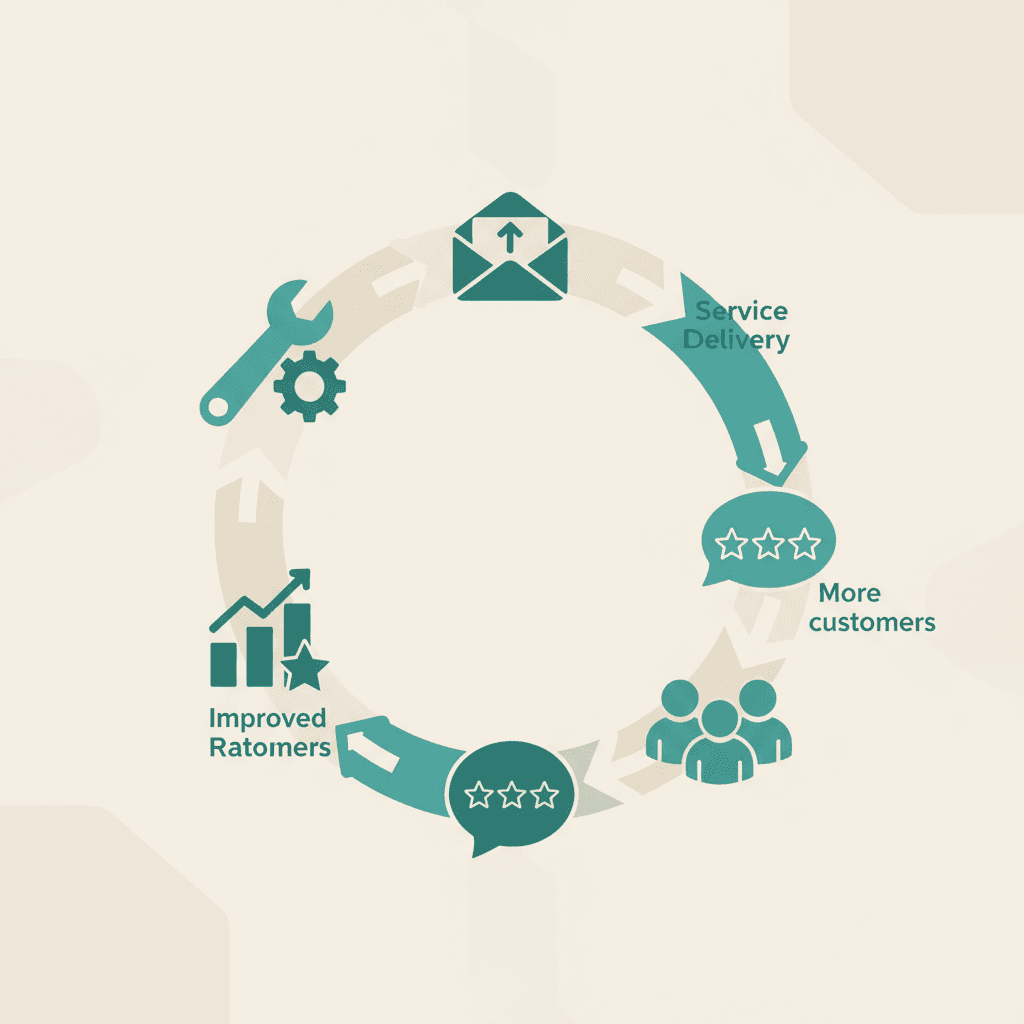
The most common question in review management is how to get more reviews. The answer is simpler than most businesses expect: ask.
Satisfied customers who are asked to share their experience — at the right moment, with minimal friction — convert into reviewers at surprisingly high rates. The challenge is establishing systematic processes rather than relying on organic, uncoordinated review generation.
Timing the Ask
The most effective moment to request a review is immediately after a positive service interaction, while the experience is fresh. Specific high-value moments:
- Immediately after a successful service delivery (e.g., at the end of a salon appointment, after a repair is completed, upon order delivery confirmation)
- Following a positive customer service interaction where an issue was resolved
- After receiving a compliment from a customer in person or by message
- Post-purchase email sequence, timed 2–3 days after delivery or service completion
Asking too early (before service is fully delivered) or too late (weeks after the interaction) both produce lower response rates.
Making It Easy
Friction is the enemy of review generation. The single most effective reduction in friction is providing a direct link to the Google review form — a URL that opens the review dialog directly rather than requiring the customer to search for the business, find the Reviews tab, and navigate to the Write a Review button.
Google provides a direct review link through Google Business Profile → Get more reviews → Share review form. This link, sent via SMS, WhatsApp, email, or a QR code on receipts or business cards, reduces the review process to a few taps.
WhatsApp is particularly effective for review requests in the Philippines, where it's a primary communication channel and has extremely high open rates compared to email.
Who to Ask
Not all customers are equally likely to convert into reviewers. Prioritize:
- Customers who have recently given verbal or written compliments
- Repeat customers who have an established relationship with the business
- Customers who actively refer others
- Customers who responded positively to a post-service satisfaction survey
Do not ask customers who expressed dissatisfaction or who had unresolved complaints. A dissatisfied customer asked to leave a review will often do exactly that — a negative one.
What Not to Do
Several common review solicitation practices violate Google's policies and should be avoided:
- Review gating: Filtering customers before asking for reviews (only asking happy customers while directing unhappy ones elsewhere) is a policy violation.
- Incentivizing reviews: Offering discounts, gifts, or other incentives in exchange for reviews violates Google's guidelines, regardless of whether the incentive is contingent on a positive review.
- Purchasing fake reviews: Review farms that produce fabricated reviews are a serious policy violation and increasingly detectable by Google's spam classifier.
- Review exchanges: Trading reviews with other businesses is a manipulation that violates platform policies.
These restrictions are not just ethical guidelines — violations risk a business's Google Business Profile being suspended, which eliminates the local pack presence entirely.
Responding to Reviews: The Full Approach
Response strategy for Google reviews follows the same principles as general review response, with platform-specific nuances. The full tactical breakdown — including templates for different review types — is in the guide on responding to negative reviews professionally.
For Google reviews specifically:
Response timing: Aim to respond within 24 hours for negative reviews and within 48–72 hours for positive reviews. Google can surface the response timeline in Business Profile analytics.
Response length: Negative review responses should be substantive enough to address the concern (typically 3–5 sentences). Positive review responses can be shorter — expressing genuine appreciation and briefly reinforcing a positive detail from the review.
Do not copy/paste identical responses. Google's systems can detect template responses, and consumers scanning multiple reviews will notice identical language. Personalization — even small details — significantly improves the quality signal of responses.
Use keywords naturally in responses. When responding to reviews, naturally incorporating service terms and location information (e.g., "We're glad your experience with our [specific service] in [location] was positive") reinforces local relevance signals. Don't force it — keyword-stuffed responses read poorly and undermine the personalization goal.
Handling Fake Reviews
Fake reviews — whether from competitors, disgruntled former employees, or review farms — are a recurring challenge for businesses with visible Google profiles. Identifying them:
- No prior reviews or a very thin review history
- Profile photo not matching a real person (easily checked with reverse image search)
- Review posted at an unusual time or in a cluster with other suspicious reviews
- Generic language with no specifics about the actual service or location
- Review from a profile that has reviewed many businesses in the same category across different geographic areas
Response: Respond publicly with a brief, professional note indicating you cannot locate a record of this interaction (as outlined in the negative review response guide). Report the review to Google through the Flag as inappropriate option in the Business Profile dashboard.
Google's removal process: Reviews that violate Google's policies — spam, fake content, off-topic content, conflicts of interest — can be removed via flagging. Google does not guarantee removal or provide timelines. Follow-up through Google Business Profile support is possible but results are inconsistent.
If removal fails: Build more legitimate reviews. The best defense against fake reviews is a large volume of genuine reviews that dilute the impact of individual fraudulent ones. A business with 300 reviews averaging 4.6 stars is far less affected by 5 fake 1-star reviews than a business with 20 reviews.
Review Monitoring Tools
Managing reviews across platforms manually is feasible for a single-location business but becomes unwieldy at scale. Tools that streamline review monitoring:
Google Business Profile dashboard: Provides notifications for new reviews (configure in Settings → Notifications). Direct response within the dashboard.
Google Alerts: Set up alerts for your business name to catch mentions outside the GBP review system.
Birdeye, Podium, ReviewTrackers: Dedicated review management platforms that aggregate reviews across Google, Facebook, and other platforms into a single dashboard. Useful for businesses managing multiple locations.
Grade.us, NiceJob: Platforms focused on review generation workflows — automating the process of requesting and following up on review requests.
For businesses operating multiple locations across the Philippines, centralized review management platforms reduce the operational complexity significantly and ensure no location's review activity goes unmonitored.
The Relationship Between Review Management and Local SEO
Review management is inseparable from local SEO performance. A business with an optimized Google Business Profile but poor review signals will rank lower than a business with equivalent technical optimization and strong reviews. Conversely, a business with excellent reviews but incomplete GBP information misses the relevance signals that connect specific search queries to the business.
The integrated approach — strong GBP optimization, consistent review generation, professional review responses, and active monitoring — is the foundation of effective local SEO for any location-based business.
A professional online reputation management service brings systematic processes for all of these elements, typically including review monitoring, response management, and review generation campaign design. Combined with social media management (which amplifies positive customer stories and creates additional reputation signals), the result is a comprehensive reputation management program that supports both local search rankings and direct customer trust.
The comprehensive picture of what ORM includes — beyond just review management — is outlined in the guide to what online reputation management is. For businesses with a physical presence, understanding how reviews interact with other local signals is part of a well-rounded approach to brand SERP management — controlling what prospective customers see when they search your business name.
Frequently Asked Questions
How many Google reviews does a business need?+
There's no magic number, but research consistently shows that consumers need to read approximately 10 reviews to trust a rating. For local pack ranking, more reviews generally correlate with better position — businesses in the top 3 local positions for competitive queries often have 50–200+ reviews. The focus should be on consistent, ongoing review generation rather than hitting a specific target.
Do Google reviews affect organic rankings (not just local rankings)?+
Directly, the evidence is weak — Google reviews are primarily a local ranking factor. Indirectly, strong review signals increase click-through rates from local pack results, which may influence organic ranking signals. Review content (especially keywords used by reviewers) contributes to entity understanding that Google uses across both local and organic results. The primary ranking impact is on local search, not organic.
Can a business with a low star rating improve it?+
Yes. Star ratings change as new reviews are added. A consistent program of review generation, combined with service improvements that address the root causes of negative reviews, can meaningfully shift a rating over 6–12 months. A business at 3.5 stars with a strong service improvement program and active review generation can realistically reach 4.0–4.3 within a year.
What should a business do if it receives a sudden cluster of negative reviews?+
First, assess whether the reviews reflect real customer experiences or a coordinated attack. If real, address the underlying service issue immediately and respond professionally to each review. If the pattern suggests a coordinated attack (multiple reviews with similar language, no prior review history, clustered timing), report all flagged reviews and document evidence. In either case, accelerating review generation from genuine customers is the most effective long-term response.
Is it okay to ask customers to change their review?+
It's acceptable to inform a customer — after genuinely resolving their issue — that they're welcome to update their review if they feel the situation has been addressed. This should be offered once, not pressured. Many customers who feel genuinely heard will voluntarily update reviews. Pressuring customers to change reviews is a policy violation and damages the trust you're trying to rebuild.