How to Respond to Negative Reviews (PH Guide)
Responding to negative reviews professionally can recover customer trust and improve local SEO. Here's how to handle every type of negative review in the Philippines.

A negative review left unanswered is a statement. To every potential customer who reads it — and research consistently shows that most do — silence looks like admission, indifference, or incompetence. A well-crafted response does the opposite: it demonstrates professionalism, shows that feedback is taken seriously, and can turn a brand detractor into a neutral or even positive voice.
In the Philippines, where word-of-mouth and social proof carry significant cultural weight, the stakes of online review management are particularly high. Filipino consumers consistently rank peer reviews among the top factors in purchasing decisions, and negative reviews on Google Maps or Facebook can directly impact walk-in traffic for local businesses.
Why Reviews Matter More Than Most Businesses Realize
The numbers are unambiguous. BrightLocal's 2025 Local Consumer Review Survey found that 93% of consumers read reviews before making purchasing decisions, and 88% trust online reviews as much as personal recommendations. For local businesses, star ratings directly influence click-through rates from Google's local pack — a jump from 3.5 to 4.0 stars can increase clicks by 25% or more.
Beyond direct consumer behavior, Google uses review signals as a local ranking factor. The volume of reviews, the average star rating, and — critically — business responsiveness to reviews all influence local search rankings. Businesses that actively respond to reviews (positive and negative) tend to rank higher in local search than comparable businesses that don't engage.
This is why review management is a core component of online reputation management rather than a separate concern. Understanding the full picture — monitoring, response strategy, review generation, and SERP control — is covered in the guide to what online reputation management is.
Understanding Your Review Landscape
Before addressing individual reviews, map where reviews about your business are appearing.
Google Business Profile: The highest-impact review platform for local SEO in the Philippines. Google Maps reviews directly influence local pack rankings and are prominently displayed in branded search results.
Facebook: For Philippine businesses, Facebook reviews (now called "Recommendations") are often more visible to local audiences than Google reviews due to Facebook's dominant penetration in the market. Many Filipino consumers default to Facebook search for local business research.
Yelp: Smaller presence in the Philippines than in North America, but worth monitoring for businesses in metro areas with international clientele.
TripAdvisor: Critical for restaurants, hospitality, and tourism businesses across the Philippines.
Lazada / Shopee seller ratings: For e-commerce sellers, platform ratings function identically to reviews and affect product ranking and buy box visibility.
Industry-specific platforms: For professional services, platforms like Clutch, Trustpilot, or local equivalents may be relevant.
Set up monitoring across all relevant platforms using Google Alerts (for brand mentions), a Google Business Profile notification setting, and periodic manual checks of each platform. Google review management is a discipline in itself for businesses where Google is the primary review channel.
The Core Principles of Review Response
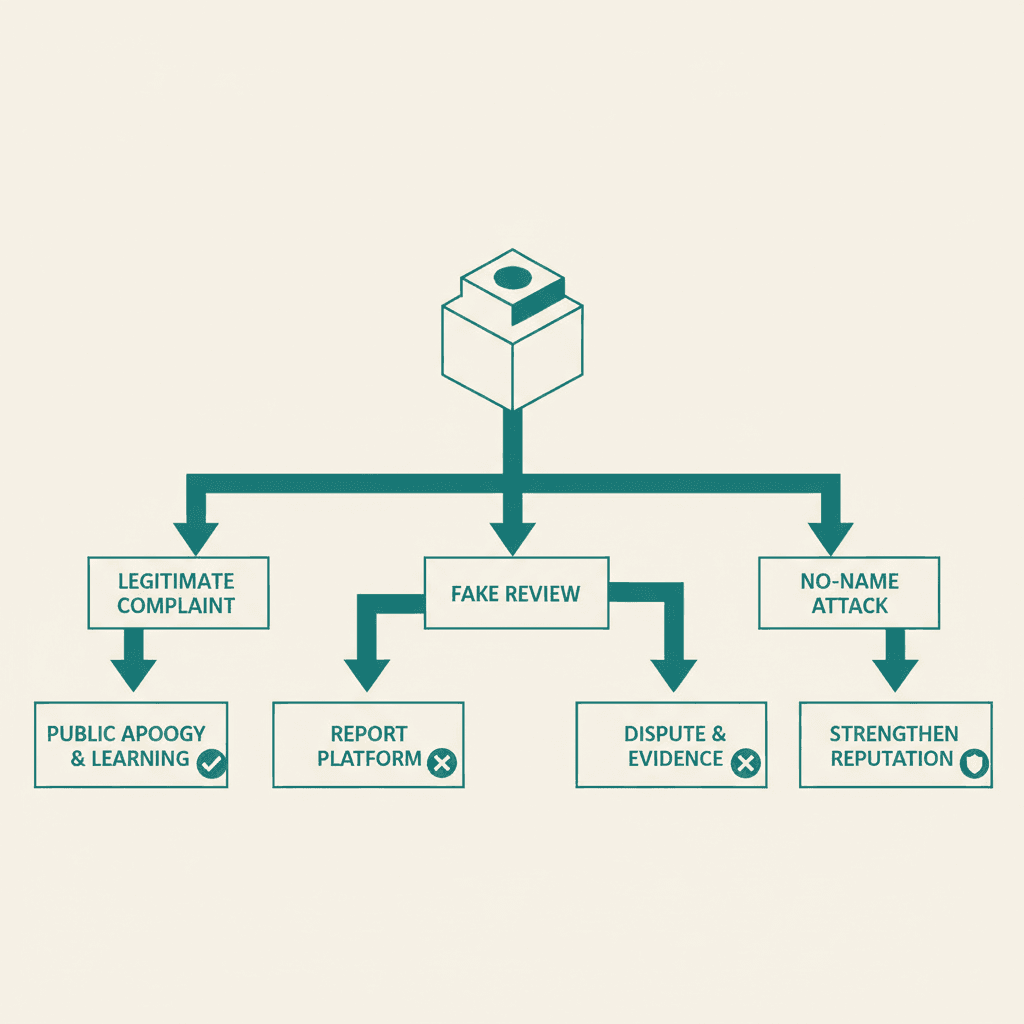
Before diving into specific templates, the principles that should govern all responses:
Respond within 24–48 hours. Speed signals responsiveness. Reviews left without responses for weeks or months communicate that the business doesn't monitor or care about customer feedback.
Acknowledge before explaining. Customers who feel heard are more likely to update their review or feel positively about the business. Starting a response with explanations or defenses (before acknowledging the customer's experience) reads as dismissive.
Keep it brief and professional. Public responses are for the audience reading the review, not just the reviewer. A concise, professional response reassures prospective customers. A long defensive essay does the opposite.
Never argue, shame, or retaliate. Even when a review is factually wrong, a confrontational public response is a PR problem that no review victory is worth. Prospective customers reading the exchange side with the customer almost universally.
Take resolution offline. Offer to continue the conversation through direct contact — phone, email, or DM — for anything requiring detailed investigation or compensation discussion. Public resolution threads often spiral.
Personalize each response. "Thank you for your feedback" templates are worse than no response. Reference the specific situation, use the reviewer's name if visible, and address the actual concern raised.
Response Templates by Review Type
Legitimate Complaint — Service Failure
Use when: A customer accurately describes a genuine failure in service, product, or experience.
Template structure:
- Use the customer's name (if visible) and thank them for taking the time.
- Acknowledge the specific experience they described without minimizing it.
- Apologize genuinely (not conditionally).
- Briefly explain what's being done to address the issue (if applicable).
- Invite them to contact you directly to make it right.
Example:
"Hi [Name], thank you for taking the time to share your experience. We sincerely apologize for the delay you experienced with your order — that falls below the standard we aim to provide. We've reviewed the situation with the team and are making changes to prevent this from happening again. We'd love the opportunity to make this right for you — please send a message to [contact] so we can discuss a resolution."
Legitimate Complaint — Disappointed Expectations
Use when: The customer's experience was technically within policy or normal, but they felt let down.
Example:
"Hi [Name], we appreciate your honest feedback. We're sorry to hear the experience didn't meet your expectations — we take this seriously and have shared your feedback with the team. We'd welcome the chance to discuss this further and understand how we can do better. Please send a message to [contact]."
Factual Inaccuracy — Wrong Order, Wrong Location, Wrong Date
Use when: The review contains specific factual errors that are demonstrably incorrect.
Principle: Correct gently and briefly. Don't lecture. Invite direct contact for resolution.
Example:
"Hi [Name], thank you for your feedback. We've looked into your visit and believe there may be some confusion — our records don't show an order matching the details you described. We'd really like to understand what happened. Please write to [contact] so we can review together and make sure any issue is resolved properly."
Potentially Fake Review — No Record of Customer
Use when: The review appears to be from someone with no verifiable interaction with your business.
Principle: Don't accuse the reviewer of lying publicly. Flag the issue professionally, report to the platform.
Example:
"Hi [Name], we take all feedback seriously and have tried to locate any record of your experience in our system but have been unable to find one. If you did interact with our business, we'd genuinely like to understand what happened — please write to [contact] so we can look into this. We want to ensure every customer has a positive experience."
In parallel: Report the review to Google/Facebook as a potential policy violation. Flagging requires a demonstrated violation of review policies (reviewer not a customer is a valid policy violation on most platforms). Document the report in case Google requests escalation evidence.
Suspected Competitor Attack
Use when: A review shows patterns of a coordinated or competitor-driven fake review campaign — reviewer profile with no other reviews or reviews of other businesses in the same category, generic complaint without specifics, or a cluster of similar reviews appearing simultaneously.
Principle: Respond professionally as you would to any review concern. Report through platform channels and, for severe cases, document for potential legal consultation.
Example:
"Thank you for your comment. We have been unable to locate any record of this interaction in our customer database. We'd welcome the opportunity to connect directly at [contact] to understand your experience. We're committed to providing excellent service to all customers."
Then: Report to platform with any available evidence. For the Philippines, filing a complaint with the DTI (Department of Trade and Industry) may be appropriate in cases of demonstrably false reviews that damage business reputation — the Consumer Act provides some protections against defamatory commercial speech.
Escalation: When Reviews Become a Legal Matter
The Philippines has a developing framework around online defamation through the Cybercrime Prevention Act of 2012 and the Civil Code provisions on libel. Truthful reviews, even harsh ones, are generally protected. False statements of fact that damage business reputation may constitute cyber libel.
The threshold for legal escalation is high and should be reserved for severe, demonstrably false, and intentionally harmful reviews — typically coordinated competitor attacks or extortion-driven reviews. Most negative reviews, even unfair ones, are better addressed through response strategy and reputation building than legal action.
Turning Negative Reviews Into Positive Outcomes
The most underestimated opportunity in negative review management is the review update. When a business resolves a customer's issue genuinely and follows up, a significant percentage of reviewers update their rating — often by one to two stars, sometimes to 5 stars.
The process:
- Respond publicly (using templates above).
- Reach out directly (phone or email) to resolve the underlying issue.
- After resolution, briefly let the reviewer know they can update their review if they feel the situation has been addressed — don't pressure, just mention the option once.
Many customers feel heard and appreciated by this approach, particularly in the Filipino cultural context where personal resolution and bayanihan values resonate. The resulting review update is visible to all future readers and demonstrates that the business takes complaints seriously and resolves them.
For businesses managing a high volume of reviews across multiple platforms, professional online reputation management services provide the systematic monitoring, response workflows, and escalation protocols that are difficult to maintain in-house at scale. Pairing this with an active local SEO strategy and social media presence creates a reinforcing loop where strong reputation signals support search visibility, which drives more customers, which generates more reviews.
Building a Proactive Review Strategy
Reducing the ratio of negative reviews is as important as responding to them well. Proactive measures:
Ask satisfied customers to review. The most effective review generation strategy. Timing matters — ask immediately after a successful service delivery or positive customer interaction, while the experience is fresh.
Make the ask specific and easy. Provide a direct link to your Google Business Profile review form. Reducing friction in the review process increases completion rates.
Identify and resolve issues before they become reviews. Post-service follow-up surveys catch dissatisfied customers before they turn to public platforms. A customer who receives a follow-up call addressing their concern has much lower propensity to leave a public negative review.
Train front-line staff on service recovery. The fastest way to prevent negative reviews is resolving problems before the customer leaves. Service recovery at the point of failure is more effective than any review response strategy.
Build a strong reviews foundation from the start. Businesses with a high volume of authentic positive reviews are far more resilient to isolated negative reviews. The full strategy for generating and managing Google reviews is covered in the Google review management guide.
Frequently Asked Questions
Should a business respond to all negative reviews?+
Yes. Responding to all reviews — positive and negative — is best practice. It demonstrates active management of the business's online presence and provides reassurance to prospective customers reading the reviews. Some platforms (including Google) show whether a business regularly responds, which is itself a trust signal.
Can negative reviews be removed from Google?+
Google will remove reviews that violate its content policies: reviews that are spam, fake, contain illegal content, or represent conflicts of interest. Reviews that are genuinely negative but represent real customer experiences cannot be removed by the business. Flagging through the Google Business Profile dashboard is the only channel — contacting Google support for review removal is rarely effective for policy-compliant reviews.
How long does it take for a flagged fake review to be removed?+
Google's review removal process is inconsistent and can take anywhere from a few days to several weeks. In some cases, legitimately policy-violating reviews are not removed. If a review is not removed through flagging, businesses can attempt to escalate through Google Business Profile support, though success rates are variable.
Does responding to reviews improve local search rankings?+
Google's documentation states that responding to reviews is one of the factors it considers in local business relevance. While review responsiveness alone won't dominate rankings, consistent engagement — combined with review volume and rating — contributes to the overall local ranking signal package.
Is it legal to offer discounts in exchange for positive reviews?+
Offering incentives for positive reviews violates the terms of service of Google, Facebook, Yelp, and most major review platforms. In regulated industries, it may also violate FTC or local DTI guidelines. Asking customers to share their honest experience (without attaching a specific outcome or incentive to the review) is acceptable; conditioning the incentive on a positive rating is not.