PPC vs SEO: Which Is Right for Your Business?
PPC delivers immediate traffic; SEO builds long-term authority. Here's how to decide which is right for your business — and when to invest in both.

PPC and SEO both drive traffic from Google. Both can generate leads, revenue, and brand visibility. But they work in fundamentally different ways, operate on different economics, and serve different strategic purposes.
Understanding the distinction between the two is one of the most important decisions a marketing budget ever has to make. Businesses that choose the wrong one for their situation waste money. Businesses that understand how they complement each other build the most durable competitive advantages in organic and paid search.
This article covers how each channel works, how they compare on cost and timeline, when each is the right choice, and how to think about combining them in the Philippine market.
How PPC Works
Pay-per-click advertising, most commonly through Google Ads, places paid listings in search results and across Google's partner network. Advertisers bid on keywords and pay a fee each time a user clicks on their ad. The position of the ad depends not only on bid amount but on Quality Score — a measure of ad relevance, landing page quality, and expected click-through rate.
The defining characteristic of PPC is immediacy. A campaign launched today can generate traffic tomorrow. There is no waiting period, no algorithm to win over, no authority to build. If a business needs customers now, PPC is the fastest path.
The defining limitation of PPC is dependency. Traffic exists only while the budget runs. When spending stops, traffic stops. There is no compounding benefit, no residual value — each click costs money, indefinitely.
How SEO Works
Search engine optimization earns organic visibility in Google's results through a combination of technical soundness, content quality, and authoritative backlinks. Unlike PPC, there is no cost per click — traffic from organic rankings is, in that sense, "free."
But free is a relative term. SEO requires significant investment in content production, technical infrastructure, and link building. The work is slower and its results are deferred — most competitive rankings take six to eighteen months to achieve. An honest understanding of what SEO is and how it actually works is a prerequisite for setting realistic expectations.
The defining advantage of SEO is compounding. Rankings built over time do not disappear when investment pauses. A page that earns a first-page ranking continues driving traffic months and years after the work that earned that ranking was done. The economics improve over time: the cost of maintaining a ranking is lower than the cost of earning it, and each piece of content added to the site contributes to cumulative domain authority.
Direct Comparison: The Numbers That Matter
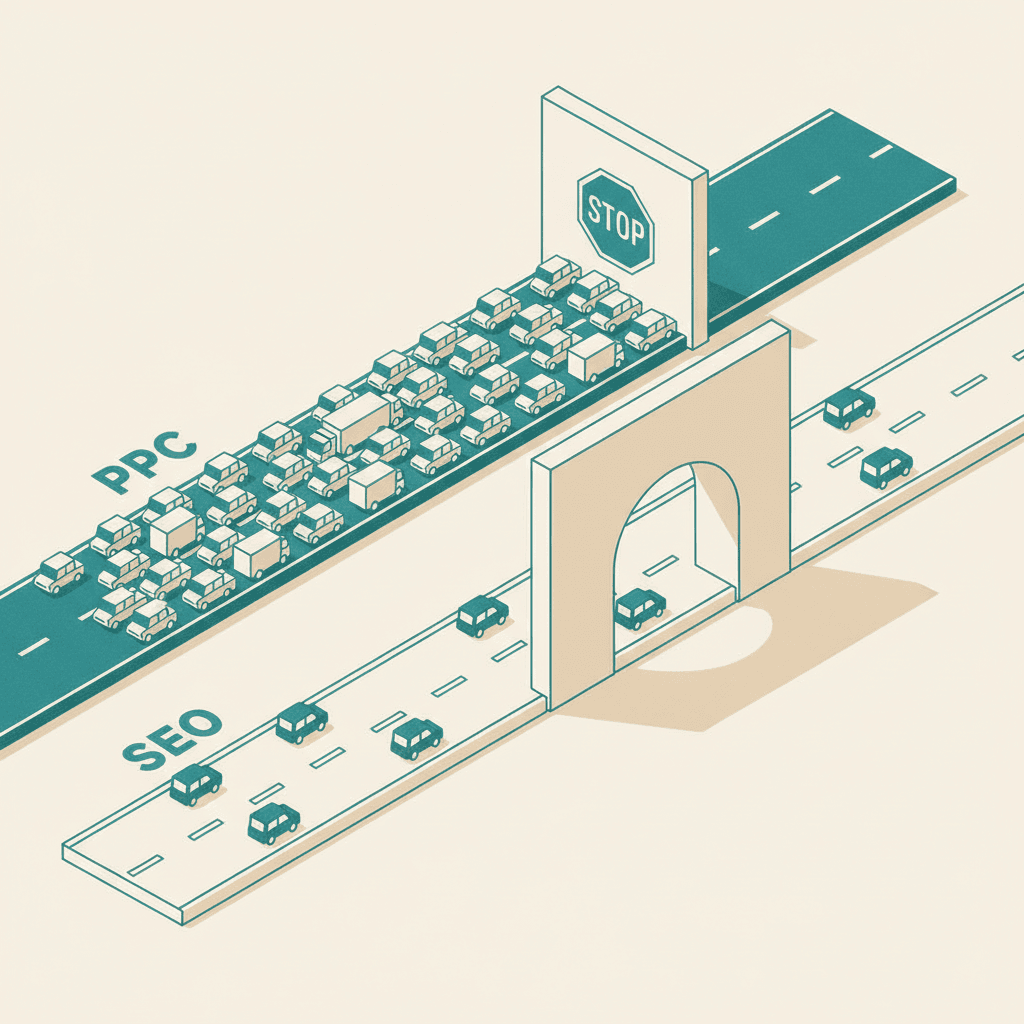
Cost Structure
PPC: Pay per click, continuously. A keyword generating 500 clicks per month at ₱25 CPC costs ₱12,500/month indefinitely. Stop spending, stop getting traffic.
SEO: Front-loaded investment with declining marginal cost. A retainer of ₱40,000/month for twelve months (₱480,000 total) builds rankings that might drive the equivalent of ₱200,000/month in PPC spend — month after month, for years, at a fraction of the ongoing cost.
Understanding SEO cost structures in detail helps frame the long-term ROI case. The most common mistake is comparing PPC spend in month one against SEO spend in month one — a comparison that always favors PPC. The right comparison is three-year total cost of traffic acquisition, where SEO typically wins decisively in competitive industries.
Timeline
PPC: Traffic in 24–48 hours. Optimization improves over four to eight weeks. Stable performance by month two or three.
SEO: First ranking movements at three to six months. Meaningful competitive rankings in most industries at twelve to eighteen months. Sustained traffic growth through twenty-four to thirty-six months.
Traffic Volume Ceiling
PPC: Traffic volume is directly proportional to spend. More budget = more clicks, up to the limit of available search volume. There is no ceiling other than market size and budget.
SEO: Traffic volume is proportional to the number of pages ranking and the competitiveness of ranked keywords. A mature SEO program compounds over time as new content is added, but growth is constrained by content production rate and the competitive landscape.
Click-Through Rate
Organic results typically receive higher click-through rates than paid results for informational queries. Studies consistently show that users trust organic results more than paid placements when researching topics. However, for transactional queries ("buy [product] Philippines"), paid results capture a larger share of commercial intent.
Data and Insights
PPC generates rich keyword conversion data quickly. Within weeks, a business knows which keywords produce leads, at what cost, and at what conversion rate. This data is exact and actionable.
SEO provides keyword data through Google Search Console, but with less granularity on conversion attribution. Understanding which organic keywords produce customers requires careful analytics configuration.
When to Choose PPC
PPC is the right primary channel when:
Speed is essential: Product launches, seasonal campaigns, event-driven promotions — situations with defined windows where waiting twelve months for SEO results is not viable.
Testing market demand: PPC is the fastest way to validate whether a product or service has search demand before investing in long-term SEO. If a keyword doesn't convert in a well-structured PPC campaign, the organic opportunity may be smaller than it appears.
High-value, low-volume keywords: Some commercial keywords have low search volume but high intent. Bidding on "business process outsourcing partner Philippines" may generate only a few clicks per month, but each click has enormous potential value. SEO investment for very low-volume keywords may not justify the effort; PPC is more efficient.
Competitive markets where SEO timeline is too long: In industries like legal, finance, and real estate, earning competitive rankings takes years. PPC is the only way to achieve meaningful search presence in the short term.
Remarketing: Retargeting visitors who have already been to the site through PPC is highly efficient. SEO cannot do this; PPC excels at it.
When to Choose SEO
SEO is the right primary channel when:
Long-term brand building matters: Businesses investing in a ten-year presence, not just a quarterly campaign, need the compounding authority that only SEO builds.
The business model depends on traffic volume: Content businesses, e-commerce sites with many product categories, and lead generation sites that need thousands of visitors per month cannot sustain those volumes through PPC alone without prohibitive cost.
Informational content is central to the strategy: Buyers who research before purchasing respond better to organic content than paid ads. A business that builds the best educational content in its niche wins trust at scale.
The competitive moat matters: Once built, a strong organic presence is genuinely hard to displace. Competitors cannot simply outbid their way to the top of organic results. SEO authority is defensible in a way that PPC placement is not.
PPC costs are rising: In the Philippines, Google Ads CPCs in competitive industries have risen substantially since 2022. Businesses that built organic authority before the CPC inflation now enjoy traffic at a fraction of what it would cost to acquire through paid search.
The Case for Combining Both
The most competitive businesses in the Philippine market in 2026 are not choosing between PPC and SEO — they're running both strategically.
The combination works because:
- PPC provides immediate traffic while SEO builds authority
- PPC keyword conversion data informs SEO content priorities
- Organic brand recognition from SEO improves PPC click-through rates and Quality Scores
- Total search presence (organic + paid) gives a brand visibility that neither provides alone
- When a page ranks organically, reducing PPC spend on those keywords frees budget for terms where the site doesn't rank yet
A common approach: invest heavily in PPC during the first year while SEO builds, then gradually shift budget from PPC to content and link building as organic rankings emerge for the most expensive keywords.
Understanding how much SEO costs and comparing it to ongoing PPC spend makes this analysis concrete and budget-specific.
PH Market Considerations
The Philippine market has a few characteristics that affect the PPC vs SEO decision:
Mobile dominance: Over 85% of searches in the Philippines happen on mobile. Both PPC and SEO require mobile-optimized execution, but the implications differ. PPC campaigns with poor mobile landing pages waste budget on high bounce rates. SEO on a site with poor mobile experience loses rankings entirely.
Price sensitivity: Filipino consumers conduct more comparison research before purchasing than in markets with higher purchasing power. This favors longer consideration cycles and content-led SEO strategies that address buyers throughout the research phase.
Facebook's dual role: In the Philippines, Facebook occupies significant discovery and research behavior that Google captures in other markets. This means the total addressable audience for any search channel — both PPC and SEO — may be somewhat smaller relative to market size than in markets where Google dominates all digital discovery. Social media investment complements both PPC and SEO.
Local search: For businesses serving specific Philippine cities or regions, local SEO and locally-targeted Google Ads are highly effective and often significantly cheaper than national campaigns because the audience is smaller and competition less intense.
An SEO audit before making the final budget allocation decision is worth the investment. It reveals where the organic opportunity is largest, which technical issues might be limiting current performance, and which keywords represent realistic targets within a given timeline — all of which directly inform how much of the total budget should go to PPC versus SEO.
Decision Framework
Use this framework to determine the right allocation:
Step 1: Define the timeline. If results are needed within three months, PPC is non-negotiable as the primary channel.
Step 2: Assess the competitive landscape. Run searches for target keywords. Are the organic results dominated by large, well-established brands? If yes, allocate more to PPC while SEO builds. If organic results are relatively accessible, SEO ROI is higher.
Step 3: Calculate PPC cost at scale. Estimate what it would cost to sustain current or target traffic levels through PPC indefinitely. Compare that number against the cost of building organic rankings that deliver equivalent traffic. If the PPC cost is prohibitive at scale, SEO investment is essential.
Step 4: Consider content assets. Businesses that produce strong content naturally as part of operations (consultancies, educational organizations, specialists) have an inherent advantage in SEO. Businesses that do not produce content need to invest more in content production to make SEO viable.
Step 5: Model the hybrid. Almost every business benefits from running both channels. The question is the ratio — how much of the total digital marketing budget goes to paid and how much to organic. Start with a 50/50 split and adjust based on which channel shows better unit economics at three and six months.
Frequently Asked Questions
Is PPC or SEO better for a new business in the Philippines?+
New businesses typically benefit most from a combination — PPC for immediate lead generation while building brand presence, and SEO investment from day one so that organic authority develops in parallel. Relying exclusively on PPC is expensive and creates no long-term asset. Relying exclusively on SEO in the early months means no traffic and no revenue while waiting for rankings to develop.
How long does it take SEO to outperform PPC in terms of cost-per-lead?+
This varies by industry and competitiveness, but for most Philippine businesses, SEO achieves lower cost-per-lead than PPC at approximately twelve to eighteen months — the point where organic rankings begin generating significant traffic volume and the cumulative retainer cost begins to be justified by traffic value.
Can a business rank in Google without doing SEO if they already run Google Ads?+
No. Google Ads and organic rankings are completely separate systems. Running paid campaigns has no effect on organic rankings. A business must invest in both separately to achieve both outcomes.
What happens to PPC performance when SEO improves?+
Generally, it improves. Higher brand awareness from organic presence means users are more likely to click on paid ads when they appear (better CTR = better Quality Score = lower CPC). Additionally, as organic rankings cover more keywords, paid campaigns can be focused on the highest-value terms rather than maintaining broad coverage — improving overall efficiency.
Should a business in the Philippines invest in SEO or Google Ads first?+
For businesses that need immediate leads and cannot wait six months, Google Ads is the right starting point. For businesses with twelve or more months of runway and a content-capable team, starting SEO from day one and adding PPC to supplement in competitive areas is the more efficient long-term path.