What Is SEO and How Does It Work?
SEO is how your website earns visibility in search engines without paying for ads. Here's a plain-language breakdown of how it works in 2026.
Every day, billions of searches happen on Google. The businesses that appear at the top of those results are not there by accident. They earned those positions through SEO — and understanding how it works is the first step to using it for your own growth.
This guide explains what SEO is, how search engines decide what to rank, the three core disciplines every SEO strategy covers, and what the 2026 search landscape means for your business.
What Is SEO?
SEO stands for Search Engine Optimization. It is the practice of improving your website so it earns higher rankings in organic (non-paid) search results on Google, Bing, and other search engines.
When someone types a query into Google, the search engine crawls billions of pages and returns a ranked list of results it believes best answer the query. SEO is the work you do to make your website one of those results — ideally near the top of the first page.
Unlike paid search advertising, organic rankings do not cost money per click. Once you earn a high-ranking position, it can send consistent traffic to your site for months or years without ongoing ad spend. This compounding nature is one of the primary benefits of SEO that separates it from most other marketing channels.
How Search Engines Work
To understand SEO, you need to understand how search engines process the web. The process has three stages.
Crawling
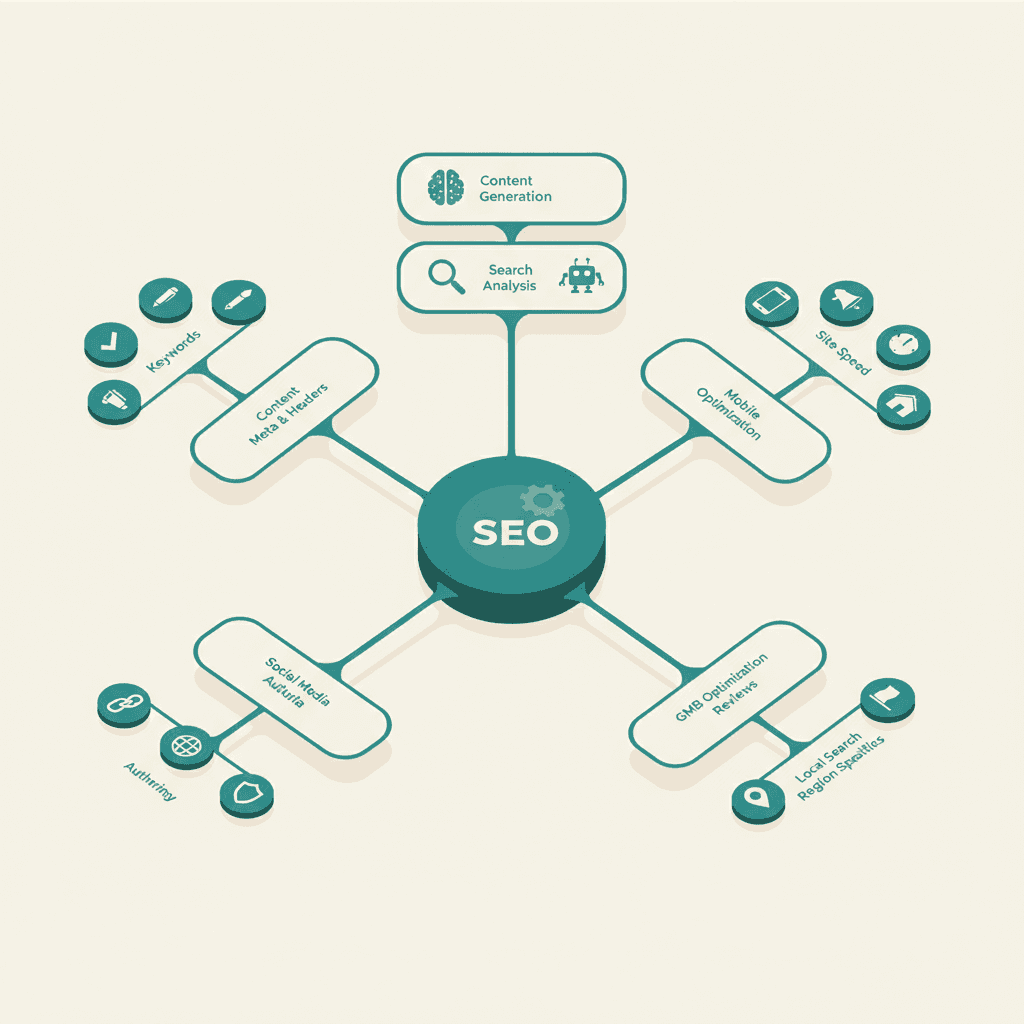
Search engine bots (called crawlers or spiders) follow links across the internet to discover new and updated pages. Google's primary crawler is Googlebot. If your site is not crawlable — due to technical errors, blocked resources, or no inbound links — Google cannot find it.
Indexing
Once a page is crawled, Google analyzes its content and stores it in a massive index. Think of the index as a library catalog. Not every crawled page gets indexed. Google may exclude pages it considers thin, duplicate, or low-quality.
Ranking
When a user enters a query, Google's algorithm evaluates all indexed pages relevant to that query and sorts them by hundreds of ranking signals. These signals assess relevance, authority, and user experience. Your SEO work directly influences how your pages are scored on these signals.
The Three Pillars of SEO
Effective SEO operates across three interconnected areas. A weakness in any one pillar limits the results you can achieve.
1. On-Page SEO
On-page SEO covers everything you control directly on your website pages: the content itself, how it is written, how it is structured, and the technical signals embedded in the HTML.
Key on-page factors include:
- Title tags and meta descriptions — the text Google shows in search results
- Heading structure — H1, H2, H3 hierarchy that helps Google understand your page's topic
- Keyword usage — natural integration of target phrases in headings, body copy, and image alt text
- Content depth and quality — comprehensive, accurate content that genuinely answers the user's query
- Internal linking — links between your own pages that distribute authority and help crawlers navigate your site
On-page SEO is often the fastest pillar to improve because it only requires changes to your own website, with no external dependencies.
2. Off-Page SEO
Off-page SEO refers to everything that happens outside your website that influences how Google perceives your authority.
The most important off-page factor is backlinks — links from other websites pointing to yours. When a high-quality, relevant site links to you, it acts as a vote of confidence. Google interprets these votes as a signal of credibility and expertise.
Other off-page factors include:
- Brand mentions (even without a link)
- Reviews and ratings on third-party platforms
- Social signals and content shares
- Digital PR and earned media coverage
3. Technical SEO
Technical SEO ensures that search engines can efficiently crawl, index, and understand your site. Even excellent content can fail to rank if technical barriers prevent Google from accessing it properly.
Core technical SEO areas include:
- Site speed — particularly on mobile devices
- Mobile-friendliness — essential since Google now uses mobile-first indexing universally
- Core Web Vitals — Google's performance metrics (LCP, INP, CLS)
- Crawl budget management — making sure Googlebot spends its time on your important pages
- Structured data / schema markup — helping Google understand what your content is about
- HTTPS security — a confirmed ranking signal
These three pillars are covered in detail across the types of SEO guide, which also covers newer disciplines like local SEO, mobile SEO, and emerging areas like AI SEO.
SEO in 2026: What Has Changed
Search has shifted significantly in the past two years. If your understanding of SEO was formed before 2024, several developments are worth knowing.
Google's Helpful Content System
Google now applies a sitewide signal based on whether it classifies your content as genuinely helpful to users or primarily written for search engines. Sites that produce low-quality, keyword-stuffed, or AI-generated content without editorial judgment have seen significant ranking drops. The threshold for "helpful" has risen.
The practical implication: writing for humans is no longer just good advice — it is a ranking requirement.
AI Overviews
Google's AI Overviews (formerly Search Generative Experience) now appear at the top of many search results pages, providing a synthesized answer before any organic results are shown. This has reduced click-through rates for some informational queries.
However, pages that are cited as sources inside AI Overviews can gain significant visibility — sometimes appearing before first-page organic results. Content that demonstrates genuine expertise, cites specific data, and is well-structured tends to earn AI Overview citations.
E-E-A-T
Google's quality evaluator guidelines now emphasize E-E-A-T: Experience, Expertise, Authoritativeness, and Trustworthiness. This is not a direct algorithm signal but a framework that shapes how many of Google's quality signals work.
Demonstrating first-hand experience (author bios, case studies, original research), citing credible sources, and maintaining a strong brand reputation all contribute to E-E-A-T.
Zero-Click Searches
Featured snippets, knowledge panels, AI Overviews, and other SERP features have increased the share of searches where users get their answer without clicking any result. SEO strategy in 2026 increasingly requires winning these SERP features, not just the organic listing below them.
What SEO Is Not
Several misconceptions persist about what SEO involves.
SEO is not instant. Organic rankings take time to develop. Most campaigns see meaningful results in 3–6 months, with competitive keywords taking 6–12 months or longer. The SEO timeline guide covers what to expect month by month.
SEO is not set-and-forget. Rankings fluctuate with algorithm updates, competitor activity, and changing search behavior. Ongoing optimization is required to maintain and improve positions.
SEO is not keyword stuffing. Repeating a keyword dozens of times no longer works and actively hurts your content. Modern SEO is about covering topics comprehensively and naturally.
SEO is not the same as PPC. Paid search (Google Ads) buys placement at the top of results pages. SEO earns organic placement. Both have value, but they work differently and serve different strategic goals.
Why SEO Matters for Your Business
For most businesses, organic search is the highest-volume, lowest-cost acquisition channel available at scale.
A well-optimized page can attract qualified visitors for years without ongoing ad spend. Unlike social media algorithms that bury your posts unless you pay to boost them, search rankings reward consistent quality improvement over time.
In the Philippines, where mobile internet usage is among the highest in Southeast Asia and where most consumer purchase research starts with a Google search, SEO is particularly valuable for businesses competing for local and national visibility.
If you are ready to build a sustainable organic presence, professional SEO services team can audit your current position and build a plan based on your specific market and competition level.
SEO works alongside other digital channels like social media marketing and paid search as part of a complete growth strategy.
The rise of AI in search has spawned a new discipline: generative engine optimization.
Frequently Asked Questions
What is the difference between SEO and SEM?+
SEO (Search Engine Optimization) focuses on earning organic (unpaid) rankings. SEM (Search Engine Marketing) is a broader term that often refers to paid search advertising. Many marketers use SEM specifically to mean Google Ads. The two strategies complement each other but operate through different mechanisms.
Does SEO still work in 2026?+
Yes. Despite AI Overviews and zero-click trends, organic search drives billions of visits daily. The approach has evolved — E-E-A-T, helpful content, and structured data matter more than ever — but the fundamental value of ranking well on Google has not changed.
How long before I see SEO results?+
Most sites begin seeing measurable improvement within 3–6 months of consistent work. Competitive industries may take 9–12 months. New websites without existing domain authority typically take longer than established sites with existing link profiles.
Can I do SEO myself?+
Yes, especially for smaller sites and less competitive niches. On-page SEO, content creation, and Google Business Profile management are accessible to business owners. Technical SEO and link building tend to require more expertise and time investment.
What is the most important SEO ranking factor?+
There is no single most important factor. Google uses hundreds of signals. Broadly, the most impactful areas are: high-quality, relevant content; credible backlinks; good technical health; and a strong user experience. Neglecting any of these limits what the others can achieve.