How to Use AI for SEO: A Practical 2026 Guide
AI has changed how every part of SEO is done. Here's how to use it across keyword research, content, technical SEO, and the new GEO discipline.

Using AI for SEO is no longer optional for teams that want to compete. In 2026, the question is not whether to use AI in your SEO workflow — it is which tools to use, where human judgment still drives results, and how to avoid the pitfalls that have tripped up teams who went all-in on automation without a strategy.
This guide covers the full picture: the AI tools producing real results, the workflow changes that make the biggest difference, and the new discipline of Generative Engine Optimization (GEO) that is reshaping how sophisticated SEOs think about visibility in AI-powered search.
If you are managing SEO for a Philippine business or agency, there is a section at the end specifically for you — because the cost structures and market dynamics here are different from what most English-language SEO content assumes.
Before diving into tactics, it helps to understand on-page SEO fundamentals — the foundational layer that AI tools help you optimize faster but cannot replace with automation alone.
The 2026 AI SEO Landscape: What Has Changed
Three shifts define the AI SEO environment in 2026:
Google AI Overviews at scale. After a staged rollout that began in 2024 and expanded through 2025, AI Overviews now appear for a significant percentage of informational queries in the US, UK, and other major markets. The SEO implication is not just reduced CTR on affected queries — it is a new optimization target. Getting cited inside an AI Overview has become a measurable SEO objective.
Gemini's integration into Google Search. Google's Gemini models power AI Overviews, the "circle to search" feature, and an increasing number of SERP features. Understanding how Gemini evaluates content — not just how PageRank works — is now part of the SEO practitioner's knowledge base.
Google's March 2025 core update and AI content quality. Google's systems have become significantly better at identifying and demoting AI-generated content that lacks genuine expertise. Teams that used AI to flood their sites with thin content in 2024 saw ranking drops in 2025. The lesson is not "avoid AI content" — it is "use AI to accelerate genuine expertise, not to simulate it."
These three changes mean the AI SEO toolkit is not just about efficiency anymore. It is about knowing how AI-powered search systems evaluate content, and structuring your work accordingly.
AI for Keyword Research
Keyword research was the first area of SEO that AI tools transformed meaningfully, and the current generation of tools is substantially better than what was available even 18 months ago.
Clustering and topical mapping. Tools like Ahrefs' AI-powered keyword grouper, Semrush's Keyword Strategy Builder, and custom ChatGPT workflows using exported keyword lists can group hundreds of keywords by topical similarity and intent in minutes. This matters because Google's systems reward topical depth — covering a subject comprehensively — over targeting individual keywords in isolation.
Intent classification at scale. Identifying whether a keyword reflects informational, navigational, commercial, or transactional intent used to require manual judgment for every keyword. AI tools now classify intent across thousands of keywords simultaneously, letting you build content calendars that match your audience's needs at each stage of the funnel.
Competitor gap analysis. Feeding competitor domains into AI-augmented tools like Ahrefs or Semrush surfaces keyword gaps — the topics your competitors rank for that you do not. AI layers add prioritization logic, surfacing gaps most likely to drive meaningful traffic given your domain's current authority.
Practical prompt for ChatGPT-4o or Claude: "Here is a list of [50] keywords related to [topic]. Cluster them into topical groups, identify the primary search intent for each cluster, and suggest a logical URL structure that reflects topical hierarchy." This kind of prompt produces a content architecture in minutes that used to take a full strategy session.
The companion guide on AI keyword research methods goes deeper on specific prompts and tool workflows if keyword strategy is your priority.
AI for Content Creation and Optimization
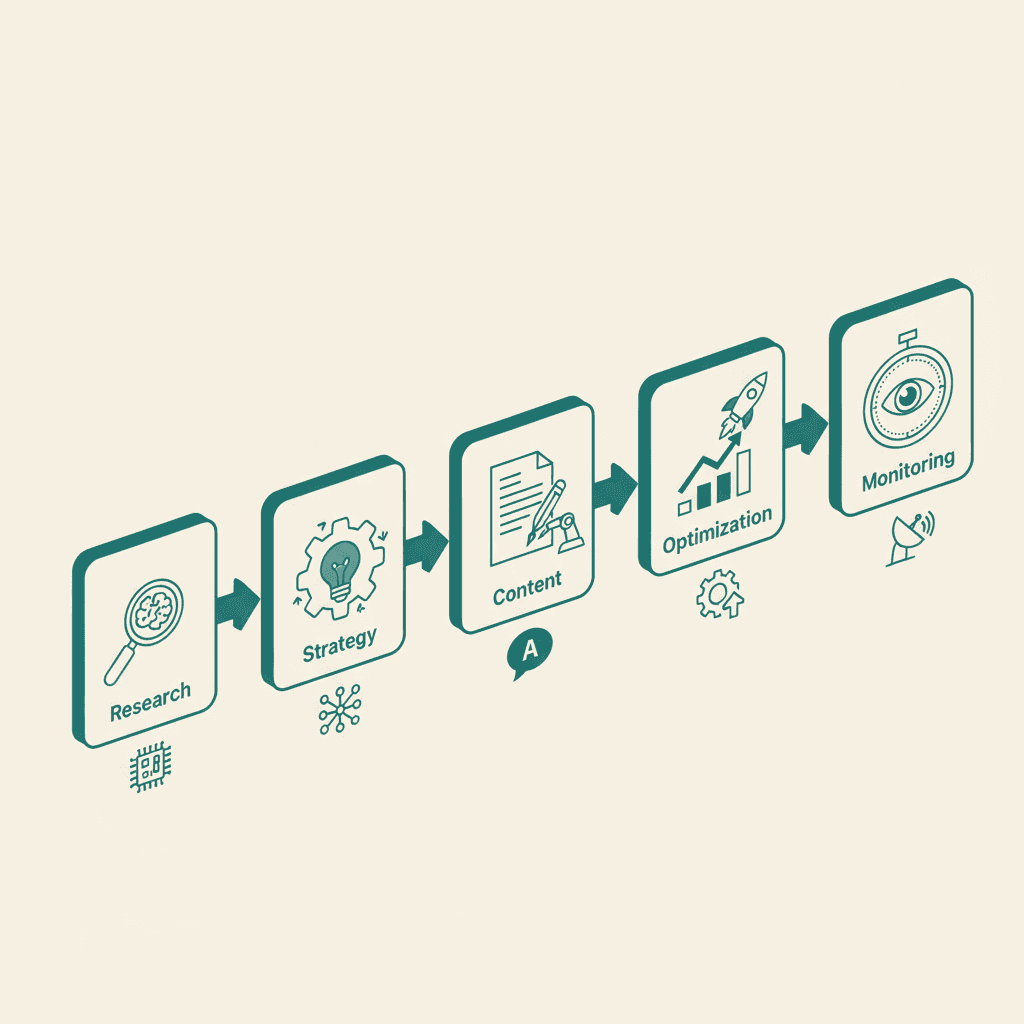
This is the most discussed application of AI in SEO — and the most misunderstood one.
AI tools excel at certain content tasks and fail at others. Getting this distinction right is the difference between building authority and accumulating ranking penalties.
Where AI adds genuine value:
Content briefs and outlines are faster and more comprehensive when AI analyzes top-ranking pages and structures an outline that covers the relevant subtopics. Tools like Surfer AI, Frase, and Clearscope's AI features automate this analysis.
First drafts for factual, structured content — product descriptions, technical documentation, FAQ sections — can be AI-generated with light human editing. The key is that the underlying facts need to be accurate, and a human reviewer needs to verify them.
Title tag and meta description optimization. AI tools generate dozens of variations quickly and can be prompted to optimize for CTR, keyword inclusion, and character limits simultaneously.
Internal link identification. Tools like LinkWhisper and custom scripts using LLMs can scan a content library and identify natural internal linking opportunities — though a human editor should review suggestions before implementation.
Where AI fails and humans must lead:
Original research, case studies, and first-hand expertise. Google's E-E-A-T framework explicitly values "Experience" — content demonstrating that the author has actually done the thing they are writing about. AI cannot provide this. Original data, client stories, and practitioner perspectives cannot be generated.
Competitive positioning and content differentiation. If your AI tool and your competitor's AI tool are both trained on the same web, the resulting content tends toward the same structure and talking points. Human editors who understand your brand voice and market position are needed to make content distinctively yours.
High-stakes technical content. Medical, legal, and financial content where factual errors have real consequences should be written or reviewed by subject matter experts, with AI serving as a research assistant rather than a primary author.
AI for Technical SEO
Technical SEO has always been data-intensive, and AI tools have made the audit-and-fix cycle meaningfully faster.
Crawl analysis and issue prioritization. Screaming Frog, Sitebulb, and similar tools now incorporate AI to prioritize issues by estimated traffic impact. Instead of a raw list of 400 technical issues, you get a ranked list that focuses attention on what matters most.
Log file analysis. Server log files reveal exactly how Googlebot crawls a site — which pages it visits, how often, and where it wastes crawl budget. AI tools analyze these logs and surface crawl inefficiencies that manual analysis would miss or take days to identify.
Core Web Vitals diagnostics. Google's PageSpeed Insights and Lighthouse now provide AI-assisted recommendations that link specific performance metrics to specific code changes. The diagnosis is faster; the implementation still requires developer work.
Schema markup generation. LLMs are excellent at generating structured data markup for products, articles, FAQs, and local businesses when given the source content. This is a legitimate use case where AI handles a tedious but high-value technical task accurately.
Optimizing for AI Overviews: The New SEO Discipline
Getting ranked in traditional blue links is no longer the complete picture. For many queries, an AI Overview appears above organic results, and appearing as a cited source inside that Overview carries real value — both for direct visibility and as a trust signal.
The tactics for AI Overview citation optimization are distinct from standard ranking optimization:
Concise, direct answers to specific questions. AI Overviews pull from content that answers questions clearly and directly. Long preambles before getting to the answer hurt your citation chances. Structure content so the answer to the page's primary question appears in the first 100-150 words of the relevant section.
Strong factual density. AI systems prefer content with verifiable facts, statistics, and specific claims over vague generalizations. Citing sources, including data, and making specific assertions rather than hedging everything improves the signal.
Semantic markup. FAQ schema, HowTo schema, and proper heading hierarchy help AI systems understand content structure. A well-marked-up FAQ section has a higher chance of appearing in AI Overviews than unstructured paragraphs covering the same content.
Topical depth over keyword stuffing. AI systems evaluate whether a page genuinely covers a topic comprehensively. Surface-level content targeting a keyword without demonstrating real understanding of the subject performs poorly in AI-powered ranking systems.
GEO: The Next Layer Beyond SEO
Generative Engine Optimization — GEO — is the practice of optimizing content and authority signals for AI-powered search surfaces beyond traditional Google: Perplexity, Microsoft Copilot, ChatGPT Search, and the AI assistants increasingly embedded in operating systems and browsers.
GEO shares DNA with SEO — authority, structured content, and genuine expertise matter in both — but it requires additional layers:
Citation worthiness. AI systems cite pages that read like authoritative references. Clear attributions, specific data, and well-structured definitions are the kind of content AI systems pull from.
Entity clarity. AI systems need to understand who you are and what you do without ambiguity. Clear entity definition — your brand name, location, services, and relationships to known entities — helps AI systems reference you confidently.
Cross-platform visibility. Traditional SEO focused on Google. GEO requires visibility across the surfaces where your audience gets AI-generated answers, which increasingly means Perplexity, ChatGPT, and vertical AI tools.
Our AI SEO services incorporate both traditional SEO and GEO into a unified strategy — because in 2026, optimizing for one without the other leaves visibility on the table.
AI SEO Workflow for Philippine Businesses
The global AI SEO conversation often assumes access to enterprise tools at US price points. For Philippine businesses, the practical reality looks different.
Tools worth the investment:
- Ahrefs Starter or Semrush Pro — keyword research, rank tracking, competitor analysis (roughly ₱2,000-4,000/month depending on the plan)
- ChatGPT Plus or Claude Pro — content drafting, brief generation, keyword clustering (~₱1,500/month)
- Screaming Frog free tier — technical crawls for sites under 500 pages
- Google Search Console and Google Analytics 4 — free, and still the most important data sources
Tools to defer until budget allows:
- Enterprise crawl tools (Sitebulb, DeepCrawl) — necessary at scale, expensive for SMBs
- Dedicated AI content platforms (Surfer AI, Frase) — useful but duplicative if you already have ChatGPT with good prompting workflows
The language consideration. Filipino businesses often need to reach audiences searching in English, Filipino, and regional languages. AI tools are substantially better at English content generation than Filipino or Bisaya content — a human bilingual editor is still essential for content targeting Filipino-language keywords, and this is not a gap AI tools have closed as of 2026.
The SEO automation tools and workflows article covers how to build a lean automation stack that keeps overhead manageable for smaller teams and budgets.
What AI Cannot Replace in Your SEO Strategy
To close the loop: after covering what AI does well, it is worth being direct about the gaps.
AI cannot build your domain's authority. Authority comes from earning genuine links from real publications, which requires relationship-building, original research worth citing, and a reputation that exists beyond your own website.
AI cannot adapt to your market in real-time. Algorithm changes, competitor moves, and shifts in search behavior require a practitioner who monitors signals continuously and makes judgment calls. AI tools surface data; they do not make strategic decisions.
AI cannot represent your brand experience. The authentic perspective that differentiates high-ranking content from AI-indistinguishable noise comes from real experience, real clients, and real results. In 2026, that is precisely what the best SEO content is built from.
Teams that pair AI tools with professional SEO expertise tend to see stronger results than those relying on automation alone.
Frequently Asked Questions
What is the best AI tool for SEO in 2026?+
There is no single best tool — it depends on the task. For keyword research and competitive analysis, Ahrefs and Semrush with their AI features are the industry standard. For content drafting and brief generation, ChatGPT-4o and Claude 3.7 are the most capable. For technical SEO analysis, Screaming Frog and Sitebulb lead the market. The most effective teams use combinations rather than relying on one platform.
Can AI write SEO content that ranks?+
Yes, with important caveats. AI-assisted content that includes genuine expertise, original data, and human editorial oversight can rank well. Purely AI-generated content that lacks real expertise, especially on topics where E-E-A-T signals matter, is increasingly likely to underperform after Google's 2025 quality updates.
How do I use AI to optimize for Google AI Overviews?+
Structure your content to answer specific questions directly and concisely, use FAQ and HowTo schema markup, include verifiable facts and statistics, and cover topics with genuine depth. AI Overviews pull from content that reads like a trustworthy reference source — not content that reads like it was written to rank.
Is AI SEO suitable for small businesses in the Philippines?+
Yes. The tools that matter most — Google Search Console, ChatGPT Plus, and Ahrefs Starter — are accessible at Philippine SMB price points. The bigger barrier is strategic expertise, not tool access. A small business that understands how to use these tools intelligently can compete effectively against larger competitors in local and niche markets.
How much does AI SEO software cost?+
A functional AI SEO toolkit for a small-to-medium business runs approximately ₱3,500 to ₱8,000 per month for core tools (Ahrefs or Semrush plus ChatGPT or Claude). Enterprise stacks with additional tools can run significantly higher. The ROI depends heavily on whether the tools are being used strategically — access to tools without strategic direction rarely produces compounding results.