Can SEO Be Automated? What's Real in 2026
Some SEO tasks can be fully automated. Others will fail if you try. Here's the honest breakdown of what automation can and can't do — and how to build a smart SEO automation stack.

SEO automation is one of those topics where the marketing around tools and the reality of what they deliver are furthest apart. Tool vendors will tell you that their platform automates SEO. Google will tell you that most "automated SEO" violates its guidelines. The truth sits somewhere between those positions — and knowing exactly where is what separates teams that scale efficiently from teams that get penalized.
The honest answer to "can SEO be automated" is: some of it, yes, completely. Some of it, partially, with AI assistance. And some of it should never be automated, because the moment you try, you produce work that harms rather than helps your rankings.
This guide draws a clear line between each category, covers the tools and workflows that produce real automation value in 2026, and explains when automation hits its limits. If you are managing SEO for a Philippine business with limited team resources, there is a practical stack recommendation at the end built around realistic budgets.
Understanding the different types of SEO provides context for where automation applies — because technical SEO, content SEO, and link building have very different automation profiles.
The SEO Automation Spectrum
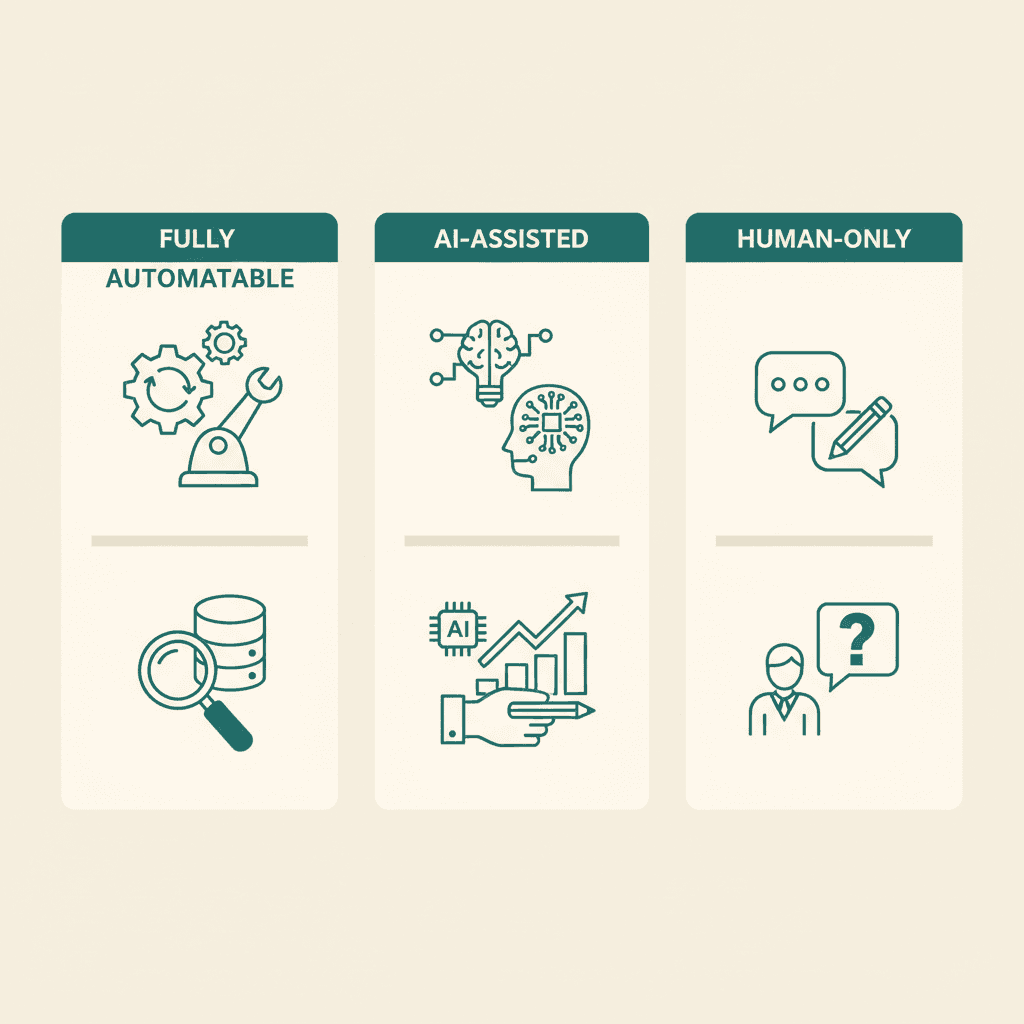
Before listing tools, it helps to establish a clear framework. SEO tasks fall into three categories:
Fully automatable. These are tasks that AI and software tools handle better and faster than humans, where the output does not require editorial judgment. Automating them frees human time for higher-value work.
AI-assisted. These tasks benefit significantly from AI acceleration but still require human review, judgment, or original thinking to produce quality output. Fully automating them degrades results.
Human-only. These tasks cannot be automated without producing work that either ranks poorly, violates Google's guidelines, or fails to serve users. Attempts to automate them typically backfire.
The most common mistake in SEO automation is miscategorizing a "human-only" task as "AI-assisted" or "fully automatable." This is how businesses end up with thin content, low-quality links, or technical configurations that trigger Google penalties.
Fully Automatable SEO Tasks
Rank tracking and alerting. Monitoring keyword positions, tracking ranking changes, and sending alerts when significant moves occur are pure automation. Tools like Ahrefs, Semrush, and Rank Tracker do this continuously without human involvement. The only human decision is what to do about changes when alerts fire.
Technical crawl monitoring. Screaming Frog, Sitebulb, and similar tools can be scheduled to crawl your site regularly and compare against previous crawls to flag new issues — broken links, new 404s, redirects going wrong, pages suddenly becoming noindex. The crawl and comparison are automated; the prioritization of fixes still benefits from human judgment.
Core Web Vitals monitoring. Google's PageSpeed Insights API and tools like SpeedVitals can be set to monitor page performance continuously. Automated alerts when Largest Contentful Paint or Cumulative Layout Shift degrade beyond thresholds catch performance issues before they affect rankings.
XML sitemap generation and submission. Every modern CMS handles this automatically. WordPress with an SEO plugin, Payload CMS, Contentful — they all generate and update sitemaps without manual work. The same applies to robots.txt for most standard configurations.
Redirect chain detection. Identifying redirect chains (A redirects to B which redirects to C), finding redirect loops, and mapping redirect structures are automated crawl tasks that tools handle without human involvement.
Schema markup generation for standard content types. Generating structured data for product pages, articles, FAQs, and local businesses from existing content fields is a pattern AI handles well. Once the template is built, it applies automatically to new content.
Search Console data reporting. Pulling GSC data via the API and building automated performance reports is standard practice. Tools like Looker Studio with Google Search Console integration give teams automated weekly visibility reports without manual data pulling.
AI-Assisted SEO Tasks
Content brief generation. AI tools can analyze the top-ranking pages for a keyword, extract the subtopics they cover, identify the questions users ask, and produce a structured content brief in minutes. This is dramatically faster than manual analysis. But a human editor still needs to review the brief, add brand-specific angles, cut irrelevant sections, and ensure the resulting brief aligns with the client's positioning and audience.
Keyword clustering and intent mapping. AI tools cluster hundreds of keywords by semantic similarity and infer search intent consistently across large datasets. The clustering output is good but not perfect — human review catches clusters that should be merged or split based on business considerations the AI does not know.
On-page optimization recommendations. Tools like Surfer, Clearscope, and Semrush's on-page checker analyze a target page against top-ranking competitors and suggest optimization changes: missing subtopics, heading adjustments, internal link additions, content gaps. The recommendations are useful inputs; treating them as automatic outputs to implement without judgment degrades content quality.
Internal link identification. AI tools can scan a content library and identify pages that should link to each other based on topical relevance. LinkWhisper and similar tools do this. But the final decision about which links to add — based on anchor text variation, editorial flow, and user experience — requires human review.
Meta description and title tag variations. AI generates strong variations of meta descriptions and title tags quickly. Testing different versions through Search Console CTR data over time tells you which performs best. The generation is automated; the evaluation of results is human.
Competitor monitoring. Automated tools track competitor keyword rankings, new content publications, backlink acquisitions, and SERP feature captures. Turning that raw intelligence into strategic decisions — what to respond to, what to ignore, what represents a real threat — requires analyst judgment.
The AI for SEO workflow guide covers how to integrate these AI-assisted tasks into a coherent production workflow without creating bottlenecks or quality gaps.
AI Agents for SEO: The New Automation Frontier
One of the most significant 2025-2026 developments in SEO automation is the emergence of AI agents — software that can execute multi-step SEO workflows autonomously, using a combination of tool access and LLM reasoning.
Practical AI agent applications in SEO:
Content gap monitoring. An agent connected to Ahrefs and a content CMS can: (1) check weekly which competitor keywords are gaining traction, (2) identify whether you have coverage for those topics, (3) generate a content brief for gaps, and (4) add it to a content queue — all without human prompting.
Internal linking maintenance. As new content publishes, an agent can scan the existing library for pages that should link to the new post, draft the anchor text and surrounding context for each link, and flag them for human approval before implementation.
SEO anomaly investigation. When rank tracking detects a significant drop, an agent can: pull the affected page's GSC data, run a crawl of the page, check for recent content changes, compare competitor ranking changes on the same keyword, and produce a summary report with likely causes. This reduces the investigation time from hours to minutes.
Structured workflow automation with tools like n8n and Make.com. For teams comfortable with workflow automation tools, n8n and Make.com connect APIs from SEO tools, CMSes, and LLMs into automated pipelines. Examples: automatically generating alt text for new images uploaded to your CMS, generating internal link suggestions when new posts are published, sending Slack alerts with GSC data summaries every Monday.
These agent-based workflows represent the current frontier of what SEO automation can do without requiring direct human involvement in every step.
Human-Only SEO Work
This is the category where automation attempts consistently backfire.
Link acquisition strategy and outreach. Earning genuine editorial links from authoritative publications requires identifying the right targets, building relationships with editors and journalists, creating content worth citing, and personalizing outreach. Automated link building — whether through link farms, PBNs, or mass outreach blasts — violates Google's guidelines and now triggers penalties more reliably than ever after the March 2025 core update. There is no shortcut here.
Content strategy and competitive positioning. Deciding which topics to pursue, which angles differentiate your content from competitors, and how to sequence your content investment based on business priorities requires understanding the business, the market, and the audience in ways that AI tools do not have access to.
Expert content creation. Content that demonstrates genuine first-hand experience — case studies, original research, practitioner perspectives, personal experience with a product or service — cannot be generated by AI without becoming factually fabricated. Google's E-E-A-T evaluation identifies this, and the March 2025 core update penalized sites that relied on AI to simulate expertise rather than communicate it.
Client relationships and strategic consulting. For agencies, the work of understanding a client's business, setting expectations, explaining strategy, and navigating decisions together is relationship work that no tool replaces.
Crisis response and algorithm recovery. When a site takes a significant ranking hit after a core update, the recovery process — analyzing what changed, hypothesizing causes, building a remediation plan, executing it, and monitoring results — requires judgment and experience. AI tools surface data; they do not diagnose complex ranking problems or prescribe recovery strategies reliably.
The Risks of Over-Automating Your SEO
Over-automation has produced measurable harm for many websites. The pattern is consistent:
A team discovers that AI tools can generate content quickly. They automate publication of AI-generated articles at high volume. Initially, the additional pages index and some rank. Then a Google core update evaluates the content quality, finds it lacks genuine expertise, and the rankings drop across the site — often affecting previously well-performing pages too.
This is not hypothetical. The March 2025 core update specifically targeted sites that had accumulated large volumes of AI-generated content without demonstrating genuine expertise. Sites with strong E-E-A-T signals were generally unaffected; sites that used AI as a replacement for expertise rather than as a tool to communicate expertise took significant hits.
The safe principle: automate what a machine genuinely does better than a human. Use AI to accelerate human expertise. Never use AI to simulate expertise that does not exist.
A complete SEO audit often reveals whether a site's existing automation practices have created compliance risks before those risks manifest as ranking losses.
Building an SEO Automation Stack for Philippine Businesses
The tools worth investing in, scaled to realistic Philippine SMB and agency budgets:
Foundation (required, mostly free):
- Google Search Console — performance data, indexing, Core Web Vitals
- Google Analytics 4 — traffic and behavior data
- Google Keyword Planner — search volume and keyword ideas
- Screaming Frog free tier (up to 500 pages) — technical crawl
Core stack (₱3,000-6,000/month):
- Ahrefs Starter or Lite — keyword research, rank tracking, backlink monitoring, competitor analysis
- ChatGPT Plus or Claude Pro — content briefs, clustering, on-page recommendations, meta generation
- Google Looker Studio (free) — automated reporting dashboards connecting GSC and GA4
Advanced stack for agencies (₱8,000-20,000+/month):
- Ahrefs Standard or Semrush Pro — expanded data access, team features
- Screaming Frog paid license — unlimited crawl, log file analysis
- n8n or Make.com — workflow automation connecting tools
- Surfer or Clearscope — content optimization scoring
What to automate immediately:
- Weekly rank tracking reports delivered to your inbox or Slack
- Crawl monitoring scheduled monthly with alerts for critical issues
- Content brief generation via ChatGPT using a standard prompt template
- GSC data reporting via Looker Studio dashboard refreshed automatically
What to keep human-led from day one:
- Link acquisition strategy and outreach
- Content strategy and topic selection
- Any content that will carry E-E-A-T requirements
Automation vs. Agency: When to Hand Off
The case for building your own automation stack is strongest when:
- You have an in-house SEO team or dedicated marketing person with time to learn the tools
- Your website is established with 50+ indexed pages and existing ranking baseline
- You are in a market with clear keyword opportunities and manageable competition
- Budget is a meaningful constraint
The case for working with an AI SEO agency is stronger when:
- Ya qualified team does not have the bandwidth to learn and manage SEO tools alongside other responsibilities
- You are launching a new site or entering a competitive market where strategic expertise matters from day one
- You want AI-era tactics — AI Overview optimization, GEO — not just standard automation
- The cost of mistakes (ranking penalties, missed opportunities) outweighs the cost of professional support
Many businesses do both: use a lean automation stack for ongoing monitoring and maintenance while working with an agency for strategic campaigns, content production, and link acquisition.
Automated workflows work best within a structured SEO strategy with clear priorities.
The newest frontier of automation involves generative engine optimization — preparing content for AI-driven search.
Teams investing in automation often pair it with AI-powered SEO tools for maximum efficiency.
Frequently Asked Questions
Can SEO be fully automated?+
No. Technical monitoring, reporting, and some content production tasks can be fully automated. But strategy, link acquisition, expert content creation, and client-facing work require human judgment that automation cannot replace. Attempting to fully automate SEO typically produces either mediocre results or ranking penalties.
What SEO tasks should never be automated?+
Link building at scale (this violates Google's guidelines), generating content that simulates expertise without genuine knowledge, content strategy and competitive positioning, and client relationship management. These are the areas where automation creates real risks.
What are the best SEO automation tools in 2026?+
For rank tracking: Ahrefs and Semrush. For technical crawling: Screaming Frog and Sitebulb. For content assistance: ChatGPT-4o and Claude 3.7. For workflow automation: n8n and Make.com. For reporting: Google Looker Studio. The right combination depends on team size, budget, and specific SEO priorities.
How do AI agents help with SEO automation?+
AI agents can execute multi-step SEO workflows — monitoring competitor activity, generating content briefs, identifying internal linking opportunities, investigating ranking drops — without human prompting for each step. They connect the data analysis and the action layer, reducing the time between noticing an opportunity or issue and responding to it.
Is SEO automation safe — will Google penalize automated content?+
Automation that improves technical quality, speeds up human-led content production, and handles monitoring tasks is safe and standard practice. Automation that generates low-quality content at scale, builds links artificially, or simulates expertise that does not exist risks penalties under Google's quality guidelines. The March 2025 core update specifically targeted the latter category.