What Is On-Page SEO? The 2026 Guide
On-page SEO is everything you do on your own pages to earn higher rankings. Here's exactly what it covers and how to do it right in 2026.
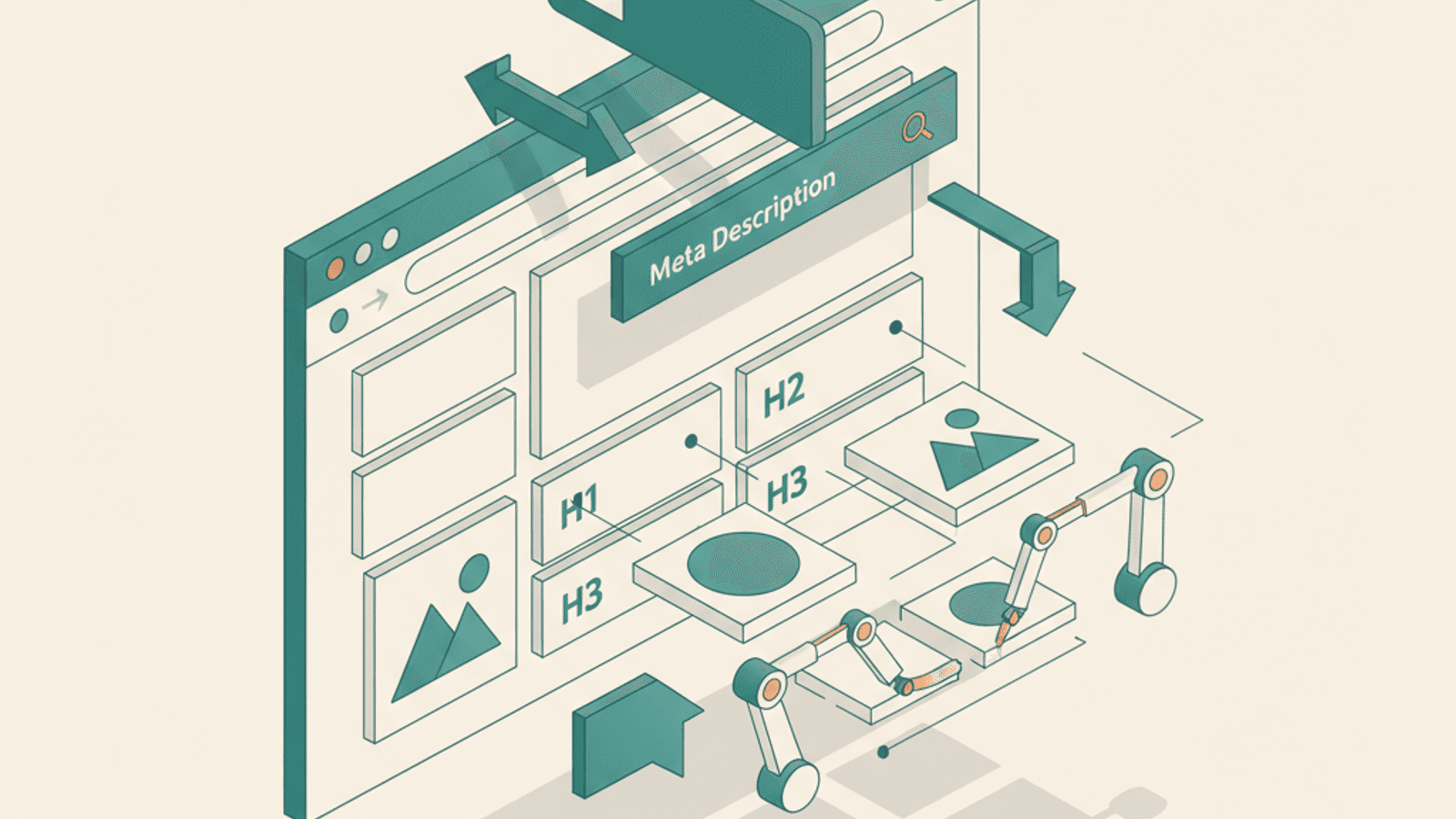
Every page you publish is either working for you in search or working against you. On-page SEO is the discipline that determines which.
Unlike backlinks or domain authority, on-page SEO is entirely within your control. You decide what goes on your pages — the titles, the content, the structure, the signals. Get these right, and you give Google every reason to rank you. Get them wrong, and no amount of link building will compensate.
This guide covers everything you need to know about on-page SEO in 2026: what it is, what it includes, which elements carry the most weight today, and how to apply it to any page on your site.
What Is On-Page SEO?
On-page SEO is the practice of optimizing the content and HTML elements of individual web pages to improve their visibility in search engine results.
The term "on-page" distinguishes this work from off-page SEO (backlinks, brand mentions, external authority signals) and technical SEO (crawlability, indexability, site infrastructure). If it lives on the page and you control it directly, it falls under on-page SEO.
In practice, on-page SEO covers:
- Title tags and meta descriptions
- Heading structure (H1 through H3+)
- Body content — depth, relevance, keyword coverage
- Image alt text and file naming
- URL slugs
- Internal linking
- Structured data and schema markup
- Page experience signals (loading speed, interactivity, visual stability)
Google reads these elements collectively to understand what a page is about, how trustworthy the source is, and whether the page deserves to rank for a given query. In 2026, that reading has grown significantly more sophisticated.
Why On-Page SEO Still Matters in 2026
Some SEO practitioners have argued that Google has moved beyond on-page signals — that machine learning means keywords matter less and overall authority matters more. The data does not support this.
Google's documentation consistently emphasizes that relevance signals — the words on your page, the structure of your content, the intent match — remain foundational. What has changed is the sophistication of how Google evaluates those signals.
Three developments make on-page SEO more nuanced in 2026:
Passage indexing. Google can now rank individual passages within a long page, not just the page as a whole. This means a single well-optimized section can drive traffic even if the overall page doesn't rank for the primary keyword. Your subheadings, section introductions, and paragraph clarity all matter more than they used to.
E-E-A-T documentation. Google's Quality Rater Guidelines place heavy emphasis on Experience, Expertise, Authoritativeness, and Trustworthiness. On-page signals that communicate these qualities — author bios, first-hand experience language, cited sources, publication dates — now function as ranking signals, not just trust signals.
AI content detection and helpful content standards. Following Google's Helpful Content system updates, thin, generic, or AI-generated pages without genuine expertise signals face systematic downranking. On-page SEO in 2026 means demonstrating real knowledge, not just optimizing keywords.
The Core On-Page SEO Elements
Title Tags
The title tag is the blue link users see in search results. It tells Google — and the user — exactly what the page is about. A well-written title tag does three things: includes the primary keyword, communicates the page's value, and fits within roughly 60 characters.
Avoid keyword stuffing in title tags. Google rewrites titles that look manipulative. Your title should read naturally and serve the user first.
Meta Descriptions
Meta descriptions don't directly affect rankings, but they affect click-through rate, which indirectly affects rankings. A compelling meta description under 155 characters summarizes the page, hints at the answer, and gives users a reason to click over the competing results.
Google frequently rewrites meta descriptions, especially when the user's search intent doesn't match your description. Write meta descriptions as a fallback for when Google keeps yours — clear, honest, and relevant.
Heading Structure
Headings communicate hierarchy. The H1 is your page's primary topic declaration — there should be only one, and it should include your primary keyword. H2 headings break the page into major sections. H3 headings organize content within each section.
Clear heading structure helps Google understand what a page covers. It also helps users navigate longer content, which improves engagement signals like dwell time and scroll depth.
Body Content Quality
Content remains the most significant on-page SEO factor. Google evaluates not just keyword presence but semantic coverage: does this page comprehensively answer the user's question? Does it cover the related subtopics an expert would address?
For 2026, high-quality on-page content means:
- Genuine depth on the topic, not just length
- First-hand experience or expertise signals (author voice, specific examples, lived knowledge)
- Semantic keyword coverage — related terms, entities, and concepts Google associates with the topic
- Clear answers to the user's actual intent, not just the surface keyword
- Updated information — stale content loses rankings progressively
A common trap is optimizing for length as a proxy for quality. Google is not counting words. It is evaluating how completely and credibly a page serves the user's intent.
Image Optimization
Every image on a page is an opportunity. File names should describe the image using the target keyword where relevant. Alt text should describe what the image shows — not keyword-stuff it — so Google and screen reader users both understand the content.
Image file size directly affects page speed, which is a Core Web Vitals factor. Use modern formats (WebP, AVIF) and compress images before uploading.
URL Structure
A clean, descriptive URL slug reinforces what the page is about. Short slugs with the primary keyword outperform long, parameter-heavy URLs. For a detailed treatment of this element, see our guide to SEO-friendly URL structure.
Internal Links
Internal links pass authority between pages and help Google understand the relationship between your content. A page with no internal links is an island — harder to find and harder for Google to contextualize. Every substantive page on your site should receive links from related content.
Use descriptive anchor text that tells users and Google what the linked page covers. Avoid "click here." Aim for 3-5 internal links per post minimum.
Structured Data
Schema markup is on-page code that explicitly tells Google what your content represents: an article, a FAQ, a product, a how-to guide. Rich results — the enhanced SERP features like star ratings, FAQ dropdowns, and recipe cards — require structured data.
In 2026, structured data also influences how AI-generated search overviews attribute and source content. Pages with clear schema are more likely to be cited accurately.
On-Page SEO for the Philippines Market
The Philippines' search landscape has some specific characteristics that affect on-page strategy.
Mobile search dominates — over 75% of Philippine internet traffic comes from mobile devices. This means your Core Web Vitals scores on mobile are the primary ranking signal, and your content must be readable on smaller screens.
Many Filipino users search in a mix of English and Filipino (Tagalog). Pages targeting Philippine audiences often benefit from addressing this bilingual reality — either by serving content in the dominant language of the target query or by structuring content to match the specific phrasing Filipino searchers use.
Local intent signals matter for service-based businesses. Pages that explicitly reference Philippine cities, regions, or local context tend to perform better for locally-intended queries than generic national content.
If you want help applying these principles to your site, professional SEO services team works specifically with Philippine businesses on on-page optimization.
On-Page SEO vs. Related Disciplines
On-page SEO is one of three interconnected disciplines:
On-page SEO — content, HTML elements, page-level signals. Your content team owns this.
Technical SEO — crawlability, indexability, site architecture, server performance. Your development team owns this, though on-page and technical overlap at structured data and URL structure. See on-page SEO vs technical SEO for a detailed breakdown.
Off-page SEO — backlinks, brand mentions, external authority signals. Your outreach and PR teams own this. For how these two disciplines relate, see our comparison of on-page and off-page SEO.
None of these operates in isolation. Technical problems prevent your on-page work from being seen. Weak off-page signals limit how far strong on-page work can take you. But on-page SEO is always the foundation — without it, nothing else works.
Common On-Page SEO Mistakes
The most damaging on-page mistakes are not technical — they are strategic. Targeting the wrong keywords, writing content that doesn't match search intent, and publishing thin pages that don't demonstrate expertise cause more ranking problems than missing alt text or slightly-off title tag lengths.
A detailed examination of the most common on-page SEO mistakes is worth reading before you start any optimization project. The mistakes are predictable, and most are straightforward to fix once you know what to look for.
Tools for On-Page SEO
You don't need expensive software to do on-page SEO well — but the right tools accelerate the work significantly. Google Search Console (free) shows you which queries your pages rank for and identifies indexing problems. PageSpeed Insights (free) measures your Core Web Vitals scores. Screaming Frog and Ahrefs handle deeper audits.
For a complete breakdown of what each tool is best for, see our guide to the best on-page SEO tools.
An On-Page SEO Checklist
Use this as a quick reference when publishing or auditing any page:
- Primary keyword in title tag, H1, and first 100 words of body
- Title tag under 60 characters
- Meta description under 155 characters with clear value proposition
- Single H1, logical H2/H3 hierarchy
- Images have descriptive file names and alt text
- URL slug is short, descriptive, and lowercase
- At least 3-5 internal links with descriptive anchor text
- Page loads in under 2.5 seconds (LCP)
- Author bio or expertise signal present for YMYL or E-E-A-T-sensitive content
- Structured data markup where applicable (Article, FAQ, HowTo)
- Content covers the topic with genuine depth and experience signals
On-page optimization works best alongside off-page link building — both signals reinforce each other.
Site speed and layout shifts also fall under broader web design best practices that affect rankings.
Modern on-page SEO increasingly intersects with AI-driven optimization tools that automate content analysis.
Frequently Asked Questions
What is on-page SEO in simple terms?+
On-page SEO is the process of optimizing what's on your web page — the content, titles, headings, images, and links — so that search engines understand it and rank it higher for relevant searches. It's everything within your direct control on the page itself.
How long does on-page SEO take to show results?+
Most on-page changes take 2 to 8 weeks to reflect in rankings, depending on how often Google crawls your site and how competitive the target keyword is. Quick wins like fixing title tags and adding internal links can show movement faster than major content rewrites.
What is the most important on-page SEO factor?+
Content quality and relevance to search intent. You can have perfect title tags and clean URLs, but if the content doesn't comprehensively and credibly answer the user's question, the page will not rank sustainably. Everything else is secondary to getting the content right.
Is on-page SEO still relevant in 2026?+
Absolutely. Google has stated repeatedly that on-page signals — content relevance, title accuracy, structured markup — remain core ranking inputs. What has evolved is how Google evaluates quality: E-E-A-T signals, helpful content standards, and passage-level indexing have raised the bar, but made strong on-page work more powerful, not less.
How does on-page SEO differ from technical SEO?+
On-page SEO covers what users and search engines see on the page: content, titles, headings, images, internal links. Technical SEO covers the infrastructure that supports all pages: site speed, crawlability, indexability, server configuration. Both matter, but on-page SEO is typically where optimization work begins.