AI SEO Tools: The Complete 2026 Toolkit
A comprehensive review of AI SEO tools in 2026 — from AI visibility monitors and content optimizers to schema generators and citation trackers.

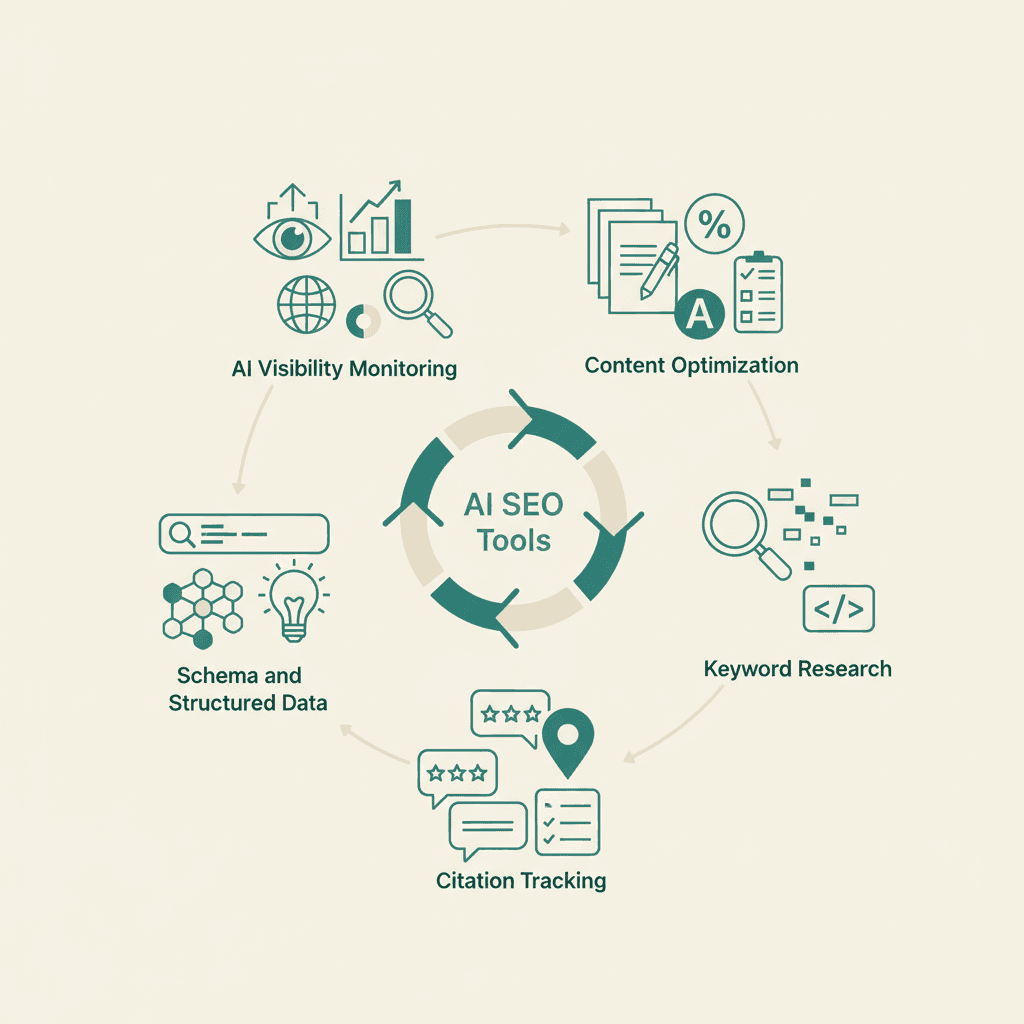
The AI SEO toolset has expanded dramatically since 2023. What started as a handful of AI writing assistants has matured into a full toolkit spanning AI visibility monitoring, content optimization, entity analysis, schema generation, and citation tracking. Choosing the right tools depends on what problems you are solving — and in 2026, the problems have multiplied significantly.
This guide organizes the current AI SEO tool landscape by use case, evaluates each category's leading options, and distinguishes what is worth paying for versus what free alternatives can cover.
Category 1: AI Visibility Monitoring
The most important new category in the AI SEO toolkit is AI visibility monitoring — tracking how often and where your brand and content appear in AI-generated answers across platforms like Google AI Overviews, ChatGPT, Perplexity, and Microsoft Copilot.
Understanding how AI is being applied to SEO broadly reveals why visibility monitoring has become non-negotiable: if AI-generated answers increasingly intercept informational queries before users reach organic results, not monitoring your AI presence means operating blind.
Ahrefs Brand Radar
Ahrefs Brand Radar aggregates brand and domain mention data across multiple AI platforms, providing Share of Voice metrics, impression history, and citation frequency data. It tracks which AI platforms are citing you, which queries trigger citations, and how citation frequency trends over time.
Best for: Agencies and in-house SEO teams tracking competitive AI visibility at scale.
Pricing: Included in Ahrefs' advanced subscription tiers (starting at higher-tier plans).
Limitation: Coverage is strongest for English-language queries; emerging market tracking is less comprehensive.
DataForSEO AI Optimization API
DataForSEO's AI optimization endpoints provide programmatic access to AI mention data, LLM response sampling, keyword data for AI-visible terms, and cross-platform aggregation. The API-first approach makes it suitable for building custom monitoring dashboards.
Best for: Technical SEO teams and agencies building custom reporting infrastructure.
Pricing: API credit-based, with costs varying by query volume.
Limitation: Requires development resources to implement; not a turnkey dashboard for non-technical users.
Semrush AI Toolkit (2026)
Semrush has integrated AI visibility tracking into its platform, allowing users to monitor AI Overview presence for tracked keywords and compare their presence against competitors. The integration with Semrush's existing keyword and backlink data makes it a convenient single-platform option.
Best for: Existing Semrush users who want AI monitoring without adding another tool.
Pricing: Included in Semrush Business and Enterprise plans.
Manual SERP Sampling
For smaller operations, manually querying ChatGPT, Perplexity, and Google for target keywords and recording citation presence in a spreadsheet remains a viable approach. Free, granular, and gives qualitative insight into how AI systems describe your brand — but does not scale beyond a few dozen keywords.
Category 2: Content Optimization for AI
This category includes tools that analyze existing content and suggest improvements to increase AI citation probability and overall quality. Many of these tools also support traditional on-page SEO optimization, making them dual-purpose investments.
Surfer SEO
Surfer uses NLP analysis of top-ranking pages to generate content briefs and score existing content. Its 2026 iteration includes AI Overview optimization hints, flagging content sections that match common AI Overview formats.
Best for: Content teams needing structured briefs for writers.
Pricing: Subscription-based, with per-article credits for content editor access.
Clearscope
Clearscope provides term frequency analysis calibrated against top-ranking content for a target keyword. Writers receive a grade as they write, with suggestions for terms and concepts to include. Clearscope's focus on topical coverage aligns well with AI citation optimization, since comprehensive coverage of a topic is a key GEO signal.
Best for: Enterprise content teams with high-volume publishing.
Pricing: Higher-end subscription, aimed at mid-market and enterprise.
MarketMuse
MarketMuse uses topic modeling to identify content gaps across an entire domain. Its cluster analysis helps plan content architecture — identifying which pages to create or upgrade to build topical authority in a category. Topical authority is a central requirement for AI Overview citation, making MarketMuse's cluster-level thinking particularly relevant.
Best for: Long-term content strategy and topical authority planning.
Pricing: Enterprise-focused pricing with a limited free tier.
Frase
Frase combines AI writing assistance with content research and SERP analysis. For teams producing high volumes of AI-optimized content, Frase can draft article outlines, pull relevant sources from top-ranking pages, and score content against target criteria.
Best for: Mid-size content teams that need both research and writing acceleration.
Pricing: Mid-range subscription with monthly article limits.
Category 3: AI Writing Assistants
AI writing assistants have become standard in most SEO content workflows. The key distinction in 2026 is between tools that simply generate text and tools that generate text with built-in SEO and GEO optimization signals.
Claude (Anthropic)
Claude is well-suited for long-form SEO content, analysis tasks, and strategic content planning. Its large context window allows feeding in competitor articles, brand guidelines, and keyword research simultaneously, producing content that synthesizes all inputs coherently. Claude's output quality for nuanced, editorial-style content is among the highest available.
Best for: Long-form pillar content, content strategy, and competitive analysis synthesis.
Pricing: Claude.ai subscription; enterprise API pricing for integration.
ChatGPT (OpenAI)
ChatGPT remains the most widely adopted AI writing assistant. GPT-4o and later models provide reliable content generation for structured formats. Operator-level customization through system prompts allows building specialized SEO content workflows within the ChatGPT interface.
Best for: Teams already embedded in OpenAI's ecosystem; rapid content drafting.
Pricing: ChatGPT Plus for individual use; API pricing for integrations.
Jasper
Jasper is a purpose-built marketing AI that integrates with Surfer SEO for combined writing and optimization. Its brand voice feature helps maintain consistency across large content teams. Jasper is designed for non-technical marketers who want AI writing in a polished interface without API integration.
Best for: Marketing teams producing high volumes of mid-funnel content.
Pricing: Mid-to-high subscription, includes team collaboration features.
Category 4: AI Keyword Research Tools
Traditional keyword research tools have incorporated AI to surface keyword opportunities that pure search volume analysis misses — particularly for AI keyword research, which addresses how users phrase queries to AI systems versus traditional search engines.
Ahrefs Keywords Explorer
Ahrefs remains the benchmark for keyword research, with keyword difficulty scores, SERP analysis, and content gap functionality. Its 2026 updates include AI Overview presence flags on keyword results, showing which keywords trigger AI panels and how often your domain appears in those panels.
DataForSEO Labs
DataForSEO's keyword data endpoints provide programmatic access to search volume, keyword difficulty, SERP features, and competitive data. The API-first model makes it the foundation for custom AI SEO workflows that need keyword data at scale.
Semrush Keyword Magic Tool
Semrush's keyword tool provides broad keyword discovery with intent classification. The AI intent labels — informational, navigational, commercial, transactional — help prioritize which keywords are most likely to trigger AI Overview panels (typically informational and comparison intents).
Google Keyword Planner
Still free. Still useful for validated search volume data, especially for Philippine market research where some third-party tools have thinner data. Useful as a cross-reference against commercial keyword tools to sanity-check volume estimates.
Category 5: Entity Analysis Tools
Entity analysis is a newer SEO category that has grown in importance as AI systems increasingly rely on entity graphs to understand content and attribute authority.
InLinks
InLinks builds entity topic models for a website, identifying which entities the site covers and how thoroughly. It can automatically generate internal linking recommendations based on entity relationships and create JSON-LD schema markup.
Best for: Teams that want entity-based internal linking automation.
Pricing: Subscription-based with project limits.
Kalicube Pro
Kalicube Pro specializes in Google Knowledge Panel management and entity authority building. It monitors entity recognition across Google, tracks Knowledge Panel accuracy, and helps correct incorrect or missing entity information.
Best for: Brands that need to manage their Knowledge Graph presence.
Pricing: Subscription-based, brand-entity focused.
WordLift
WordLift generates structured data from existing content automatically, building entity graphs that connect pages through their subject matter. It outputs JSON-LD schema and provides a knowledge graph API that can feed into SEO reporting.
Best for: Publishers with large archives who need automated structured data at scale.
Category 6: Schema Markup Generators
Schema markup is foundational to both traditional SEO and AI citation optimization. Tools in this category reduce the technical barrier to implementing structured data correctly.
Google's Rich Results Test
Free. Google's own tool validates schema markup and previews how rich results will display. Essential for any schema implementation workflow — not for generating schema, but for verifying it.
Schema App
Schema App provides a comprehensive structured data management platform, including schema generation, deployment, and monitoring. It supports all major schema types and integrates with most CMS platforms.
Merkle Schema Markup Generator
Merkle's free schema generator provides a form-based interface for creating JSON-LD for common schema types. No account required. Useful for one-off schema generation and for training content teams on schema concepts.
Yoast SEO (WordPress)
For WordPress sites, Yoast SEO automatically generates foundational schema — Organization, WebSite, Article — based on site settings. Its built-in schema builder handles the most common types without requiring manual JSON-LD.
Category 7: Citation Trackers and AI Audit Tools
Tracking AI citation presence requires dedicated tooling separate from traditional rank tracking.
Semrush AI Overview Tracker
Semrush's integrated AI Overview tracker monitors AI Overview presence for tracked keywords and shows which URLs are cited. It covers Google AI Overviews specifically, with a clean interface for non-technical users.
BrightEdge Data Cube X
BrightEdge's enterprise platform includes AI Overviews tracking integrated with its rank data, providing correlation between traditional ranking positions and AI Overview citation presence. Best suited for large enterprises with existing BrightEdge subscriptions.
Perplexity Manual Audit
For Perplexity-specific tracking, the most reliable approach remains manual querying, sampling responses across target keywords, and tracking citations in a spreadsheet. No purpose-built tool provides reliable Perplexity-specific citation tracking at scale yet in 2026.
Free vs Paid: Where to Start
For businesses just beginning to build an AI SEO practice, the priority investments are:
Must-have free tools: Google's Rich Results Test (schema validation), Google Search Console (baseline traffic and indexing data), Merkle Schema Generator (schema creation).
First paid investment: An AI visibility monitoring tool — Ahrefs Brand Radar or Semrush's AI Overview tracker — to establish a baseline. Without measurement, optimization is blind.
Second paid investment: A content optimization tool like Surfer or Clearscope, to upgrade existing content systematically rather than creating new pages from scratch.
The AI SEO service space in the Philippines is evolving to bundle these tools within managed services for businesses that lack in-house technical SEO capacity. Full SEO services packages now commonly include AI visibility monitoring as a standard component alongside traditional rank tracking.
For teams running SEO audits as the starting point for a new engagement, running an AI visibility audit alongside the technical and on-page audit is becoming standard practice. A technical audit that does not account for AI citation performance is missing an increasingly important dimension of organic search visibility. Understanding what GEO is and how it works provides the strategic context for why AI monitoring tools have become indispensable.
Frequently Asked Questions
What is the most important AI SEO tool to add in 2026?+
AI visibility monitoring — tracking whether your brand and content appear in AI-generated answers — is the most urgent gap in most existing SEO toolkits. Without it, there is no baseline to optimize against.
Can I do AI SEO with free tools only?+
A basic AI SEO practice is possible with free tools: Google Search Console, manual SERP sampling for AI Overviews and Perplexity, Google's Rich Results Test for schema, and Google Keyword Planner for keyword data. But at scale, the manual work becomes prohibitive and paid tooling is necessary.
Do AI writing assistants help with AI citation optimization?+
Indirectly. AI writing assistants can help produce well-structured, factually dense content that follows GEO best practices. But the citation performance of that content still depends on domain authority, entity recognition, and structured data — factors that writing tools do not address.
Are there AI SEO tools designed specifically for the Philippines market?+
Most leading AI SEO tools are global with some regional data limitations. DataForSEO and Ahrefs have stronger Philippine market data than many alternatives. For local SEO in specific Philippine cities, combining global tools with local citation monitoring is the current best practice.
How often should AI visibility data be reviewed?+
Monthly reviews of AI citation presence are a minimum for most businesses. Weekly reviews are appropriate for competitive categories where AI citation share is a key performance metric. Some enterprise teams run daily AI SERP sampling for their most important brand keywords.