What Is GEO? Generative Engine Optimization Guide
GEO is the practice of optimizing content to be cited by AI-powered answer engines. This guide covers the research, strategies, and tools you need in 2026.

When Princeton and Georgia Tech researchers published "GEO: Generative Engine Optimization" in 2024, they gave a name to something many practitioners were already doing informally: optimizing content specifically for AI-generated answer engines rather than — or in addition to — traditional search result pages. By 2026, GEO has moved from academic concept to a core channel for any serious digital marketing strategy.
This guide explains what GEO is, how it differs from SEO and AI SEO, and what concrete actions produce better citation rates across the AI platforms that millions of people now use as their primary information source.
What Is Generative Engine Optimization?
Generative Engine Optimization (GEO) is the discipline of structuring content, building entity authority, and earning citation signals so that AI-powered answer engines — systems like ChatGPT, Perplexity AI, Google AI Overviews, and Microsoft Copilot — retrieve and cite your content when generating answers to user queries.
The Princeton and Georgia Tech research paper defined GEO as "the practice of optimizing websites for AI-powered generative engines" and demonstrated through controlled experiments that several content modifications consistently increased citation frequency. Among the most effective were adding authoritative citations within the content itself, restructuring information into named, scannable sections, and including relevant statistics.
GEO sits above SEO in the information retrieval stack. You still need to be indexed, crawled, and trusted by traditional search engines — because most AI answer engines pull from those indices — but GEO adds a second optimization layer focused on how AI models evaluate, parse, and reference content once they have retrieved it.
How Retrieval-Augmented Generation (RAG) Works
To understand GEO, you need to understand retrieval-augmented generation, the architecture that most AI answer engines use.
Traditional language models were trained on a static corpus and could only answer from their training data, leading to outdated information and hallucinations about recent events. RAG solves this by splitting the process:
- Retrieval: When a user submits a query, the system first retrieves a set of candidate documents from an external knowledge base (often a live web index).
- Augmentation: The retrieved documents are inserted into the model's context window as reference material.
- Generation: The model generates an answer grounded in the retrieved documents and attributes the answer to those sources.
This is why GEO differs fundamentally from gaming a static training corpus. You cannot simply repeat keywords or flood the web with mentions. The model retrieves specific documents in real time and evaluates them for quality, relevance, and trustworthiness before generating its answer.
For content to be cited, it must: (a) be retrievable from the index the AI system queries, (b) be judged as relevant to the specific query, and (c) be structured in a way the model can extract meaningful information from.
How GEO Differs from SEO and AI SEO
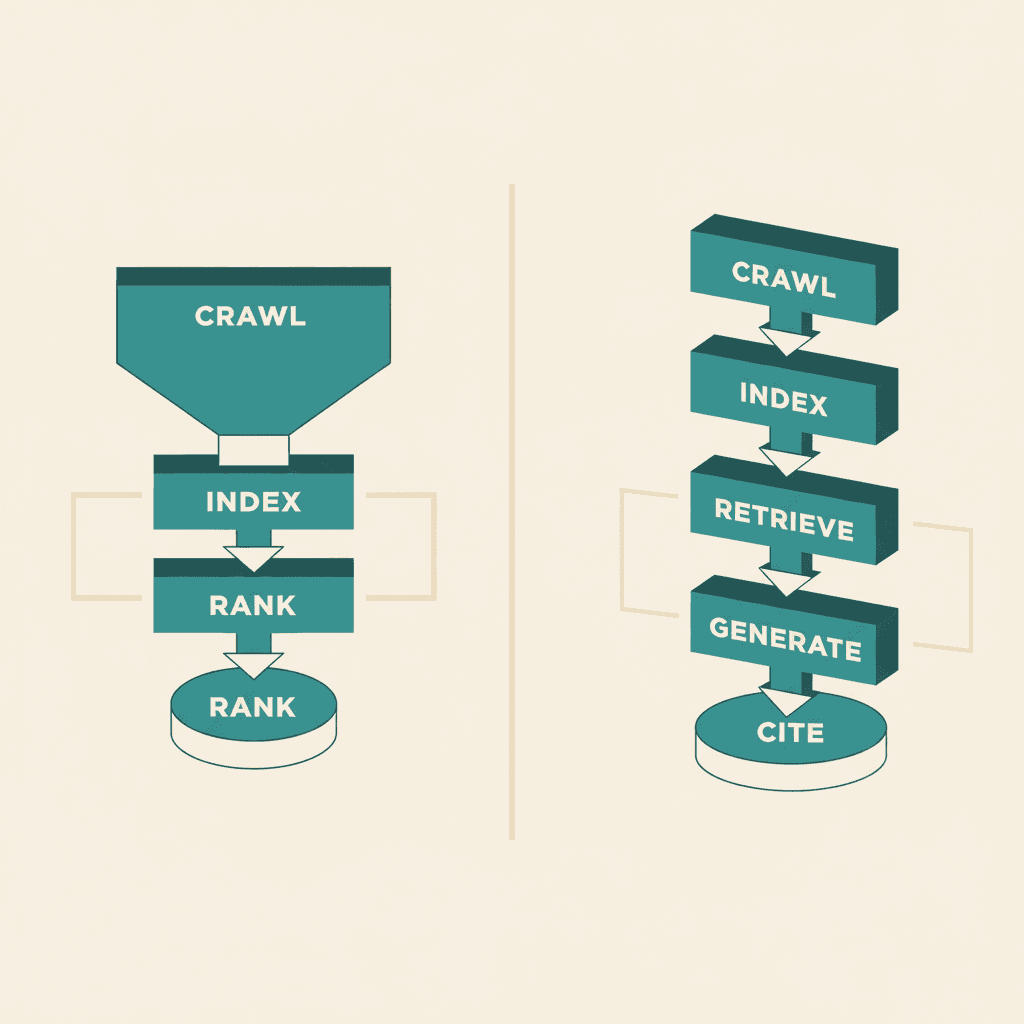
These three terms are related but distinct:
SEO (Search Engine Optimization) focuses on ranking in traditional search result pages — the ten blue links model. Success is measured in organic rank positions and the traffic those positions drive.
AI SEO refers to using AI tools and automation to perform SEO work more efficiently — using AI writing assistants to scale content production, using AI-powered keyword research tools, or using AI models to analyze competitor gaps. AI SEO is about SEO workflows, not about the distribution channel.
GEO is about a different distribution channel entirely. The goal is not to rank on a page that humans scroll through — it is to be cited inside an AI-generated answer that a human reads without leaving the AI platform. AI SEO services in 2026 increasingly bundle GEO as a distinct deliverable within broader mandates.
Google AI Overviews represent the most prominent GEO surface because they live inside the dominant search engine. But GEO extends to any platform where AI generates answers with citations: Perplexity, ChatGPT (with web browsing), Copilot, Claude, and emerging vertical AI tools.
Entity Authority: The Core Currency of GEO
In traditional SEO, authority is largely expressed through backlinks. In GEO, authority is expressed through entity recognition. An entity is any person, organization, place, concept, or product that an AI model treats as a discrete, knowable thing.
If an AI model's knowledge base — its training data and its retrieved context — consistently associates your brand or website with accurate, useful, factual information about a topic, that brand becomes a recognized entity in that topic space. Recognized entities get cited more often because the model has stronger confidence in their reliability.
Building entity authority for GEO involves:
- Consistent naming: Using your brand name, product names, and key concepts consistently across all content, structured data, and external mentions.
- Knowledge panel presence: Establishing a Google Knowledge Graph entry through Wikipedia mention, Wikidata presence, and well-structured schema on your site.
- Brand mentions at authority sources: Being named, quoted, or linked by recognized authoritative domains — news sites, academic sources, industry publications — trains both AI models (through their web training corpus) and live RAG systems (through retrieval index quality signals).
- Authorship clarity: Named authors with verifiable credentials who publish consistently on a topic build entity authority at the individual level, which transfers to the domain.
This is more demanding than traditional link building. Getting a link from a low-quality directory does nothing for entity authority. Being cited by a relevant industry publication does.
Content Structuring for LLM Citation
The Princeton and Georgia Tech study identified several content strategies that consistently improved citation rates in controlled experiments. These align with what practitioners have observed in 2025–2026 field testing:
Cite Authoritative Sources Within Your Content
Pages that reference credible external sources — academic studies, government statistics, reports from recognized institutions — are treated as more reliable by RAG systems. A claim backed by a citation from a national statistics bureau is more likely to survive the model's implicit quality filter than an unsupported assertion.
For Philippine businesses and publishers, this means citing data from the Philippine Statistics Authority, Bangko Sentral ng Pilipinas reports, and reputable local and international research where relevant.
Add Statistics and Data Points
The research found that adding specific, verifiable statistics meaningfully increased citation frequency. Vague claims ("many businesses use X") are less likely to be cited than specific ones ("57% of Philippine SMEs report X, according to Y study"). This aligns with how RAG models prefer factual, verifiable content over opinion or puffery.
Use Fluent, Direct Prose
Counterintuitively, highly technical or jargon-dense prose can reduce citation rates because the model finds it harder to extract clean, usable facts. Plain declarative sentences that state a fact clearly and completely are easier for the model to incorporate into a generated answer.
Organize Content into Named Sections
The AI's retrieval mechanism is sensitive to document structure. Content organized under clear H2 and H3 headings that match likely query sub-topics is more accurately matched to specific queries. A page with a section titled "How GEO differs from SEO" is more likely to be cited for a query asking exactly that than a page where the same information is buried in a continuous passage.
Include Expert Quotes and Attributions
Named quotes from recognized subject matter experts are a strong authority signal. Including attributed quotes from researchers, industry analysts, or well-known practitioners builds the factual credibility of the page.
Citation Signals Across Platforms
Different AI platforms have different retrieval architectures and therefore respond to slightly different optimization signals.
Google AI Overviews pull from Google's live web index, which means Google's traditional quality signals (PageRank, E-E-A-T, structured data) apply. See the detailed guide on optimizing content for ChatGPT and Perplexity for platform-specific implementation detail across multiple AI systems.
Perplexity AI operates its own web crawler and builds its own index. Perplexity tends to favor well-structured, recently updated, factually dense pages. It weights domain reputation and fresh content more visibly than traditional search engines.
ChatGPT with web browsing uses Bing's index as its primary retrieval source. Bing ranking signals — backlinks, structured data, content quality — apply. Pages well-optimized for traditional SEO on Bing tend to perform reasonably well in ChatGPT citations.
Microsoft Copilot is deeply integrated with Bing and the Microsoft ecosystem. Pages with strong Bing presence and schema markup appear more frequently.
Emerging vertical AI tools — legal AI, medical AI, financial AI — often use curated specialty indices. Getting into the authoritative sources for a vertical (e.g., being published on a recognized legal information platform) matters more than general web authority.
Measurement and Tracking
Measuring GEO success is less standardized than measuring SEO success, but the tooling is maturing.
Brand mention tracking across AI platforms: Tools like Ahrefs Brand Radar, DataForSEO's AI mentions API, and dedicated GEO monitoring platforms track how often a brand or domain appears in AI-generated responses across multiple platforms.
Query-level citation auditing: For your target keyword list, manually querying AI platforms and recording whether your pages are cited gives ground-truth data. This is time-intensive at scale but essential for calibration.
Share of Voice: The GEO equivalent of keyword ranking share is AI Share of Voice — what percentage of relevant AI-generated responses include your domain, compared to competitors.
Traffic from AI referrals: In Google Analytics 4 and similar tools, some AI platform traffic appears as referral traffic from ChatGPT, Perplexity, or Copilot domains. This is incomplete (many AI interactions are zero-click) but provides a partial signal.
The concern that AI will replace SEO as a discipline understates the complexity: GEO is complementary to SEO, not a replacement. Pages that rank well organically are also more likely to be cited by AI systems, because both outcomes depend on the same underlying quality foundations.
What Not to Do
Do not keyword-stuff for AI: Repetitive keyword insertion does not improve AI citation rates and hurts traditional SEO, creating a net negative outcome.
Do not try to manipulate training data: Some practitioners have experimented with submitting low-quality content at scale hoping to influence AI training. RAG systems retrieve from live indices; training corpus manipulation is ineffective and against platform terms of service.
Do not ignore traditional SEO fundamentals: GEO does not replace traditional SEO. If your pages are not indexed, crawled cleanly, and trusted by search engines, they will not be retrievable by AI systems that pull from those indices.
Do not neglect link building: Backlinks remain a trust signal for both traditional search and AI retrieval. Link building quality matters for GEO as much as for organic rank.
Do not ignore search intent: AI systems are query-specific. Content that does not actually address the query will not be cited for it, regardless of how well-structured it is.
GEO for Philippine Businesses in 2026
The Philippine digital market has several characteristics that make GEO particularly relevant. English-language search is dominant for commercial and professional queries. The market has high mobile-first internet usage, with AI-powered search assistants increasingly used on mobile devices. Brands with strong English-language entity presence — appearing in recognized industry publications, having verifiable credentials, and publishing consistently structured content — are well-positioned to capture AI citation share in this market.
Philippine businesses that have invested in GEO services in early 2026 are building a meaningful competitive moat. The brands that establish entity authority now will be harder to displace as AI platforms mature and their indices become more established.
Frequently Asked Questions
What does GEO stand for?+
GEO stands for Generative Engine Optimization. It refers to the practice of optimizing content and building entity authority to earn citations in AI-generated answers from platforms like ChatGPT, Perplexity, Google AI Overviews, and Microsoft Copilot.
Who coined the term GEO?+
The term was formalized by researchers at Princeton University and Georgia Tech in a 2024 research paper titled "GEO: Generative Engine Optimization," which ran controlled experiments to measure which content modifications improved citation frequency in AI-generated answers.
How is GEO different from SEO?+
SEO aims to rank pages in traditional search engine results. GEO aims to earn citations in AI-generated answer panels. GEO requires the same technical foundations as SEO but adds a layer of optimization for how AI models evaluate and extract information from content.
Which AI platforms does GEO apply to?+
GEO applies to any platform that uses retrieval-augmented generation to generate cited answers — primarily Google AI Overviews, Perplexity AI, ChatGPT with web browsing, and Microsoft Copilot. The specific optimization priorities vary slightly by platform.
How do I measure whether my GEO efforts are working?+
Measurement tools include AI brand mention trackers (Ahrefs Brand Radar, DataForSEO AI mentions API), manual query auditing across AI platforms, and referral traffic analysis in GA4. GEO measurement is less standardized than SEO measurement but is improving rapidly as dedicated tools mature.