Digital Marketing in the Philippines: 2026 Guide
A complete guide to digital marketing in the Philippines — covering SEO, PPC, social media, content, and how to measure ROI in the PH market.

The Philippines sits at a unique intersection in Southeast Asia's digital economy. With over 86 million internet users, one of the world's highest social media usage rates, and a mobile-first population that averages more than ten hours online per day, the country offers exceptional reach for businesses that build the right digital presence.
Yet the landscape is also crowded. Every industry — from logistics to legal services to local restaurants — now competes for attention across multiple channels simultaneously. Understanding how digital marketing channels work together, and which ones deserve the most investment for a given business model, is the difference between a marketing budget that compounds over time and one that disappears with nothing to show for it.
This guide covers the full picture: how each major channel works, what the Philippine market looks like in 2026, which platforms dominate, and how to think about budget allocation and ROI measurement.
The Philippine Digital Landscape in 2026
The numbers frame the opportunity clearly. Internet penetration in the Philippines has crossed 78%, driven almost entirely by mobile connectivity. Smartphones account for more than 90% of browsing sessions. Social media platforms — Facebook, TikTok, YouTube, and Instagram in particular — see engagement rates that routinely outperform global averages.
But engagement alone does not equal commercial intent. The Philippine consumer path-to-purchase is often longer and more research-heavy than in more mature markets. Price sensitivity is high, trust is earned slowly, and word-of-mouth — now largely digital through reviews, Facebook groups, and YouTube commentary — carries enormous weight.
For businesses, this means a few things practically. First, visibility across multiple touchpoints matters more than dominance on a single platform. Second, organic channels like search engine optimization compound over time in ways that paid channels cannot replicate. Third, the businesses that invest in building genuine authority — through content, backlinks, and consistent brand presence — outperform those chasing short-term spikes.
Understanding what SEO is and how it works is foundational to any digital marketing strategy in the Philippines, because search remains the highest-intent channel available.
Channel Overview: How the Major Disciplines Fit Together
Search Engine Optimization (SEO)
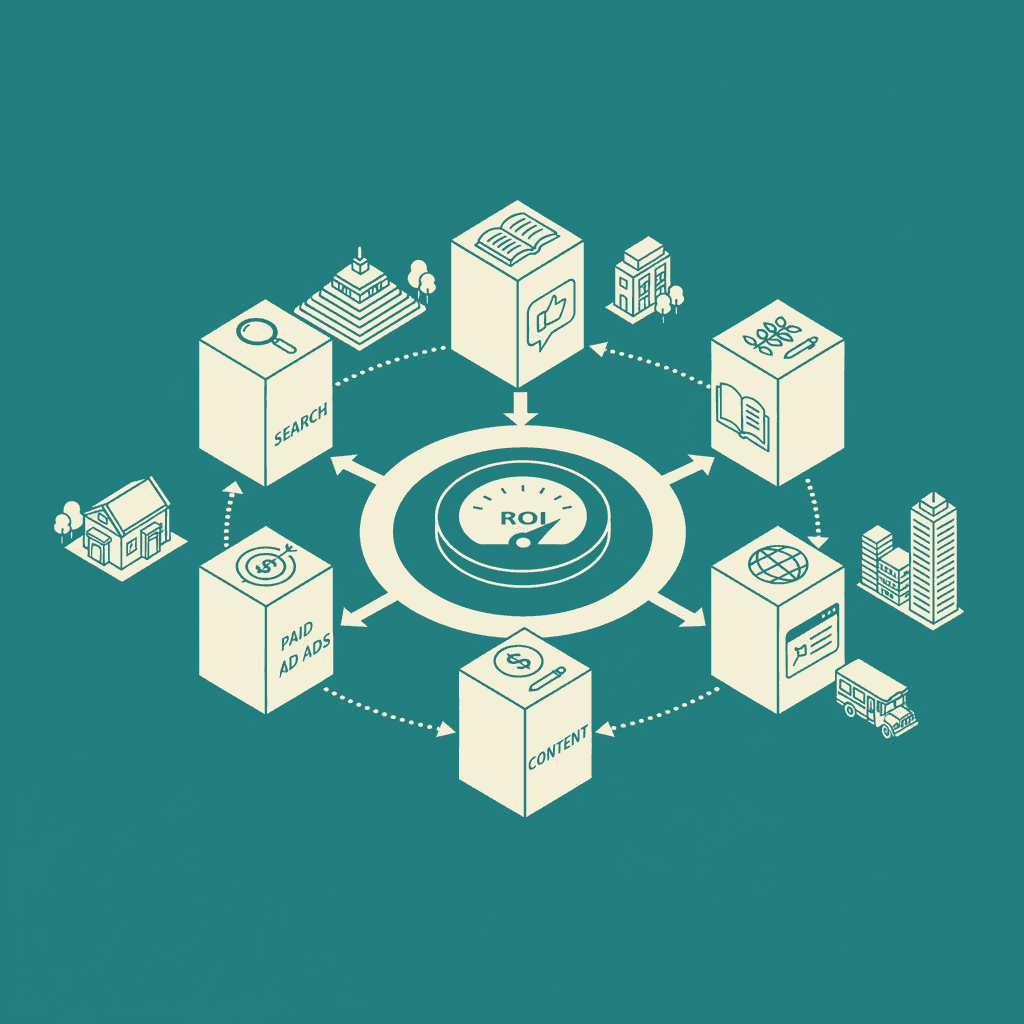
SEO is the practice of earning organic visibility in Google's search results. In the Philippines, Google commands over 97% of the search market, making it the primary battleground for organic traffic.
A well-executed SEO strategy delivers compounding returns. Unlike paid advertising, rankings built through quality content and authoritative backlinks do not disappear when a budget runs out. For businesses targeting informational and commercial keywords in competitive industries — legal, finance, healthcare, real estate, education — SEO is often the highest-ROI channel over a 12-to-24-month horizon.
The benefits of SEO extend beyond traffic volume. Organic search visitors tend to convert at higher rates than social media traffic because they arrive with explicit intent — they searched for something specific and found it.
Pay-Per-Click Advertising (PPC)
PPC — primarily Google Ads and Meta Ads in the Philippine context — delivers immediate visibility. Where SEO takes months to build momentum, paid campaigns can generate traffic on day one.
PPC management is best understood as a tool for specific scenarios: new businesses that cannot wait for organic rankings to build, seasonal promotions with defined windows, product launches, or remarketing to users who have already shown interest.
The limitation is the dependency. PPC traffic stops the moment spending stops. For sustainable growth, businesses that use PPC effectively treat it as a complement to organic efforts rather than a replacement.
Social Media Marketing
Social media occupies a distinctive position in the Philippine digital economy. Facebook remains the dominant platform for reach across demographics, but TikTok has experienced explosive growth since 2023 and now drives meaningful discovery for consumer products, particularly among users under 35.
Social media marketing in the Philippines is less about broadcasting brand messages and more about participating in community. The platforms reward consistency, authenticity, and responsiveness. Pages that post regularly, reply to comments, and engage in their niche consistently outperform those that treat social as a one-way broadcast channel.
Content Marketing
Content marketing underpins every other channel. SEO requires content to rank. Social media requires content to engage. Email marketing requires content to retain. PPC landing pages require content to convert.
In practice, content marketing means producing articles, videos, guides, infographics, and case studies that genuinely address what the target audience is searching for and talking about. The businesses that invest in content consistently gain durable advantages because quality content earns links, builds trust, and continues driving traffic years after publication.
Web Design and Conversion Optimization
No digital marketing effort succeeds if the website it sends traffic to fails to convert visitors. Site speed, mobile experience, clarity of messaging, and ease of navigation all affect conversion rates directly.
Professional web design is not just aesthetic — it is structural. A website that loads in under two seconds, presents a clear value proposition above the fold, and makes the next action obvious will consistently convert better than a beautiful site that is slow or confusing.
The Mobile-First Reality
Any digital marketing strategy for the Philippines must be designed around mobile first. More than nine in ten sessions come from mobile devices. Google ranks mobile versions of pages for its mobile-first index. Social media is consumed almost entirely on smartphones.
Practically, this means:
- Pages must load in under three seconds on a 4G connection
- Typography must be legible at small sizes without pinching or zooming
- CTAs must be large enough to tap comfortably
- Forms must be short and easy to complete on a touch keyboard
Businesses that audit their sites through a mobile lens before investing in driving traffic avoid one of the most common conversion killers in the Philippine market.
Platform Priorities by Business Type
Not every channel deserves equal investment. The right mix depends on the business model, target audience, and competitive landscape.
B2B service businesses (agencies, consultancies, legal, finance) tend to see the strongest returns from SEO and content marketing, supplemented by LinkedIn and email. Decision-makers research extensively before choosing vendors, making organic search the dominant acquisition channel.
E-commerce and consumer products benefit from a combination of social media (particularly TikTok and Facebook for discovery), Google Shopping and Performance Max for intent-based capture, and SEO for category and product pages.
Local service businesses (clinics, restaurants, salons, contractors) should prioritize local SEO, Google Business Profile optimization, and Facebook community presence before investing in broader channels.
SaaS and technology products in the Philippines often find that content marketing combined with Google Search campaigns delivers the most qualified traffic, because the purchase decision is research-intensive and comparison-heavy.
Measuring ROI Across Channels
The single most common failure in digital marketing is measuring the wrong things. Vanity metrics — follower counts, impressions, page views — feel meaningful but rarely correlate with revenue.
The metrics that matter:
- Cost per lead (CPL): total spend divided by qualified leads generated
- Cost per acquisition (CPA): total spend divided by customers acquired
- Return on ad spend (ROAS): revenue generated divided by paid advertising cost
- Organic traffic value: estimated cost of acquiring organic traffic through paid channels (a proxy for SEO ROI)
- Customer lifetime value (CLV): the total revenue a customer generates over the relationship, which determines how much acquisition cost is acceptable
Understanding how much digital marketing costs in the Philippines is a prerequisite for setting realistic ROI targets. A business that budgets ₱30,000 per month for SEO and expects to outrank established competitors in six months will be disappointed. A business that invests that same budget with a 12-to-18-month timeline and tracks CPL and CPA consistently will see real returns.
Integrating Channels for Maximum Impact
The most effective digital marketing programs treat channels as interconnected rather than siloed. A few examples of how integration compounds results:
- SEO content that ranks for high-volume keywords gets amplified through social media, earning additional backlinks and brand exposure
- PPC campaigns that test messaging can inform which value propositions to emphasize in SEO content
- Email nurture sequences that educate leads use the same content produced for the blog, extending its life
- Retargeting campaigns on Facebook and Google reach users who found the business through organic search but didn't convert on the first visit
The businesses gaining the most ground in the Philippine market in 2026 are not those with the largest budgets — they are the ones executing across multiple channels in a coordinated way, with consistent messaging and a clear understanding of which metrics indicate real progress.
Choosing the right digital marketing agency in the Philippines to execute this strategy, or building the internal capability to manage it well, is a separate but equally important decision. Understanding the full range of digital marketing services available helps frame which capabilities are truly needed versus which can be deprioritized early on.
Budget Allocation Frameworks
For a business entering digital marketing for the first time with a modest budget, a reasonable starting allocation looks something like this:
₱50,000–100,000/month:
- 50% SEO and content (long-term compounding channel)
- 30% PPC (immediate traffic while organic builds)
- 20% social media (brand presence and community)
₱100,000–300,000/month:
- 40% SEO and content
- 35% PPC (Google Ads + Meta Ads)
- 15% social media management
- 10% email and conversion optimization
₱300,000+/month:
- Full-funnel integration with dedicated resources per channel
- Systematic testing and optimization across all touchpoints
- Investment in content production at scale
These are starting points, not rigid formulas. The right allocation shifts as data accumulates on which channels deliver the lowest CPL and CPA for a specific business in a specific market.
Frequently Asked Questions
What is the most important digital marketing channel in the Philippines?+
For most businesses, search engine optimization delivers the highest long-term ROI because it targets users with explicit intent and compounds over time. However, the most important channel depends on the business model — e-commerce businesses often prioritize social commerce and paid search, while local service businesses benefit most from local SEO and Google Business Profile.
How long does it take to see results from digital marketing in the Philippines?+
PPC campaigns can generate traffic within 24 to 48 hours of launch. SEO typically requires three to six months before meaningful organic traffic growth becomes visible, and twelve to eighteen months to build competitive rankings in most industries. Social media shows engagement growth within weeks but brand authority builds over months.
Is Facebook still effective for marketing in the Philippines?+
Yes. Facebook remains the dominant social platform in the Philippines by user volume and daily time spent. It is particularly effective for reaching users over 30, running community-driven engagement, and retargeting. TikTok has grown rapidly for consumer discovery, especially among younger demographics.
Do businesses in the Philippines need to invest in mobile SEO specifically?+
Mobile optimization is not a separate consideration — it is the baseline. Google uses mobile-first indexing, meaning the mobile version of a site determines how it ranks. Any site that is not fast, accessible, and well-structured on mobile will underperform in search regardless of other SEO investments.
How do Philippine businesses measure digital marketing success?+
The most reliable measures are cost per lead, cost per acquisition, and return on ad spend for paid channels, and organic traffic volume, keyword rankings, and conversion rate for SEO. Vanity metrics like follower counts and page views are useful for directional signals but should not be the primary basis for budget decisions.