Digital PR vs Guest Posting for Link Building
Digital PR and guest posting both build backlinks, but they work differently. Here's when to use each and how to get the most from both strategies.

Link building has two very different creative modes. Guest posting gives you control — you write the content, target the publication, and the link is agreed upon in advance. Digital PR gives you scale — one well-placed piece of original research can earn dozens of links across publications without any one-to-one outreach negotiation.
Both are legitimate white-hat strategies. The question is which serves your goals, and when the answer is "both," how to allocate resources between them.
What Is Digital PR?
Digital PR is the practice of creating genuinely newsworthy content — original research, data studies, unique datasets, expert commentary, or culturally resonant campaigns — and distributing it to journalists and editors who cover those topics.
When a journalist writes about your research or cites your data, the resulting article typically includes a link to the source. That link is an editorial backlink from a real news publication, with real traffic, and editorial credibility that Google's systems value highly.
Digital PR links tend to cluster at the high end of the quality spectrum. A link from a major business publication, an industry trade journal, or a regional news outlet carries significantly more authority than the typical guest post placement. The tradeoff is unpredictability: you don't control whether coverage materializes, how many placements you get, or what anchor text the journalist uses.
What Is Guest Posting?
Guest posting is writing original content for another website in exchange for a byline and one or more links back to your site. The content is agreed upon with the publication in advance, the link placement and anchor text are typically within your control (within the host's editorial guidelines), and the outcome is relatively predictable.
Done well — targeting relevant publications with real audiences and writing genuinely useful content — guest posting is a legitimate link acquisition strategy. The foundational breakdown of white-hat link building strategies covers guest posting as one of several sustainable methods.
The risk is when volume becomes the objective: publishing hundreds of guest posts across generic "write for us" sites, using paid placement intermediaries, or targeting links over editorial value. Google's classifiers have become increasingly accurate at identifying scaled guest posting programs, and algorithmic devaluation of links from obvious link-for-content arrangements is an ongoing risk.
How Digital PR Differs from Guest Posting
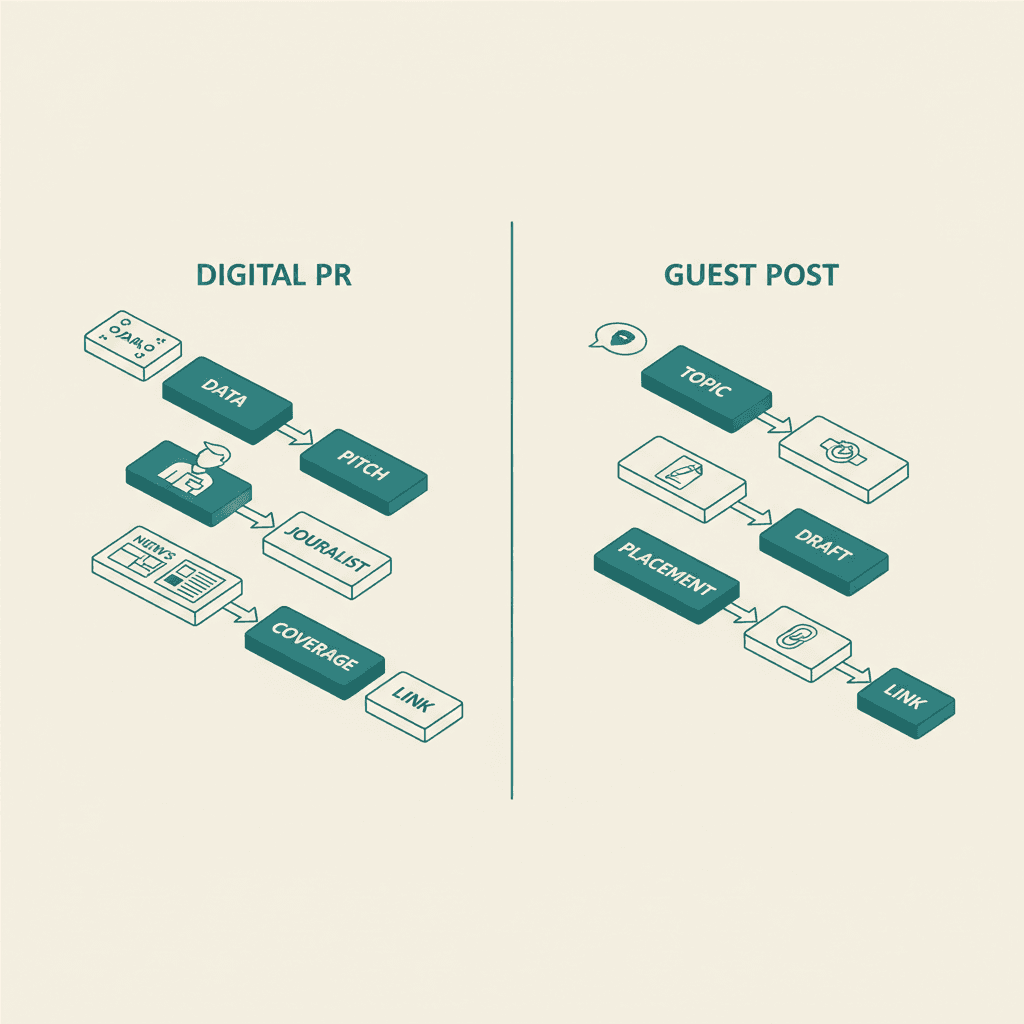
The structural difference is worth understanding clearly before allocating budget or effort.
Content creation. In guest posting, you write an article on a topic suitable for the host publication. In digital PR, you create a content asset — typically research, data analysis, or a unique dataset — that others write about. You're not writing the article that runs; you're creating the source that journalists reference.
Link control. In guest posting, you typically control link placement and anchor text (within editorial guidelines). In digital PR, you have no direct control over how coverage is written or whether a link is included. Most editorial coverage includes source links, but this is at the journalist's discretion.
Scale potential. A well-executed guest post earns one link per placement. A well-executed digital PR campaign can earn 10, 50, or hundreds of links from a single piece of content as coverage spreads across publications. The upside ceiling is dramatically higher.
Predictability. Guest posting is relatively predictable once you have editorial relationships. Digital PR outcomes vary widely — some campaigns earn dozens of placements; others fall flat despite strong execution.
Cost structure. Guest posting costs are primarily creation time and outreach effort, with some publications charging placement fees (a red flag for link quality, but common in the market). Digital PR often involves research costs (survey platforms, data collection, analysis) but doesn't typically involve placement fees — coverage is earned, not purchased.
Authority ceiling. Guest posts on niche sites tend to be in the DR 30–60 range for most practitioners. Digital PR links from major publications can be DR 80–90+ — a category of link that is essentially impossible to replicate through guest posting.
Creating Newsworthy Content for Digital PR
The core constraint of digital PR is that content must genuinely be news. "We wrote a helpful guide" is not news. What qualifies:
Original survey data. Commission a survey of consumers, professionals, or businesses in your target market. 500+ respondents is typically the threshold for journalistic credibility. A survey of Filipino e-commerce shoppers about their platform preferences, purchase triggers, and trust signals is a story. An article summarizing other people's surveys is not.
Industry data analysis. Take publicly available data — from the PSA (Philippine Statistics Authority), BSP, industry associations, or platform APIs — and surface patterns that aren't obvious. If a meaningful trend emerges from analysis that hasn't been reported, that's a newsworthy finding.
Annual benchmarks. "The State of [Topic] in [Year]" reports, updated annually, become citation anchors. Publications cite them every year when writing about the topic, generating recurring link acquisition from a single content investment.
Expert commentary on breaking news. When something happens in your industry — a regulatory change, a technology shift, a major company's announcement — subject-matter experts who can provide rapid, quotable analysis are valuable to journalists under deadline pressure. Speed matters more than depth here.
Unique datasets and tools. Interactive tools, calculators, or regularly updated databases that don't exist elsewhere become permanent reference points. They earn initial coverage when launched, then long-term organic links as the resource continues to be discovered and cited.
Cultural or regional angles. For businesses serving Philippine markets, specifically local data is often more compelling to local publications than repackaged global research. "How Filipino consumers use social media to research products before purchase" is more relevant to Manila Bulletin or BusinessWorld than generic Southeast Asian consumer data.
Journalist Outreach: How It Actually Works
The outreach mechanics differ significantly between digital PR and guest posting.
For digital PR:
- Build a targeted media list of journalists and editors who regularly cover your topic area. Use tools like Muck Rack, Cision, or simple Google searches to identify bylines and contact emails.
- Write a pitch email that leads with the finding, not the process. Journalists don't want methodology — they want the story. "We surveyed 600 Filipino shoppers and found that 71% check negative reviews before purchasing from a new brand" is a pitch. "We conducted a survey about consumer behavior in the Philippines" is not.
- Keep the pitch short — under 200 words in the email body. Attach a press release or data document for those who want depth.
- Personalize for each publication. A business publication pitch should frame the finding as a business story; a consumer news outlet pitch should frame it for everyday relevance.
- Follow up once, 5–7 days later, if there's no response. More than one follow-up is counterproductive for media relationships.
For guest posting:
- Identify target publications by searching your topic + "write for us" or "contributor guidelines."
- Study the publication's existing content — tone, format, typical word count, what topics have been covered recently.
- Pitch a specific article idea (not a request to guest post generally) with a one-paragraph summary of the angle and why it's valuable to their audience.
- If accepted, write to the publication's standards, not your own SEO needs. The editorial quality matters more than anchor text optimization.
The comparison between the two outreach approaches reveals why digital PR has a higher ceiling but lower floor: journalist cold outreach is harder than editorial pitching, but the outcomes when it works are significantly more valuable.
Measuring Coverage and Success
For digital PR campaigns:
- Number of placements (total articles covering the campaign)
- Quality of publications (DR, estimated traffic)
- Number of links generated (some articles cover without linking; still valuable for brand mentions)
- Share of voice in target publications
- Referral traffic from coverage
For guest posting:
- Number of placements per month
- Domain quality of host publications (DR, topical relevance, traffic)
- Anchor text diversity across placements
- Referral traffic from author bio and in-content links
Shared metrics:
Both strategies ultimately contribute to the same outcomes: referring domain growth, domain authority improvement, and (with a 2–4 month lag) ranking improvements for target pages.
The SEO benefits of strong backlink profiles — rankings, traffic, and authority compounding over time — apply equally whether links came from digital PR or guest posting.
When to Use Digital PR vs. Guest Posting
Use digital PR when:
- You have access to original data or research (or budget to commission it)
- You're targeting links from major national or industry publications
- You want scalable link acquisition from a single content investment
- Brand awareness alongside link acquisition is a goal
Use guest posting when:
- You need predictable link acquisition on a consistent monthly cadence
- You're targeting specific topical relevance (writing for niche publications in your exact industry)
- You need to demonstrate topical authority through content distribution
- You're building relationships with specific publications over time
Use both when:
- You have sufficient content production capacity for both types
- You're in a competitive niche where both link quality and link velocity matter
- You want to build a diverse, natural-looking backlink profile that includes both editorial and contributed content links
In practice, sophisticated link building programs run both channels simultaneously. Digital PR produces the high-authority links that move domain-level authority; guest posting fills in topical relevance gaps and maintains consistent monthly velocity.
Philippines-Specific Considerations
For businesses operating in the Philippine market, the digital PR landscape has specific characteristics worth noting.
Local publications (BusinessWorld, Manila Bulletin, Inquirer.net, Rappler, CNN Philippines) are generally accessible to well-pitched story angles with Filipino data and local business angles. Their Domain Ratings — typically DR 60–80 — represent extremely valuable links for local businesses.
Regional trade publications and industry associations (Philippine Retailers Association, ECCP, various chambers of commerce) are underutilized digital PR targets that often cover research and data stories relevant to their members.
The HARO-equivalent ecosystem is less developed in the Philippines than in the US or UK, making direct journalist relationships more valuable than platform-based expert sourcing. LinkedIn outreach to journalists who cover your beat — combined with genuine thought leadership content — builds the relationships that produce ongoing coverage opportunities.
For technical implementation of a link building program that includes both digital PR and guest posting, a professional link building service provides the outreach infrastructure and media relationships that take years to build internally.
Exploring the full taxonomy of link types — and which strategies produce which categories — is covered in the complete guide to what link building is.
A well-rounded SEO strategy positions link building as one component alongside technical foundations, content quality, and on-page optimization — all of which benefit from the authority that digital PR and strategic guest posting build over time. For businesses also managing reputation signals, pairing link building with social media management amplifies the distribution reach of digital PR campaigns.
Frequently Asked Questions
Does digital PR always include a backlink?+
No. Some journalists and publications have policies against external links, or may cover a story without linking to the data source. Coverage without a link still has value — brand awareness, branded search volume, and potential for future link acquisition from secondary coverage — but the direct SEO impact is lower than linked coverage. A well-structured pitch makes it easy for journalists to link by including the exact URL of the research landing page.
How much does a digital PR campaign cost?+
Costs vary widely. Survey data collection through platforms like SurveyMonkey Audience or Pollfish can run $2,000–$8,000 for a credible sample size. In-house data analysis costs primarily time. Distribution (pitching) costs depend on whether it's done in-house or through an agency. Full-service digital PR campaigns from agencies typically run $3,000–$10,000 per campaign; in-house programs cost primarily staff time.
Is guest posting on a niche site better than a high-DA unrelated site?+
In most cases, yes. A DR 40 site that is topically aligned with your content will pass more meaningful authority than a DR 70 site in an unrelated niche. Google's understanding of topical context in link evaluation has improved significantly. Chasing DR at the expense of relevance is a common mistake in guest posting strategy.
How many guest posts per month is too many?+
There's no fixed limit, but patterns matter. Dozens of guest posts per month from similar-quality sites with similar anchor text profiles is a pattern that Google's classifiers have been trained to detect. Fewer, higher-quality placements on diverse publications with varied anchor text is safer and more effective than volume-based approaches.
What makes a good digital PR pitch?+
Three elements: a specific, interesting finding (not a vague description of a study), a clear angle tailored to the target publication's audience, and brevity. Journalists receive hundreds of pitches daily. A pitch that takes more than 30 seconds to read is already fighting against itself. Lead with the story, not the methodology.