What Is Link Building? The Complete 2026 Guide
Link building is the process of earning hyperlinks from other websites to yours. Learn why it matters, how it works, and how to do it right in 2026.

Every major Google ranking factor study published in the last decade reaches the same conclusion: backlinks remain one of the most powerful signals in search. Yet most website owners have only a vague idea of what link building actually involves, let alone how to do it sustainably. This guide covers everything — from first principles to the metrics that tell you whether your efforts are paying off.
What Is Link Building?
Link building is the practice of acquiring hyperlinks from external websites that point to pages on your own site. In SEO terminology, these incoming links are called backlinks or inbound links.
Google's original breakthrough was PageRank — the insight that a link from one page to another functions like a vote of confidence. The more high-quality votes a page accumulates, the more likely it is to rank well. That logic still underpins how search engines evaluate authority in 2026, even though PageRank has been layered with hundreds of additional signals.
Understanding what SEO is helps frame why links matter so much: search engines need a way to evaluate trustworthiness and relevance at scale. Reading every page on the web and judging its quality from content alone is difficult. But looking at which sites other credible sites have linked to? That's a scalable proxy for quality. It's crowd-sourced editorial judgment, and it's been surprisingly durable.
For businesses operating in the Philippines, where organic search competition is intensifying rapidly, link building has shifted from optional to essential. Local businesses, e-commerce stores, and service providers that invest in quality backlinks now are building a moat that becomes harder to cross the longer competitors wait.
Why Links Still Matter in 2026
Google has repeatedly tried to de-emphasize links — or at least make that claim publicly. But correlation studies consistently show that pages ranking in positions 1–3 have significantly more referring domains than those on page 2 and beyond.
What has changed is link quality thresholds. In the early years, volume was enough. Today, a handful of genuinely relevant, high-authority links outperforms hundreds of low-quality links. Google's Spam Brain system (now running as a continuous classifier, not a periodic update) identifies and devalues link schemes in near real-time.
The other shift is topical authority. Links from sites in the same niche carry more weight than generic links, even from high-Domain Rating domains. A link from a major Philippine business news publication means more to a Manila law firm than a link from an unrelated directory site.
Types of Links
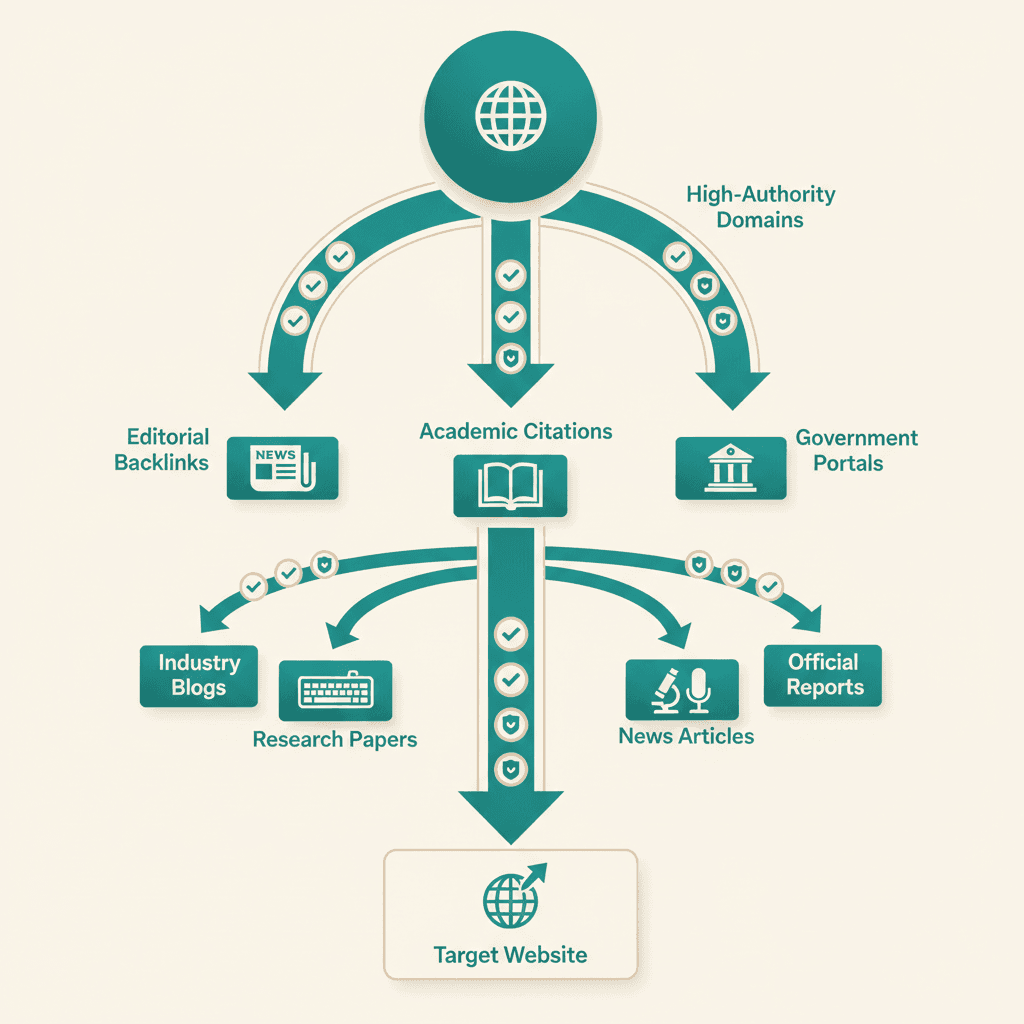
Not all backlinks are created equal. Understanding the taxonomy helps prioritize effort.
Editorial Links
The gold standard. An editorial link is one where an external editor, writer, or publisher chose to link to your content because they found it genuinely useful or authoritative. These are earned, not manufactured. The Ahrefs study page cited in a Forbes article is an editorial link. So is the mention of a local restaurant in a food blogger's roundup — assuming the blogger found it organically.
Editorial links are the hardest to get and the most valuable. They require content worth linking to.
Guest Post Links
Guest posting means writing an article for another site in exchange for a byline and one or more links back to your site. When done well — pitching relevant publications, writing genuinely helpful content — this is a legitimate white-hat strategy covered in detail in the guide to white-hat link building strategies.
When done at scale (buying placements, spinning content, targeting irrelevant sites purely for links), it becomes a link scheme that risks manual penalties.
Resource Page Links
Many websites maintain resource pages — curated lists of useful tools, guides, or organizations in a given topic area. Getting your content listed on a relevant resource page is a reliable way to earn genuinely contextual links. The pitch is straightforward: you find a resource page covering your topic, identify a gap your content fills, and pitch the page owner.
Digital PR Links
Digital PR involves creating genuinely newsworthy content — original research, data studies, surveys, expert commentary — and distributing it to journalists and publishers who cover those topics. When the coverage runs, it typically includes a link back to the source. This approach is explored in depth in the article on digital PR versus guest posting.
Broken Link Building
When external sites link to pages that no longer exist (returning 404 errors), webmasters have a small problem. Broken link building finds these dead links, creates or identifies replacement content on your site, and pitches the webmaster with a solution. It works because you're offering something useful, not just asking for a favor.
Backlink Profiles from Competitors
Analyzing where competitors get their links reveals opportunity sets. If ten competitors all have links from a particular industry publication, that publication is likely linkable for you too. Running a backlink audit surfaces both your own profile weaknesses and competitor acquisition patterns.
Link Quality Signals
Chasing any link is a trap. The signals that determine whether a link helps or hurts include:
Domain Rating (DR) / Domain Authority (DA): Third-party metrics from Ahrefs and Moz respectively that approximate the overall authority of a linking domain. Higher is better, but relevance matters more than raw score at the extremes.
Topical Relevance: A link from a site covering the same or closely related topics passes more contextual authority. A digital marketing agency in Manila benefits more from links on Filipino business publications than on generic article directories.
Traffic: Links from pages that receive real organic traffic are more valuable than links from pages that exist purely for link exchange. Google can infer whether a page has traffic signals; a link from a dead page tells a different story than one from an active editorial piece.
Link Placement: In-content links within body copy carry more weight than footer links or sidebar links. Contextually embedded links signal editorial intent.
Anchor Text: The clickable text of a link is a relevance signal. Exact-match keyword anchors (e.g., "SEO services Philippines") that appear manipulative can trigger over-optimization penalties. Varied, natural anchor text — including branded, generic ("read more"), and partial-match terms — is healthier.
Follow vs. NoFollow vs. Sponsored: Standard followed links pass PageRank. The `nofollow` attribute (common on press release sites, forums, and some news outlets) historically did not. Since 2020, Google treats nofollow, UGC, and sponsored attributes as "hints" rather than directives — meaning some nofollow links may still pass partial value. A diverse link profile includes both.
Link Freshness: New links from active, recently-updated sites carry stronger signals than links on pages last crawled years ago.
White-Hat vs. Black-Hat Link Building
The distinction matters practically, not just ethically.
White-hat methods align with Google's guidelines: earning links through content quality, legitimate outreach, and digital PR. They are slower to build but durable.
Black-hat methods violate Google's guidelines: purchasing links, using private blog networks (PBNs), automated link blasts, link exchanges at scale, and hidden links. They can produce short-term ranking gains but carry severe risks — algorithmic devaluation or manual penalties that are difficult to recover from.
Gray-hat sits in the middle: guest posting at scale, link insertions negotiated through payment, and some niche edits. Google has become increasingly aggressive about these practices since 2024.
For businesses building long-term organic presence — which is the only reasonable objective — white-hat is the only viable track. Understanding the types of SEO clarifies how link building fits within a broader strategy that includes technical, on-page, and content elements.
How to Start a Link Building Campaign
A structured approach beats ad hoc outreach every time.
Step 1: Audit your current backlink profile. Before building new links, understand what you already have. Use Ahrefs, SEMrush, or Google Search Console to see your referring domains, identify toxic links, and spot gaps. This is covered in detail in the backlink audit guide. Engaging an SEO audit service is useful for establishing a baseline if you're starting from scratch.
Step 2: Define what you're building links to. Most link building campaigns focus on a handful of target pages — usually money pages (service or product pages) and linkable assets (detailed guides, research, tools). Not every page on your site is an equally good target.
Step 3: Build linkable assets. Content that earns links is content people want to share: original data, comprehensive guides, unique perspectives, free tools, or visual assets. Thin content rarely earns editorial links regardless of outreach quality.
Step 4: Identify link prospects. Use competitor backlink research, resource page searches, and industry publication lists to build a prospecting list. Quality over quantity — 50 highly relevant prospects outperform 500 generic ones.
Step 5: Conduct outreach. Personalized, specific email outreach has a far higher response rate than templates. Reference the specific article you found on their site, explain the value your content adds, and make the ask clear but not pushy.
Step 6: Track and iterate. Log all outreach. Track which content earns links naturally. Double down on formats and topics that generate the most inbound links.
A professional link building service can accelerate this process, particularly for businesses without in-house content and outreach capacity.
The Difference Between Link Building and Link Earning
The SEO industry often distinguishes "link building" (proactive outreach and acquisition) from "link earning" (creating content so good that links come to you). In practice, both matter and they're not mutually exclusive.
Even the best content benefits from strategic distribution. A definitive industry study sitting on a new domain with no traffic will not earn links on its own — it needs to be surfaced to the writers and editors who would find it valuable. Outreach amplifies the reach of great content; it doesn't substitute for it.
Metrics to Track
Referring Domains: The number of unique external domains linking to your site. Growth here is a leading indicator of authority gains.
Domain Rating / Domain Authority: Monitor your overall domain-level authority score over time. Meaningful movement typically takes months, not weeks.
Organic Traffic to Target Pages: Link building should ultimately translate to traffic gains for the pages being linked to. Track this at the page level.
Keyword Rankings for Target Pages: As authority to a page increases, targeted keyword rankings should improve. Set up rank tracking for your primary target pages.
New Links vs. Lost Links: A net positive (more new links than lost links per month) is the baseline goal. High link attrition can offset acquisition gains.
Anchor Text Distribution: Ensure your anchor text profile stays natural. Spikes in exact-match anchors are a warning sign.
For a comprehensive view, a properly configured SEO reporting setup should include all of these alongside technical and content metrics.
Common Mistakes to Avoid
Pursuing links before your content deserves them is the most fundamental error. No outreach strategy overcomes content that has nothing worth linking to.
Other frequent mistakes:
- Targeting quantity over quality — 10 links from irrelevant low-quality domains add noise, not authority.
- Ignoring anchor text distribution — over-optimized anchor text is a manual penalty trigger.
- Neglecting internal linking — internal links distribute link equity across your site. New backlinks to one page should be complemented by internal links from that page to related content.
- Abandoning outreach after one attempt — most responses come on the second or third follow-up, sent one to two weeks apart.
- Buying links from link farms — these are identifiable by Google's spam classifiers and the risk-reward ratio is terrible.
A well-rounded SEO strategy pairs link building with technical foundations, content quality, and user experience — none of these elements operates in isolation.
Frequently Asked Questions
What is the difference between a backlink and a link?+
A backlink (also called an inbound link or referring link) is a hyperlink on another website that points to your site. A "link" in isolation can refer to any hyperlink — internal or external. In SEO, "backlink" specifically means an external link pointing toward your domain.
How many backlinks does a website need to rank?+
There is no universal number. What matters is the quality and relevance of links relative to the competition for a given keyword. Some low-competition keywords rank with a handful of strong links; highly competitive terms may require dozens of authoritative referring domains. Competitive analysis — looking at what the top-ranking pages actually have — is the only reliable benchmark.
How long does link building take to show results?+
Most practitioners see measurable ranking improvements 2–4 months after a consistent link building effort begins. Google needs time to discover, crawl, and process new links. Authority accumulation is gradual. Domains with very few existing backlinks may see faster initial gains; established domains in competitive niches move more slowly.
Is buying links safe in 2026?+
Paid links that pass PageRank violate Google's guidelines. Google's Spam Brain classifier has become significantly more accurate at detecting paid link patterns. While some practitioners continue to buy links with some success, the risk of algorithmic devaluation or manual penalties makes paid link acquisition a poor long-term strategy for businesses that depend on organic traffic.
What tools are used for link building?+
Ahrefs and SEMrush are the dominant tools for backlink research, competitor analysis, and link prospecting. Google Search Console provides authoritative data on your own inbound links. Hunter.io and similar tools assist with finding contact email addresses for outreach. BuzzStream and Pitchbox help manage large-scale outreach campaigns.