White-Hat Link Building Strategies That Work
White-hat link building earns backlinks through genuine value, not manipulation. Here are the strategies that consistently deliver results in 2026.

Google's spam detection systems have become significantly more sophisticated since the spam-update cycle accelerated in 2024. Tactics that worked five years ago — mass guest posting, PBN links, link insertions paid through intermediaries — now carry serious algorithmic or manual penalty risk. What remains is a smaller, harder set of strategies that work precisely because they're harder: earning links through genuine editorial value.
These white-hat link building methods are not shortcuts. They require content investment, research, relationship-building, and persistence. But the links they produce are durable, topically relevant, and often from domains with real traffic — the characteristics that translate into sustained ranking improvements.
What Makes a Strategy "White-Hat"?
Google's link guidelines draw a clear line: links that are "created primarily for the purpose of artificially inflating a site's PageRank" violate the guidelines, regardless of how they're acquired. The intent test matters.
White-hat link building passes this test by ensuring that the primary purpose of any link-generating activity is genuine editorial value — a journalist linking to a data source, a resource page linking to a useful tool, a blogger citing an article that genuinely helped their readers. The link is a byproduct of value creation, not the primary objective.
This matters practically because Google's Spam Brain classifier is trained on patterns of manipulation, not just specific tactics. Scaled guest posting that generates hundreds of similar-format links from similar-quality sites raises flags even if each individual post is technically "real" content. The pattern is detectable.
Before running any link campaign, understanding what link building actually is and where it fits in a broader SEO strategy saves significant wasted effort.
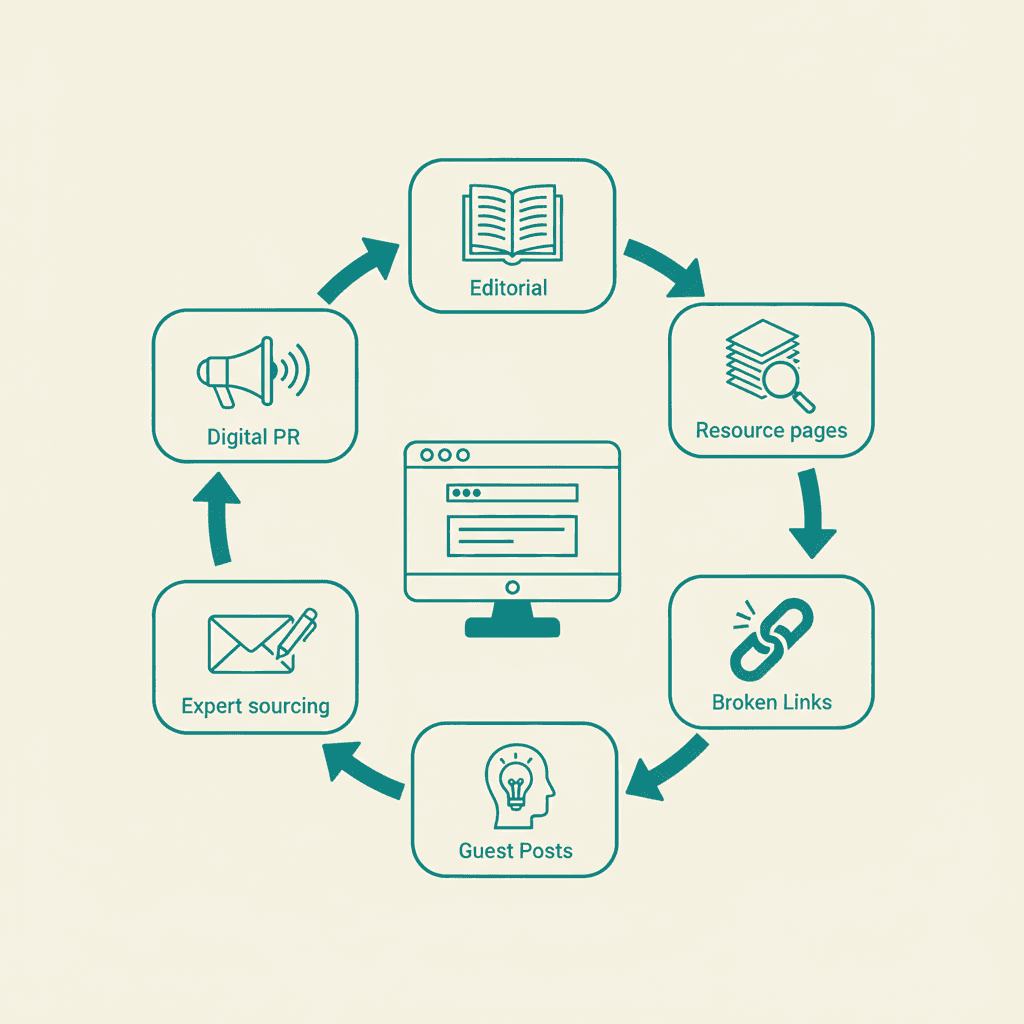
1. Editorial Outreach
Editorial outreach means identifying content you've already published that would be genuinely useful as a reference or citation for existing articles on other sites, then reaching out to the authors or editors to suggest the addition.
The workflow:
- Find articles that are already ranking for topics you cover — competitors or related-niche content that's missing a specific reference.
- Identify gaps: are they missing a data point, a definition, a case study, or a resource you've created?
- Reach out to the author or site editor with a specific, low-friction pitch: "I noticed your article on X doesn't include a reference to Y — we published a detailed breakdown here that your readers might find useful."
Response rates on cold editorial outreach average 5–15%. The critical variable is personalization. Generic "I'd like to suggest a link" emails go directly to trash. Specific references to the target article's content, paired with a clear explanation of the value add, perform significantly better.
For Philippine businesses, targeting regional publications — business news outlets, industry associations, trade publications — often yields better results than chasing international high-DA domains that have no topical connection to the local market.
2. Digital PR
Digital PR involves creating content that is inherently newsworthy — original research, industry surveys, data analyses, expert commentary, or unique data visualizations — and distributing it to journalists, bloggers, and publications who cover those topics.
The distinction from standard guest posting is that digital PR generates coverage, not just placements. When a journalist writes about your study and links to the source, that's an editorial link from a real news publication. These links are among the most valuable in existence.
What works in digital PR:
Original research and surveys. Commissioning a survey of 500 Filipino consumers about online shopping behavior, then publishing the results, gives journalists a data source they can cite. The more specific and locally relevant the data, the more attractive it is to regional publications.
Industry data analysis. Pulling publicly available data (from government sources, industry bodies, or aggregated platforms) and analyzing it for meaningful patterns creates citable content without original data collection costs.
Expert commentary and thought leadership. When news breaks in your industry, positioning subject-matter experts for journalist interviews (via HARO-equivalent platforms, direct journalist relationships, or proactive media pitching) generates coverage and often a link to the source.
Unique datasets and tools. Free calculators, interactive maps, or regularly updated datasets become permanent link magnets. A "Cost of SEO in Southeast Asia" calculator, updated annually, would generate recurring citations from marketing publications.
The difference between digital PR and guest posting — and when to use each — is explored further in the article on digital PR versus guest posting for link building.
3. Resource Page Link Building
Across almost every industry, websites maintain curated resource pages: lists of useful tools, guides, organizations, or publications that their audience would benefit from. These pages exist specifically to link to valuable external resources — which makes them highly receptive to well-matched link pitches.
The process:
- Find resource pages by searching Google for queries like `"[topic] resources"`, `"best [topic] guides"`, `"[topic] tools" site:edu`, or `"useful links" [topic]`.
- Evaluate each page for relevance (does your content fit?) and domain quality.
- Identify which of your pages would genuinely belong on the list — a comprehensive guide, a free tool, a detailed case study.
- Email the resource page owner with a brief, specific pitch explaining why your resource is a good addition.
Resource page owners have a built-in motivation to keep their pages useful. If your content legitimately fits, the ask is natural. This tactic consistently delivers a higher positive response rate than cold editorial outreach.
4. Broken Link Building
When websites link to pages that no longer exist (returning 404 errors), webmasters have a small but real problem: their visitors are clicking through to dead content. Broken link building finds these dead links, creates relevant replacement content, and offers the webmaster a solution.
The pitch is inherently helpful rather than self-serving — you're alerting the webmaster to a broken link on their site and offering a fix. This framing generates better response rates than standard link pitches.
Tools like Ahrefs' Site Explorer, Check My Links (browser extension), and SEMrush's Backlink Analytics can identify broken links on target sites in your niche. Once you've found a broken link pointing to content similar to yours (or content you can create), the outreach is:
- Notify the webmaster of the broken link.
- Briefly describe your replacement resource.
- Offer the URL as a potential replacement.
The more relevant your replacement content, the higher the uptake. This is not a cold pitch for a link — it's a service offer that happens to benefit you.
5. Guest Posting (Strategic, Not Scaled)
Guest posting is legitimate when done with genuine editorial intent: writing high-quality, original content for relevant publications in exchange for authorship credit and a contextual link.
What separates legitimate guest posting from the link scheme version:
- Target quality publications in your industry, not "write for us" directories or obviously link-selling sites.
- Write for the audience, not for the link. Articles that provide genuine value to readers earn better placement, better editorial relationships, and better link equity.
- Keep volume reasonable. A few high-quality guest posts per month on relevant publications is sustainable. Hundreds of posts per month on generic sites is a pattern Google's classifiers recognize.
- Avoid over-optimized anchor text. When the host publication allows link control, use varied anchor text — branded, generic, partial-match — rather than exact-match keyword anchors.
In the Philippines, many industry associations, chambers of commerce, and sector-specific publications accept guest contributions. These local, topically relevant placements often outperform generic international guest posts on domain metrics alone.
6. HARO and Expert Sourcing Platforms
Help a Reporter Out (HARO) and its equivalents connect journalists seeking expert quotes with subject-matter experts willing to provide them. Responding to journalist queries with substantive, quotable expert commentary often results in coverage that includes a link to the expert's site.
The key is selectivity and quality of response:
- Respond only to queries where you have genuine expertise. Journalists are skilled at identifying shallow responses.
- Lead with the usable quote. Journalists are on deadline. Put the quotable content in the first paragraph, then provide supporting context.
- Keep responses concise. Long responses get skimmed; the usable quote gets extracted, often without the context that would prompt a link. Shorter, punchier responses perform better.
Coverage rates vary by platform and query type, but practitioners consistently report that this is among the highest-quality link acquisition methods available — the links come from real journalists at real publications, with real editorial standards.
7. Content-Driven Link Acquisition
Some content formats earn links reliably over time without ongoing outreach effort. Building these assets creates compounding returns.
Comprehensive guides. Long-form, expert-level content on topics where existing coverage is thin or outdated becomes the default reference in its niche. When other writers cover the topic, they cite the best existing source. Being the best existing source is a durable acquisition strategy.
Original data and research. Any content containing statistics that don't exist elsewhere on the web becomes a citation magnet. Writers need data sources; if you're the original source of a statistic, you get cited every time someone uses it.
Free tools and calculators. Tools that solve a real problem become permanent link targets. An SEO keyword difficulty estimator, a content readability checker, or a local business NAP consistency checker will earn links from every list-of-useful-tools article in its category.
Visual assets. Infographics, charts, and data visualizations that explain complex information clearly earn links when others embed them. Including a "use this image with attribution" note increases uptake.
The SEO benefits from strong link profiles are substantial — building them through content is documented in detail in the guide on SEO benefits for businesses.
What to Avoid
Several tactics are commonly presented as "gray-hat" but carry real penalty risk in 2026:
Private Blog Networks (PBNs). Networks of sites owned specifically to provide links to client sites. Google's detection of PBNs through footprint analysis (shared hosting, similar registration patterns, thin content) has become highly accurate. Sites penalized by PBN association lose rankings that are difficult to recover.
Paid link placements. Purchasing links from link brokers, "sponsored content" arrangements where the primary purpose is link equity rather than audience reach, and link insertion services all violate Google's guidelines. The risk has increased significantly as Spam Brain's detection accuracy has improved.
Link exchanges at scale. Reciprocal link arrangements between a handful of related sites are a normal part of the internet. Coordinated link exchanges involving dozens of sites are a link scheme pattern that's detectable algorithmically.
Thin guest post networks. Sites that exist primarily to sell guest post placements — with thin content, no real audience, and little organic traffic — are identifiable. Links from these sites provide minimal value even when they don't trigger penalties.
A technical SEO audit can identify whether your current backlink profile has exposure to any of these risk categories before they become a problem. Running a professional backlink audit periodically is standard practice for established domains.
Measuring Success
White-hat link building has a longer feedback loop than paid tactics. Useful metrics at each stage:
Outreach stage: Response rate, positive response rate, link placement rate. These tell you whether your targeting and messaging are working.
Link acquisition stage: New referring domains per month, quality of acquired links (traffic, relevance, DR). Aim for consistent growth, not spikes.
Impact stage: Organic traffic to target pages (tracked via Google Search Console), keyword rank changes for target keywords (tracked via rank tracking tools). Allow 2–4 months for new links to manifest in rankings.
A structured link building service typically tracks all three stages and adjusts strategy based on what's working within a specific site and niche context.
The most important measure is whether rankings and organic traffic are trending upward over a 3–6 month period. Everything else is a leading indicator pointing toward or away from that outcome. A comprehensive SEO strategy pairs link building with technical foundations, content quality, and user experience — no element operates effectively in isolation.
Frequently Asked Questions
How long does white-hat link building take to produce results?+
Most practitioners report visible ranking changes 2–4 months after beginning a consistent white-hat link building program. Authority accumulation is gradual, and Google processes new links on a crawl-based timeline. Patience is a prerequisite for white-hat link building — it's a long-term investment, not a short-term tactic.
Is guest posting still white-hat in 2026?+
Strategic guest posting — writing high-quality, original content for legitimate publications with real audiences — remains white-hat. Scaled, paid, or low-quality guest posting that targets links over editorial value has become a flagged pattern. The key distinction is whether the primary value of the content is for the publication's readers or for the link.
How many links should a site build per month?+
There is no universal answer. The appropriate velocity depends on the site's age, existing authority, and competitive landscape. A new site building 50 links per month from low-quality sources looks more suspicious than an established site building 5 links per month from relevant, high-authority sources. Focus on quality and relevance over volume.
What's the difference between white-hat and gray-hat link building?+
White-hat methods align fully with Google's guidelines: earning links through editorial merit. Gray-hat methods exploit loopholes or involve some payment or exchange without being as blatant as PBNs or link farms. The distinction matters less than the risk profile: gray-hat tactics carry meaningful penalty risk that white-hat methods do not.
Can white-hat link building compete with black-hat in the short term?+
In short competitive sprints, aggressive black-hat tactics can temporarily outperform white-hat methods. But Google's updates increasingly close these windows. Domains that have built authority through white-hat methods are more stable through algorithm updates, while black-hat gains tend to evaporate. For businesses that depend on organic traffic as a core channel, white-hat is the only strategy with an acceptable risk profile.