Does Google Use AI in Search? The Full Picture in 2026
Google has used AI in search for years, but 2025 changed everything. Here's how Gemini, AI Overviews, and Google's core AI systems actually work — and what they mean for SEO.

Yes, Google uses AI extensively in search — and it has been doing so for nearly a decade. But the nature and scale of that integration changed dramatically between 2024 and 2026, to the point where "Google uses AI" has a fundamentally different meaning today than it did when most articles on this topic were written.
The RankBrain era, the BERT era, and the MUM era are history. We are now in the Gemini era, and that shift has practical implications for every website competing for visibility in Google search results.
This guide explains what Google's AI systems actually do, how each one affects rankings and content, and what the AI Overviews rollout has changed for SEO practitioners and Philippine businesses specifically. By the end, you will have a clear picture of why optimizing for Google today requires understanding AI — not just traditional ranking factors.
For context on how to put this knowledge into action, the guide on AI SEO services and strategy connects these technical realities to practical campaign decisions.
Google's AI Infrastructure: A Brief History
Google did not become an AI-first search engine overnight. The evolution happened in distinct phases, each adding an AI layer to search infrastructure that was already running underneath.
RankBrain (2015). Google's first major machine learning system in search. RankBrain helps Google interpret queries it has never seen before — and there are a lot of them. Google processes approximately 15 percent of search queries daily that it has never encountered in that exact form. RankBrain maps unfamiliar queries to the closest related searches it understands, improving relevance for ambiguous or novel queries.
BERT (2019). Bidirectional Encoder Representations from Transformers — a natural language processing model that transformed how Google understands words in context. Before BERT, Google processed words in sequence. BERT processes words in relation to all other words in a query simultaneously, capturing meaning that depends on context. The query "can you get medicine for someone at the pharmacy" is processed very differently after BERT — it understands "for someone" matters to the intent.
MUM (2021). Multitask Unified Model — 1,000 times more powerful than BERT according to Google at launch. MUM can understand and generate language across 75 languages simultaneously, process text and images together, and understand complex queries that require synthesizing information across multiple sources. It underpins Google Lens, some image search features, and the ability to handle complex multi-part queries.
These three systems are still operating in Google's infrastructure. They are not replaced by Gemini — they are baseline layers that newer AI integration builds on.
Gemini in Search: What Actually Changed in 2025
The transition from Google's internal research models to Gemini in search products began in late 2024 and accelerated through 2025. This is the shift that changed the SEO landscape in ways practitioners are still adapting to.
Gemini's role in query understanding. Gemini's language models are significantly more capable than BERT at understanding complex, conversational, and multi-step queries. When you ask Google a nuanced question — "what's the difference between GEO and SEO for a small business in the Philippines" — Gemini-era query understanding captures the intent with a level of nuance that earlier systems did not.
Gemini powering AI Overviews. The most visible change driven by Gemini is AI Overviews — the AI-generated summaries appearing above organic results. These are powered by Gemini models synthesizing information from multiple high-quality sources. The model decides which sources to reference, how to structure the summary, and what level of detail to include.
Circle to Search and multimodal queries. Google's Circle to Search feature, which lets users search directly from images and videos by circling elements, is powered by Gemini's multimodal capabilities. For e-commerce and visual industries, this is creating new search entry points that do not fit the traditional keyword query model.
Gemini in Knowledge Graph updates. Google's Knowledge Graph — the database of entities and relationships that powers rich results and local business cards — is being updated and expanded using Gemini. This affects entity-based SEO, where being correctly recognized and categorized as an entity in the Knowledge Graph influences how your brand appears in AI-generated results.
AI Overviews: Google's Biggest Search Change Since PageRank
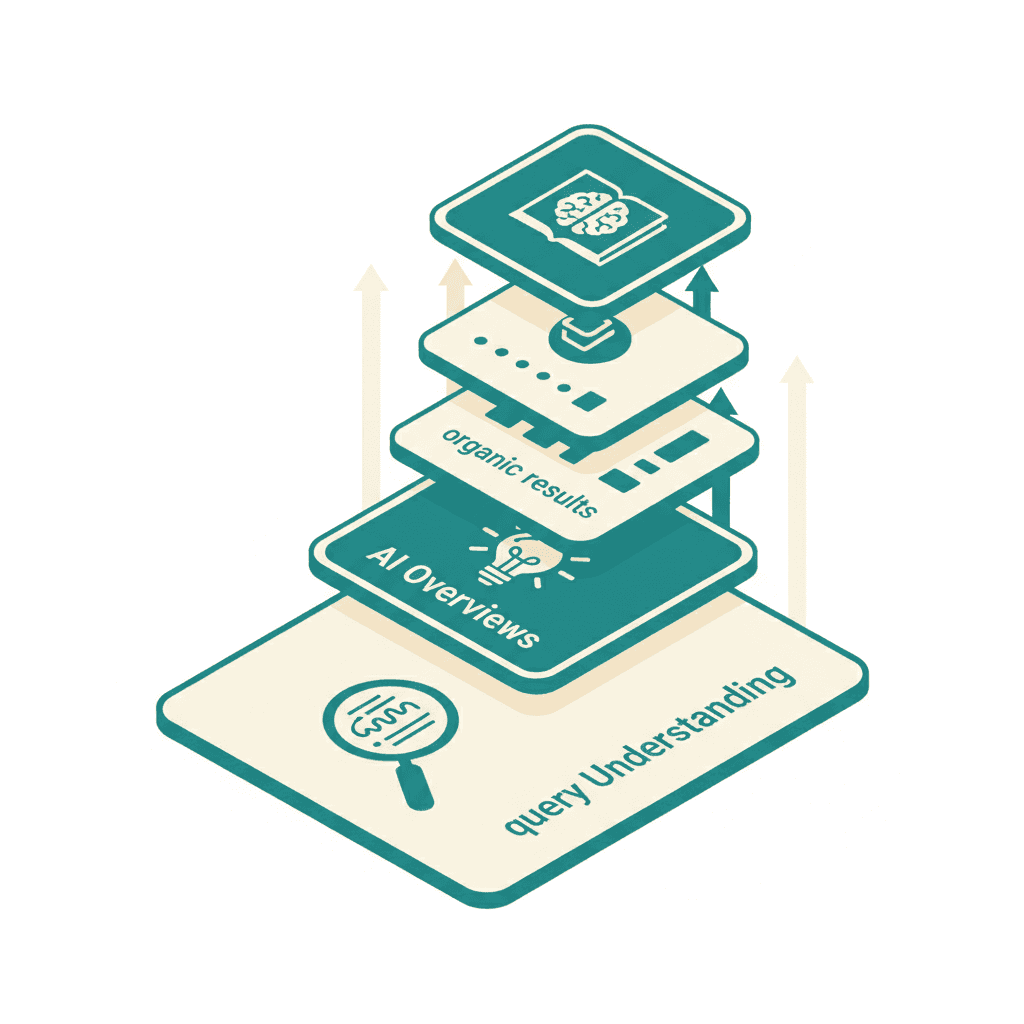
Of all Google's AI integrations, AI Overviews represent the most significant shift in the actual user experience of search — and therefore the most significant shift in what SEO is optimizing for.
AI Overviews are AI-generated summaries that appear above organic results for many informational and research queries. They pull content from multiple sources, attribute those sources with links, and provide a direct answer without requiring the user to click through to any specific website.
Where they appear. AI Overviews appear most frequently on:
- "What is" and "How does" questions
- Comparison queries
- Research queries with multiple dimensions ("what are the pros and cons of...")
- Step-by-step how-to queries
The traffic impact. Independent research tracking clickthrough rates before and after AI Overview appearances documented average CTR decreases of 15 to 30 percent on affected queries. Some studies tracking specific high-traffic informational terms found larger impacts. This is not uniform — transactional queries and local service queries are less affected because AI Overviews appear less frequently on those terms.
The citation opportunity. Being cited inside an AI Overview has measurable value. The links within AI Overviews drive direct traffic, but the greater value is brand-level: appearing as a source Google's AI recommends builds trust with searchers who see your brand associated with authoritative answers. For B2B companies and professional services, this visibility matters even when clicks do not happen.
What makes a page citation-worthy. Based on analysis of which pages appear inside AI Overviews, the pattern is consistent: pages with strong E-E-A-T signals, specific verifiable facts, clear structured answers to questions, proper semantic markup, and genuine topical depth earn citations. Thin content targeting a keyword without demonstrating real expertise does not.
Google's March 2025 Core Update and AI Content
The March 2025 core update was Google's most significant algorithmic update specifically targeting AI-generated content quality since the 2022-2023 "helpful content" updates.
The update penalized patterns associated with low-quality AI content at scale:
- Sites that published hundreds of AI-generated articles in a short timeframe with minimal human editing
- Content that covered topics accurately but without any evidence of first-hand experience or expertise
- Pages that answered questions but did not demonstrate the author had any actual knowledge of the subject
The update did not penalize AI-assisted content across the board. Pages where AI helped structure, draft, or edit content that was also informed by genuine expertise — real experience, original research, subject matter knowledge — were largely unaffected or improved in rankings.
The practical implication for SEO practitioners: the question is not "was this content written by AI" but "does this content demonstrate genuine expertise." AI is a tool in the production process; E-E-A-T signals are what Google's systems evaluate.
This is directly relevant to understanding how to use AI for SEO effectively — the integration has to be expertise-first, not efficiency-first.
How Each AI Layer Affects Your SEO Strategy
Understanding the theory is only useful if it changes how you work. Here is what each layer of Google's AI infrastructure means practically.
RankBrain implications. Because RankBrain handles novel queries by mapping them to similar known queries, optimizing for exact-match keyword phrases is less important than covering topics comprehensively. Content that addresses a topic from multiple angles — using natural language, synonyms, and related concepts — performs better than content that repeats target keywords mechanically.
BERT and semantic search. BERT's ability to understand context means keyword stuffing is not just useless — it actively signals low quality. Write for what your reader needs to understand, use natural language, and trust that Google's systems will understand what your content is about without needing every exact keyword phrase to appear.
Gemini and AI Overviews. The highest-leverage optimization for Gemini-era search is E-E-A-T. Demonstrating experience, expertise, authoritativeness, and trustworthiness in your content and through your site's authority signals is the strategy most aligned with how Gemini's models evaluate quality. This means original research, clear author expertise, citations, and building genuine topic authority over time.
A comprehensive SEO audit identifies which of your existing pages are underperforming against these signals and what specific changes would bring them into alignment with current evaluation criteria.
What This Means for SEO in the Philippines
Philippine businesses face a distinctive version of the AI search transition. Here is the honest assessment.
AI Overviews rollout status. As of early 2026, AI Overviews have a limited presence in Philippine Google search results compared to the US and UK. Filipino searchers using google.com.ph see traditional results with occasional AI features. The full AI Overview rollout in the Philippines is expected to continue through 2026, following the pattern of other non-US English markets.
This creates a window. Philippine businesses that build genuine topical authority and strong E-E-A-T signals now will be well-positioned when AI Overviews become more prevalent locally. The SEO investments made before AI Overviews dominate a market tend to compound better than reactive investments made after.
Local search and AI. Google's AI integration in local search — the map pack, local business results, local knowledge panels — is advancing separately from AI Overviews. Gemini's entity understanding is improving how Google recognizes and categorizes local businesses. Ensuring your Google Business Profile is complete, your website content clearly articulates your location and services, and your business information is consistent across the web has become more important as AI-powered local results evolve.
Content in Filipino. AI Overviews for Filipino-language searches are less developed than for English. This means Filipino-language informational content faces less AI Overview competition for click-through. For businesses targeting Filipino-speaking audiences, high-quality Filipino-language content currently has a meaningful ranking advantage in markets where AI Overviews have not yet displaced organic results.
The full implications of optimizing for these AI-driven changes are what Generative Engine Optimization addresses as a discipline — moving beyond traditional ranking signals to the new visibility surfaces created by AI-powered search.
How to Optimize for Google's AI-Powered Results
Given everything above, here is a practical optimization framework for 2026:
Demonstrate genuine expertise first. Every piece of content should answer: who has the experience to write this, and how does the content show that? Author bios, case studies, original data, and specific examples from real practice all signal expertise.
Structure content for AI extraction. Use clear H2 and H3 headings. Put the answer to your page's primary question in the first 100-200 words of each section. Use FAQ schema for question-and-answer content. These structures help AI systems understand what your content covers and how to reference it accurately.
Build topical authority, not keyword silos. Google's AI systems evaluate whether a site genuinely understands a subject by looking at the breadth and depth of its coverage. A site with 20 well-researched articles on AI SEO will outrank a site with one article targeting the same keywords.
Earn genuine authority signals. Links from publications that Google considers authoritative in your niche still matter. So do mentions and citations from sources that Gemini associates with expertise. Building these signals through original research, data, and genuine expertise is the only durable strategy.
Monitor AI Overview appearances for your keywords. Track which of your target keywords are triggering AI Overviews. For those queries, evaluate whether your content could become a cited source, and optimize structure and expertise signals accordingly.
Understanding how Google uses AI is essential for anyone investing in search engine optimization today.
Frequently Asked Questions
What AI does Google use in its search engine?+
Google uses multiple AI systems at different layers: RankBrain for interpreting novel queries, BERT for understanding language context, MUM for complex multilingual and multimodal queries, and Gemini for powering AI Overviews and newer search features. These systems work together rather than replacing each other.
How do Google AI Overviews affect my website's traffic?+
For queries where AI Overviews appear — primarily informational and research queries — clickthrough rates on organic results below the Overview decrease. Studies have documented average CTR drops of 15 to 30 percent on affected queries. However, being cited as a source within the AI Overview provides brand visibility and some direct traffic.
Is Google's AI search available in the Philippines?+
AI Overviews have a limited rollout in the Philippines as of early 2026, appearing on fewer queries than in US or UK Google search. The rollout is expected to continue expanding through 2026. Other AI features including Gemini-powered query understanding are active globally.
How do I optimize my content for Google AI Overviews?+
Focus on E-E-A-T signals: demonstrate genuine expertise, cite sources, include specific verifiable facts, and structure content so questions are answered directly and clearly. Use FAQ schema and proper heading hierarchy. Build topical authority by covering your subject area comprehensively rather than targeting individual keywords in isolation.
Did Google's AI updates hurt SEO rankings?+
Google's March 2025 core update hurt rankings for sites publishing low-quality AI-generated content at scale without genuine expertise. Sites with strong E-E-A-T signals and genuine topical authority were largely unaffected or improved. The updates reward authentic expertise — AI is a tool in the production process, not a replacement for it.