How to Rank in Google Maps: PH Business Guide
A practical guide to ranking in Google Maps local pack for Philippine businesses — covering proximity, relevance, prominence, citations, reviews, and on-page local signals.

When someone in Makati searches for "digital marketing agency" on Google, three business listings appear in the local pack before the organic results. These three positions — and the Google Maps results that correspond to them — capture a disproportionate share of clicks for local queries. For Philippine businesses competing in any city or category, understanding how to achieve and maintain local pack presence is a foundational SEO priority.
This guide explains the ranking factors Google uses for local search, what actionable steps move the needle, and how to track local map ranking progress across Philippine cities and regions.
The Three Core Local Ranking Factors
Google's documentation on local search ranking explicitly identifies three factors: relevance, distance, and prominence. Every local pack optimization strategy is ultimately a plan to improve one or more of these three signals.
Relevance
Relevance measures how well a business listing matches the intent of a search query. A search for "coffee shop Bonifacio Global City" should return coffee shops in BGC, not general restaurants or businesses in other categories.
Relevance is influenced by:
- Business category selection in GBP: The primary and secondary categories chosen in Google Business Profile are the most direct relevance signal
- Keywords in the business name: Google uses the business name itself as a relevance signal. A business named "Manila Digital Marketing Agency" has an inherent relevance advantage for digital marketing queries in Manila over a business named by a personal brand
- Keywords in the business description: The GBP business description, posts, and product/service listings all contribute to the keyword profile that Google uses for relevance matching
- Website content: Google crosses references GBP data against the linked website. A GBP profile for a dental clinic that links to a website covering dental services comprehensively has stronger relevance than one linking to a generic business homepage
Distance (Proximity)
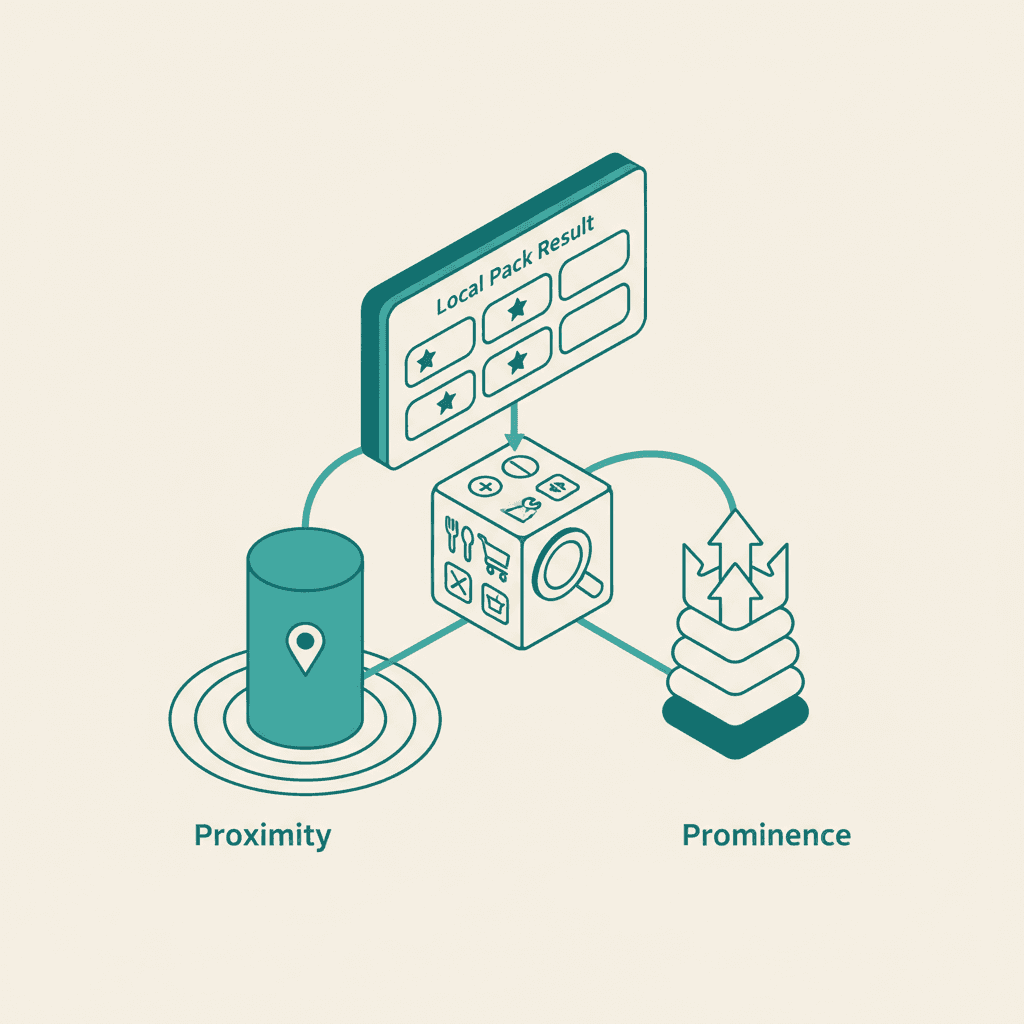
Distance measures how far the business location is from the searcher or from the location specified in the query. A "restaurant near me" query returns businesses closest to the searcher's current location. A "restaurant Alabang" query returns businesses in or near Alabang.
Distance is the factor businesses have the least direct control over — a business in Quezon City cannot appear in the local pack for "near me" searches by someone standing in Parañaque. However, businesses can influence the geographic area they appear relevant for through service area settings and the creation of location-specific content.
Prominence
Prominence measures how well-known and authoritative a business is — both online and offline. Google incorporates data from multiple sources: backlink profiles, mentions in online publications, citation presence, review volume and ratings, and overall GBP activity.
Prominence is the factor most directly influenced by active SEO effort. A new business with a well-configured GBP but no reviews, citations, or website authority will rank below a competitor with years of accumulated signals, regardless of proximity and category match.
Google Business Profile Optimization for Maps Rankings
The foundation of local map ranking is a complete, accurate, and active Google Business Profile. See the Google Business Profile optimization guide for full detail on GBP setup and management. For businesses that compete across multiple cities in the Philippines, the multi-location local SEO guide covers how to systematize GBP management and location page creation at scale. The key elements for map ranking specifically are:
Complete all GBP fields: Businesses with complete profiles rank better than incomplete ones. Hours, website, phone number, address, description, categories, and products should all be filled in.
Use the most specific accurate primary category: This is the single highest-impact configuration choice in GBP. Spend time finding the most precise category that matches the business.
Post regularly: Active GBP profiles with regular posts signal to Google that the business is active and engaged, which positively influences ranking.
Upload quality photos consistently: Profiles with more photos receive more engagement, and engagement metrics (clicks, direction requests, calls) feed back into ranking signals.
Maintain accurate hours: Business hours listed in GBP should match actual hours. Inaccurate hours erode trust and can result in a downranking or profile suspension for businesses that receive complaints.
Review Signals
Reviews are one of the most significant and controllable prominence signals for local map ranking. Three dimensions of reviews matter:
Volume: More reviews, held constant for quality, increase prominence. A business with 200 reviews outranks a business with 20 reviews in comparable categories.
Rating: Average star rating affects both ranking and conversion. Google's local algorithm tends to favor businesses with ratings of 4.2 and above. Below 4.0, ranking suppression has been observed across several categories.
Recency: Recent reviews carry more weight than old ones. A business that earned 50 reviews two years ago and has had no new reviews since is at a disadvantage against a competitor with 20 reviews from the past six months.
Keyword content in reviews: Reviews that mention specific services, locations, or products contribute to the business's relevance profile. A dentist whose reviews frequently mention "teeth whitening" is more likely to rank for "teeth whitening dentist near me" queries.
For online reputation management, the review acquisition strategy and response approach are as important for map rankings as for customer trust.
Citation Building
Citations are mentions of a business's name, address, and phone number (NAP) on external websites — directories, local listings, industry databases. Citations are a traditional prominence signal in local SEO.
NAP consistency is critical. If the business is listed as "Acme Digital" in GBP but "Acme Digital Marketing Inc." in directory listings, or if the phone number format varies across citations, Google treats these as potentially different businesses. NAP inconsistency dilutes citation authority.
Priority citation sources for Philippine businesses:
- Google Business Profile (primary citation)
- Yellow Pages Philippines (yp.com.ph)
- BusinessList Philippines
- Foursquare / Mapstr (feed Apple Maps and other platforms)
- Bing Places (relevant for Bing and Copilot users)
- TripAdvisor (for hospitality and tourism businesses)
- Grab (for restaurants and food businesses)
- OpenStreetMap (feeds many navigation apps)
- Industry-specific directories: Legal directories, medical directories, real estate platforms
The combination of general and industry-specific citations creates the broadest local citation footprint. Local SEO services typically include citation audit and citation building as core deliverables.
On-Page Local SEO Signals
The website linked from a GBP profile contributes to local ranking through on-page signals:
NAP on the website: Name, address, and phone number should appear on the website (typically in the footer and on the contact page) and match GBP exactly. This consistency confirms the relationship between the website and the GBP profile.
Location keywords in title tags and H1s: Service pages and location pages should include city and neighborhood names where relevant. "Digital Marketing Services in Makati" as a page title provides a relevance signal for Makati-specific queries.
LocalBusiness schema markup: JSON-LD LocalBusiness schema on the homepage and location pages gives Google machine-readable confirmation of the business's name, address, phone, hours, and geographic coordinates. This schema directly supports local pack eligibility.
Location-specific pages: Businesses serving multiple areas — a courier company serving Metro Manila cities, a clinic network with branches — benefit from creating individual pages for each service area or location. Each page targets the specific city or neighborhood with localized content, title tags, and map embeds.
Embedded Google Map: Embedding the Google Map for the business location on the contact page is a traditional local SEO signal that helps confirm the geographic relationship between the website and the GBP listing.
Review Monitoring and Response
Review monitoring is as important as review acquisition for long-term map ranking. A business that acquires reviews but does not respond to negative ones sends a negative quality signal.
For Philippine businesses, a responsive review management practice includes:
- Setting up GBP notifications for new reviews
- Responding to all reviews within 24–48 hours
- For negative reviews: acknowledging the issue, apologizing where appropriate, and describing corrective action — moving detailed resolution to private channels (call, email, message)
- Never posting promotional content in review responses
Local Link Building
Links from locally relevant websites — city newspapers, local business associations, community organizations, regional industry groups — carry disproportionate local relevance weight compared to generic links.
High-value local link sources for Philippine businesses:
- Local news sites: Philippine Daily Inquirer regional editions, Manila Bulletin city coverage, regional publications
- Local Chambers of Commerce: Metro Manila Chamber of Commerce, city-specific chambers
- Industry associations: Philippine Chamber of Commerce and Industry, industry-specific associations
- Local event coverage: Sponsorship of local events typically results in links from event websites
- University partnerships: Business schools in Metro Manila often feature partner organizations
- NGO and community organizations: Partnerships with local organizations can generate authentic local links
The SEO service discipline of local link building is more relationship-driven than general link building — it is primarily about identifying and participating in local business networks and communities where links flow naturally. Understanding what SEO is and how it works at a foundational level helps business owners prioritize local link building within the broader SEO picture.
Tracking Map Rankings
Standard keyword rank tracking tools report organic rankings, not local pack positions. Local map ranking requires dedicated local rank tracking.
Tools for local rank tracking:
- BrightLocal: Purpose-built local rank tracking with city-level and postal-code-level granularity
- Whitespark: Local rank tracker with strong citation management integration
- Semrush Local: Integrated local tracking within Semrush's platform
- GBP Insights: Direct data on search impressions and actions from the GBP dashboard — not a ranking tool but provides engagement trend data
For Philippine businesses tracking across multiple cities — Metro Manila, Cebu, Davao, Iloilo — running separate rank tracking for each city provides accurate competitive intelligence. A business can rank number one in Quezon City and not appear in the local pack in Pasay for the same query.
Philippine Cities and Regions: Local SEO Considerations
Philippine local SEO has geographic nuances that global tools may not capture:
Metro Manila fragmentation: The National Capital Region is composed of 17 cities and municipalities, each functioning as a distinct local search zone. Targeting "Metro Manila" as a single location is less precise than targeting individual cities.
Cebu City vs. Metro Cebu: Cebu City is the largest city in the Visayas, with its own local search ecosystem separate from neighboring municipalities. Businesses serving the Greater Cebu area need city-specific and metro-wide optimization.
Davao, Iloilo, Bacolod, Cagayan de Oro: Each of these cities has its own local pack with local competitors. National businesses expanding to these markets need localized GBP profiles, citations, and on-page signals for each city.
Tagalog and Bisaya in review content: While GBP content is primarily English, reviews in Filipino, Taglish, or Bisaya are common and legitimate. Google processes reviews in these languages and incorporates their content into relevance scoring.
Comprehensive local SEO strategy for a Philippine national business is a multi-city program — not a single-profile optimization exercise.
Frequently Asked Questions
What is the Google Maps local pack?+
The local pack is a set of three business listings that appears at the top of Google Search results for local queries. It includes the business name, star rating, address, hours, and links to the GBP profile and website. Local pack positions are separate from and above organic results, making them highly valuable for local businesses.
How long does it take to rank in the Google Maps local pack?+
For new businesses with no citation or review history, local pack ranking often takes three to six months of consistent optimization. Businesses in competitive categories in major Philippine cities may take six to twelve months to reach the top three positions. Businesses with established GBP profiles and some existing reviews can see improvements within weeks of targeted optimization.
Does my website ranking affect my Google Maps ranking?+
Yes, indirectly. The website linked from GBP contributes relevance signals (through on-page content) and authority signals (through backlinks and domain trust) to the overall prominence score. Businesses with strong organic ranking in a category tend to also rank well in the local pack for that category.
Can I rank in Google Maps without a physical address?+
Service area businesses — plumbers, electricians, cleaning services, consultants — can rank in the local pack without displaying a physical address. Google allows service area businesses to specify their service regions rather than a storefront address. Rankings for service area businesses tend to be somewhat weaker than physical location businesses in the same category due to the absence of a precise geographic pin.
What is the best thing to do if a competitor is ranking above me unfairly?+
If a competitor appears to be using black-hat tactics (fake reviews, keyword stuffing in the business name, multiple duplicate listings), these can be reported through Google Business Profile's feedback system. For legitimate competitors who are simply better optimized, the response is a systematic improvement plan: more reviews, stronger citations, better website signals, and more complete GBP data.