Local SEO for Multi-Location Businesses
Managing local SEO across multiple locations requires a distinct strategy. This guide covers GBP management, location pages, citations, reviews, and franchise SEO at scale.
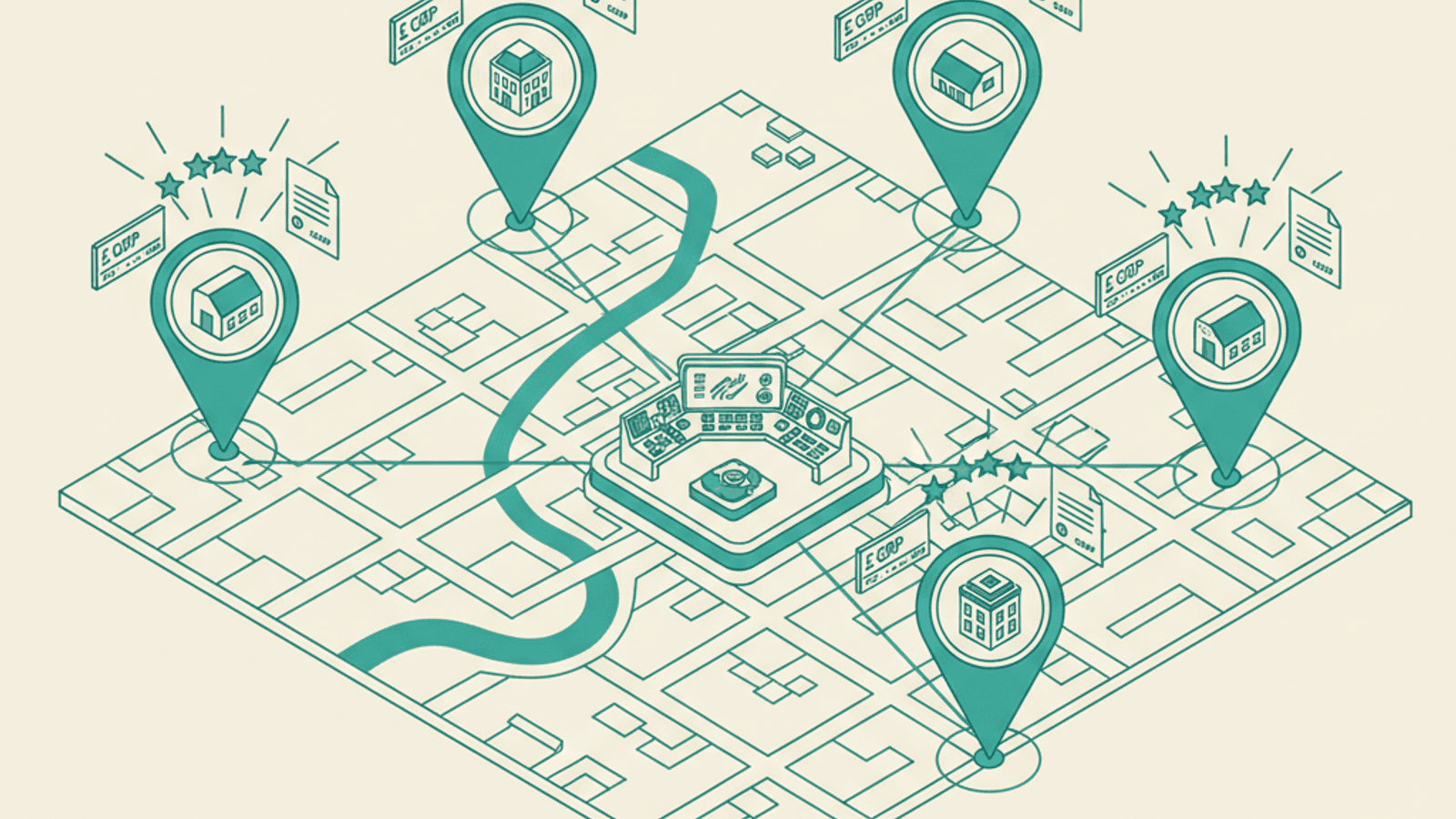
A local SEO strategy that works well for a single-location business breaks down at scale. Managing five Google Business Profile listings is not simply five times the work of managing one — it requires different systems, different tooling, and different governance structures to maintain quality and consistency across all locations simultaneously.
For Philippine businesses with multi-city operations — retail chains, franchise networks, healthcare providers, restaurant groups, professional services firms — multi-location local SEO is a significant competitive differentiator when done well, and a significant competitive liability when neglected.
The Challenges of Multi-Location Local SEO
Multi-location businesses face challenges that single-location businesses do not:
NAP consistency across locations: Each location has a different address and often a different phone number. Maintaining consistent, accurate NAP data across dozens of citation sources multiplied by multiple locations creates a large surface area for errors.
Duplicate content risk: Creating location pages for twenty locations using a template with only the city name swapped creates thin, near-duplicate content that Google may deindex or discount.
Review management at volume: A business with ten locations receiving twenty reviews per location per month needs to respond to two hundred reviews monthly. Without systems, response quality degrades or stops entirely.
GBP management at scale: Posting, photo management, Q&A monitoring, and hours management across dozens of profiles requires either significant team time or automation tools.
Performance visibility: Understanding which locations are performing well in local search and which need attention requires aggregated reporting that single-location dashboards do not provide.
Local vs. centralized decision-making: For franchise networks, the question of who controls the GBP profile — the franchisor or the franchisee — is both a strategic and a logistical question with significant SEO implications.
Individual GBP Management at Scale
Each business location must have its own Google Business Profile. Attempting to serve multiple locations from a single GBP profile violates Google's guidelines and produces poor local search results for all locations involved.
Setting Up a GBP Business Group
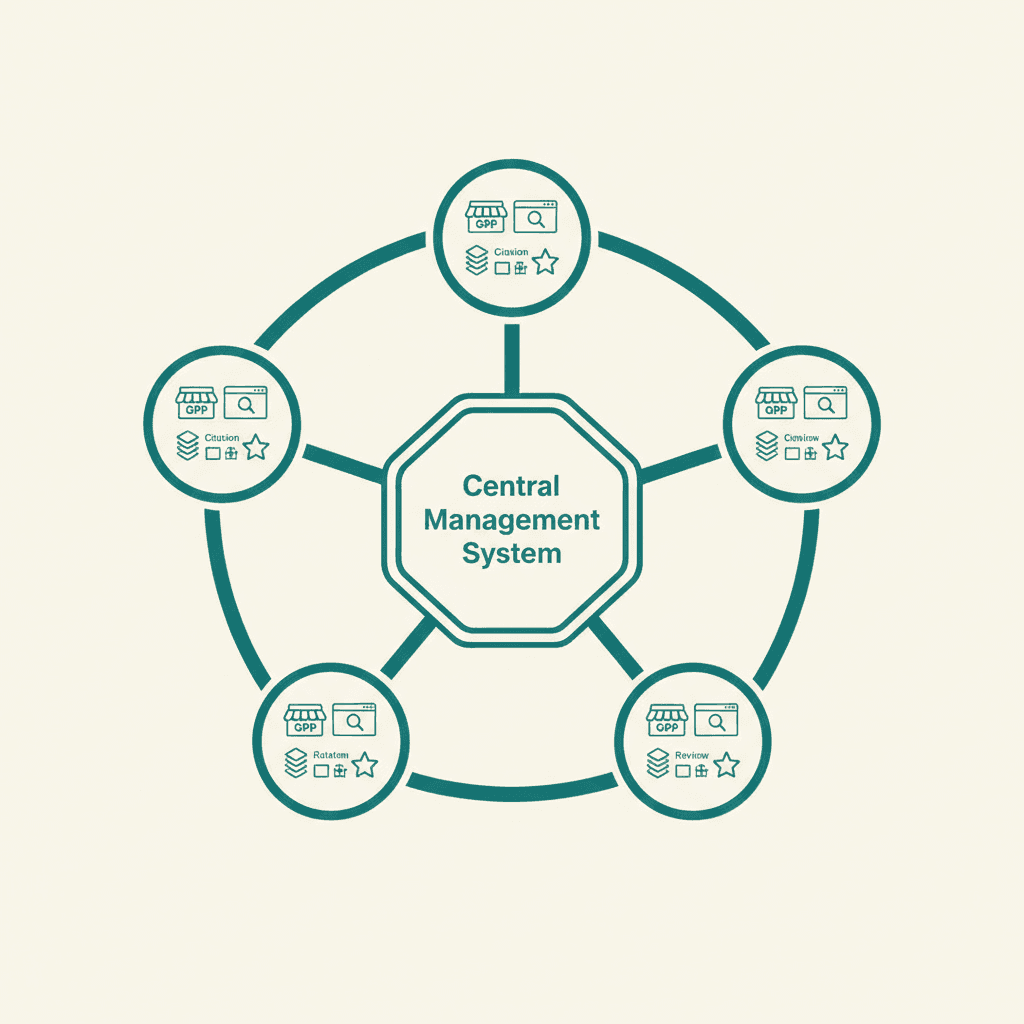
Google Business Manager allows multiple locations to be grouped under a single organizational account. This provides:
- Centralized login and access management
- Bulk operations (updating hours across all locations simultaneously)
- Unified reporting across locations
- Permission management for team members or franchise operators
For Philippine businesses with ten or more locations, the Business Group setup is essential for manageable administration.
Location-Specific GBP Data
Even within a centralized management structure, each location profile must have data specific to that location:
- Unique phone number: Each location should have its own local phone number. A single national hotline listed on all profiles conflates location-specific signals.
- Location-specific hours: Business hours that differ by location must be accurately maintained per profile. Incorrect hours are among the most common and damaging GBP data errors.
- Location-specific description: The GBP description for each location can share a core brand narrative but should include location-specific information — the specific neighborhood, nearby landmarks, or unique services available at that location.
- Location-specific photos: Exterior and interior photos for each location should show that specific location, not stock images or photos from other branches.
Regular Updates and Posts
For Google Business Profile optimization at scale, a content calendar that produces location-specific posts at least once per week per location is the gold standard. In practice, multi-location businesses often publish brand-wide posts pushed to all locations (for national promotions, product launches, or seasonal content) supplemented by location-specific posts for local events, staff spotlights, or regional promotions.
The local SEO service industry has developed tools that allow drafting a single post and distributing it across hundreds of GBP profiles simultaneously, with variable fields for location-specific content. This approach scales content publishing without requiring each location to independently create content.
Location-Specific Web Pages
Each location needs a corresponding page on the website — not a generic "Locations" directory page, but a substantive, individually optimized page for each location.
What Location Pages Need
Unique, valuable content: A location page that contains only the address, phone number, and a map embed is thin content. Google's quality systems are increasingly effective at identifying location pages built from templates with minimal unique content.
Strong location pages include:
- Location-specific heading (e.g., "Digital Marketing Services in Cebu City")
- Brief description of the specific location (neighborhood context, how to find it, parking)
- Location-specific services or specialties if they differ from other locations
- Staff introduction for that location
- Location-specific testimonials and reviews
- Location-specific FAQ content
- Photos of that specific location
- Embedded Google Map for that location
- LocalBusiness schema markup with location-specific address and phone
Proper URL structure: Location pages should follow a consistent URL pattern. Common patterns:
- `/locations/city-name`
- `/city-name` (for simple structures)
- `/services/city-name` (for service + location targeting)
Internal linking: The main navigation or a locations directory page should link to all location pages. Location pages should cross-link where geographically relevant (e.g., "Also serving nearby Quezon City").
Scalable Location Page Production
For businesses with twenty or more locations, producing substantive unique content for each location requires a systematic process. This typically involves:
- A content template with shared brand sections and variable location-specific sections
- A brief for each location capturing unique details: neighborhood, nearby landmarks, local staff names, location-specific testimonials
- A quality review process to ensure no page is thin or duplicate
Web design services for multi-location businesses should include location page architecture as part of the site structure planning, not as an afterthought.
Scalable Citation Building
Citation building at scale requires tools and processes that single-location operations do not need.
Citation Audit First
Before building new citations, audit existing citations for NAP consistency. Inconsistencies accumulated across years — old phone numbers, previous addresses, name variations — dilute citation authority and can confuse Google's entity matching. Tools like BrightLocal's Citation Audit, Semrush Listing Management, and Yext identify inconsistencies across hundreds of citation sources.
Automated Citation Platforms
Citation management platforms sync NAP data from a master source to citation networks automatically:
Yext: Pushes business data to 100+ directories and platforms simultaneously. Changes update across all directories when the master record changes. Strong coverage of global and Philippine-specific directories.
BrightLocal: Provides citation building services with Philippine-specific directory targeting. Manual citation building on high-value local sources.
Semrush Listing Management: Integrated with Semrush's platform, syncs data to key directories and monitors for inconsistencies.
For Philippine businesses, supplementing automated platforms with manual submissions to local directories (BusinessList.ph, YP.com.ph, local Chamber directories, industry-specific Philippine directories) is important because global citation platforms have thinner coverage of local Philippine sources.
Maintaining NAP Accuracy
Every time a location changes its phone number, moves to a new address, or adjusts its business name, the update must propagate to all citation sources. A change management process — a checklist that includes citation update as a step in any location change — prevents NAP drift over time.
Review Management at Scale
Aggregate review metrics across all locations are a significant competitive signal. A restaurant chain with thirty locations averaging 4.5 stars across 2,000 reviews is a fundamentally different local SEO asset than one with 4.0 stars and 400 reviews.
Centralized Review Monitoring
Tools that aggregate review data across all GBP locations — BrightLocal, Podium, Birdeye — allow a central team to monitor all review activity in a single dashboard, flag negative reviews for priority response, and track rating trends by location.
Review Acquisition Systems
A systematic review acquisition program deployed consistently across all locations is the highest-leverage review management investment. This might include:
- Post-service automated SMS with review link (using tools like Podium, Reputation.com, or simple SMS automation)
- QR codes at point of sale linking to the GBP review form for that specific location
- Staff training to ask for reviews verbally at service completion
For Philippine multi-location businesses, SMS-based review acquisition works particularly well given the high mobile penetration and common WhatsApp usage patterns.
Response at Scale
Responding to hundreds of reviews per month across locations requires either a dedicated team or AI-assisted response tools. AI response drafting tools can generate contextually appropriate responses that a human then reviews and approves — dramatically reducing the per-response time while maintaining quality.
Centralized vs. Distributed Approach
One of the key strategic questions for multi-location local SEO is governance: who controls the GBP profiles and local content?
Centralized approach: The main organization controls all GBP profiles, content, and review responses. Consistency is maximized. Risk is that local relevance suffers because content lacks genuine local context.
Distributed approach: Each location or franchise operator controls their own profile and content, with brand guidelines provided. Local relevance can be stronger. Risk is inconsistency, quality variation, and potential brand damage from poorly managed profiles.
Hybrid approach: The most common best practice. Central control of core NAP data, business hours, and brand content. Local operator permission to add location-specific photos, posts, and to respond to reviews within brand guidelines.
For franchise SEO specifically, the hybrid approach typically works best. The franchisor maintains control over the data that affects consistency (address, phone, categories, business name formatting) while franchisees can contribute local content that improves relevance.
Franchise SEO Considerations
Franchise operations have additional complications: multiple operators, varying levels of marketing sophistication, potential conflicts over brand representation, and the need for brand standards compliance alongside local optimization.
Franchise SEO program elements:
- Franchise-specific GBP management guidelines
- Approved post templates that franchisees can use with local customization
- Centralized review monitoring with escalation paths for negative reviews
- Regular franchise-wide citation audits
- Training for franchise operators on local SEO fundamentals
For franchisors in the Philippines — where franchise operations have grown significantly in the food, retail, and services categories — treating local SEO as a franchise support service (like training or operations manuals) is an increasingly common approach.
Tracking Multi-Location Performance
Aggregate vs. Location-Level Reporting
Multi-location local SEO reporting should include both aggregate performance (total local pack impressions, total GBP actions across all locations) and location-level performance (which specific locations are underperforming in local pack ranking, review rating, or GBP engagement).
Locations that consistently underperform are priority candidates for site audits, citation cleanup, and targeted review acquisition campaigns.
Key Local SEO Metrics
- Local pack impression share: What percentage of relevant searches trigger a local pack appearance for each location
- GBP action rate: Calls, direction requests, and website clicks per 1,000 impressions, by location
- Average star rating per location: Tracked monthly to identify rating trends
- Review velocity: New reviews per month per location
- Citation accuracy score: NAP consistency across major citation sources
- Local pack position: Average position in local pack for target keywords, by location
Philippines Multi-Location Context
Several characteristics of the Philippine market shape multi-location local SEO strategy:
City-to-city variation: Philippine cities differ significantly in demographics, infrastructure, and digital behavior. Cebu and Davao have distinct local search ecosystems from Metro Manila. National businesses expanding to Visayas and Mindanao markets cannot simply replicate their Metro Manila approach.
GCash and payment method mentions: Philippine customers frequently ask about payment methods — especially GCash, Maya, credit card, and installment options. Including this information in GBP Q&A and on location pages is a high-relevance local signal.
Mall vs. street-level: A significant portion of Philippine retail and food businesses operate within malls. Mall address formatting (mall name, floor level, unit number) in GBP requires care for accurate mapping and consistent citation matching.
English and Filipino: Maintaining GBP content in English while allowing authentic reviews in Filipino, Taglish, or regional languages is the practical standard. Forcing English-only review content is counterproductive — authentic reviews in any language are valuable.
A complete local SEO strategy for multi-location Philippine businesses is a significant program that combines technology platforms, content production, team training, and ongoing measurement. The investment is proportional to the number of locations and the competitiveness of the categories in each market.
Understanding how to rank in Google Maps for individual locations is the foundation that multi-location strategy builds on. Getting the fundamentals right at the single-location level first, then systematizing them across locations, produces more sustainable results than trying to manage scale from the start without a solid optimization model.
The broader SEO service stack for multi-location businesses in 2026 integrates local SEO management with content strategy, technical optimization, and online reputation management in a unified program rather than treating each as a separate service. The foundational local SEO principles — NAP consistency, citation building, review management, and on-page local signals — apply to every location in a network and must be executed correctly at each site for the aggregate strategy to succeed.
Frequently Asked Questions
Does each business location need its own Google Business Profile?+
Yes. Each physical business location must have its own Google Business Profile with a unique address. Attempting to serve multiple locations from a single profile violates Google's guidelines and reduces visibility for all locations.
How do I prevent a franchise partner from mismanaging their GBP profile?+
The franchisee can be given contributor or owner access to their own location's profile without having access to other locations. As the franchisor, maintaining owner-level access to all profiles in the business group preserves ultimate control while allowing franchisees to contribute content. Clear brand guidelines on what franchisees can and cannot post are essential.
What is the biggest mistake multi-location businesses make in local SEO?+
The most common mistake is treating multi-location SEO as a one-time setup task rather than an ongoing management program. Business information changes, reviews accumulate, citations drift into inaccuracy, and competitors improve their optimization over time. Multi-location local SEO requires continuous maintenance, not a set-and-forget configuration.
Should all locations share the same website, or should each location have its own website?+
For most multi-location businesses, a single domain with location-specific subpages is the strongest approach. It concentrates link authority on one domain and maintains brand consistency. Separate websites per location can be appropriate for franchise operations where each franchisee is legally an independent business and needs their own digital identity.
How long does it take for a new location to start ranking in the local pack?+
New locations with freshly created GBP profiles typically take three to six months to achieve stable local pack presence in competitive categories. The timeline can be shortened through aggressive citation building, early review acquisition, and strong initial on-page optimization of the location page on the website.