Local SEO in the Philippines: How to Rank in Your City
Local SEO helps Philippine businesses appear when customers search for services nearby. Here's the complete guide to Google Maps, Business Profile, and local rankings in 2026.

When a Filipino consumer searches "dentist near Katipunan" or "accounting firm Cebu," they are not looking for a general website — they are looking for a business they can visit or call today. Local SEO is what puts your business in those results.
For Philippine SMBs, local search is one of the highest-ROI digital marketing channels available. A fully optimized Google Business Profile and consistent local presence can drive calls, direction requests, and website visits from customers who are actively ready to buy — without any ad spend.
This guide covers how local SEO works, the specific tactics that matter most in the Philippine market, and how 2026 changes to Google's local search behavior affect your strategy.
What Is Local SEO?
Local SEO is the practice of optimizing your online presence to appear in location-based search results. These results include:
- The local pack — the map with three business listings that appears at the top of search results for local queries
- Google Maps results — the full directory of businesses in a given area
- Organic local results — website pages optimized for location-specific keywords that appear below the local pack
- AI Overviews with local intent — Google's AI-generated summaries that increasingly pull from Google Business Profile data
Understanding the broader context of what SEO is helps clarify where local fits: it is a specialized layer of SEO focused on geographic relevance and proximity signals, alongside the standard relevance and authority signals that affect all rankings.
Local SEO is also the most mobile-centric of all SEO types — the vast majority of local searches happen on smartphones, making it inseparable from mobile SEO.
The Google Business Profile: Your Most Important Local Asset
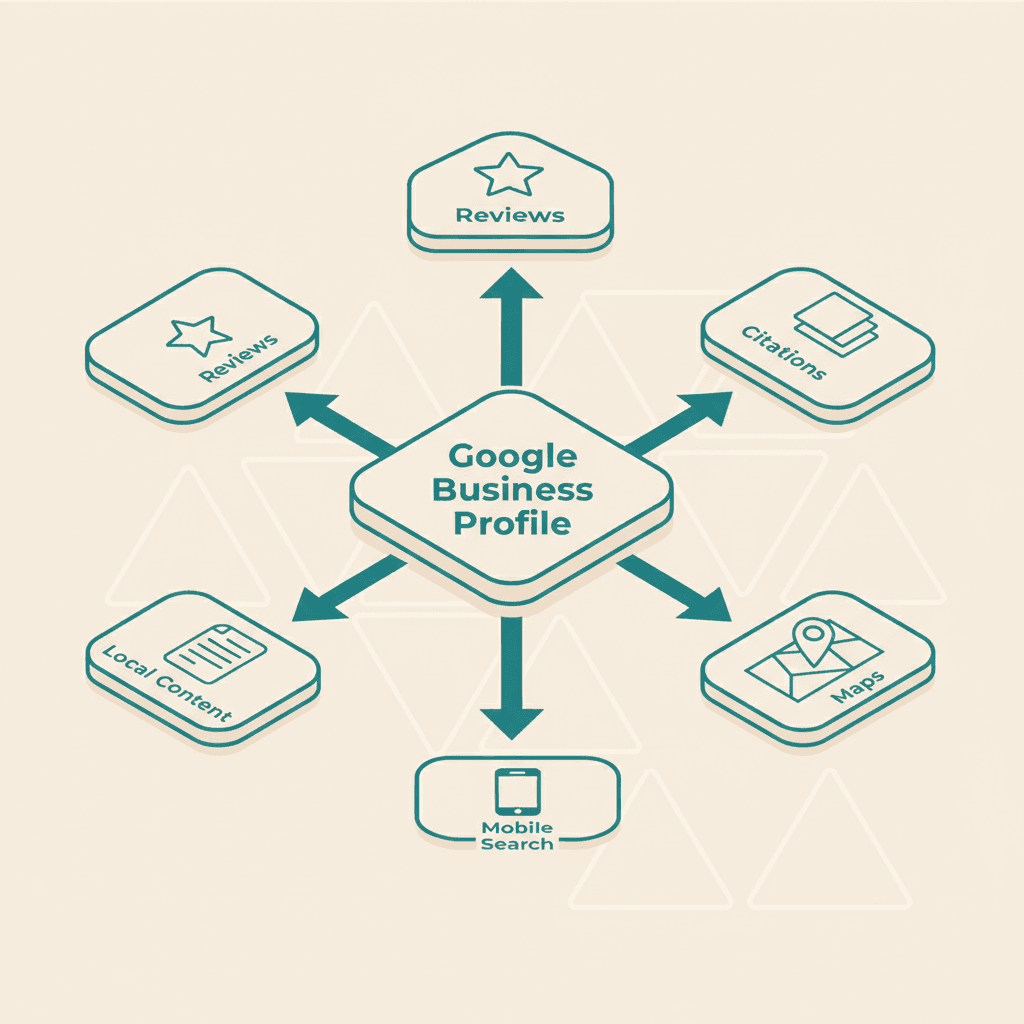
If you do nothing else for local SEO, claim and optimize your Google Business Profile (formerly Google My Business). It is the single most impactful action for local visibility.
Your GBP listing appears in Google Maps and the local pack. When it is complete and well-maintained, it provides potential customers with your address, phone number, hours, services, photos, reviews, and direct messaging — all before they ever visit your website.
Steps to Optimize Your GBP
1. Claim or create your listing.
Search for your business on Google Maps. If a listing exists, claim it. If not, create one at business.google.com. Verification requires a postcard, phone call, or video verification depending on business type.
2. Complete every section.
Google rewards completeness. Fill in business name, address, phone number, website, hours, service area, business category (be specific — choose the most precise category available), and a thorough business description.
3. Add high-quality photos.
Businesses with photos receive significantly more direction requests and website clicks than those without. Add exterior photos, interior shots, team photos, and product or service images. Update regularly — stale profiles signal inactivity.
4. List all services and products.
Use the Services section to list every service you offer with descriptions. This helps Google match your profile to relevant queries beyond your business name.
5. Post regularly.
Google Posts allow you to share updates, offers, and events directly on your profile. Regular posting signals that the business is active and engaged, which can positively affect local pack rankings.
6. Enable messaging.
Filipino consumers increasingly message businesses before visiting. Enabled messaging reduces friction in the decision process.
NAP Consistency: The Foundation of Local Citations
NAP stands for Name, Address, Phone Number. Google cross-references your business details across the web to build confidence in your location information. Inconsistencies — different phone numbers, address formats, or business name variations — create confusion that can suppress local rankings.
Ensure your NAP is identical across:
- Your website (header, footer, contact page)
- Google Business Profile
- Facebook business page
- All directory listings
In the Philippines, relevant citation sources include:
- YellowPages Philippines (yp.com.ph)
- BusinessList Philippines (businesslist.ph)
- Manta (international directory with PH listings)
- Foursquare (used by Apple Maps and other platforms)
- Facebook (major local discovery platform in the PH)
- Industry-specific directories relevant to your sector
The more consistent and widespread your NAP citations, the stronger your local authority signal to Google.
Reviews: The Local SEO Signal With Business Benefits
Online reviews affect both local rankings and conversion rates. Google considers review quantity, recency, rating average, and owner response rate as local ranking signals.
More practically: Filipino consumers read reviews before visiting a local business. A business with 4.7 stars and 80 reviews will consistently outperform a competitor with 3.8 stars and 10 reviews — in both rankings and actual foot traffic.
Building Your Review Profile
Ask directly. Most customers who have a positive experience will leave a review if asked. Train ya qualified team to ask at the point of completed service. Send a follow-up message with a direct link to your Google review form.
Make it easy. Create a short link to your Google review page and share it via text, email, receipts, and WhatsApp (a primary communication channel for many Filipino businesses).
Respond to all reviews. Thank reviewers who leave positive feedback. For negative reviews, respond professionally, acknowledge the concern, and describe how you will address it. This signals to both Google and prospective customers that you are engaged and accountable.
Do not buy reviews. Fake review schemes are against Google's terms of service and can result in listing suspension. The short-term gain is not worth the risk.
Local Content: Creating Pages That Rank for Location Queries
Beyond your GBP, your website should have location-specific content that targets the search queries your potential customers use.
For businesses with a single location, a dedicated contact page with full NAP information, an embedded Google Map, and a paragraph about the area you serve is a starting point.
For businesses with multiple locations or service areas across the Philippines, create individual landing pages for each location:
- "/accounting-services-cebu" not just "/services"
- "/dental-clinic-makati" not just a contact form
Each location page should include:
- The city or area name naturally throughout the content
- Specific services offered at that location
- Local testimonials or case studies
- NAP information matching your GBP
- Local schema markup (see below)
- An embedded Google Map
Avoid creating thin "clone" pages that differ only in the city name — Google's helpful content system penalizes this. Write genuinely useful content for each market.
Local Schema Markup
Structured data helps Google understand what your business is, where it is located, and what it offers. The most important schema types for local SEO are:
- LocalBusiness schema — includes name, address, phone, URL, hours, and geographic coordinates
- Review schema — if you aggregate reviews on your site
- BreadcrumbList schema — for navigational clarity
Implementing LocalBusiness schema is a technical task, but most modern CMS platforms (including WordPress and Payload CMS) support schema plugins or manual implementation via JSON-LD in the page head.
Local SEO in 2026: AI Search and the Philippines Context
Google Business Profile AI Features
Google now generates AI summaries for many business searches — pulling data from your GBP, reviews, and website to create a synthesized description that appears before your listing details. Businesses with complete, consistent, and well-reviewed profiles are better represented in these summaries.
Local AI Overviews
For queries like "best restaurants in BGC" or "SEO agency Manila," Google increasingly shows an AI-generated overview that synthesizes multiple sources. Local businesses cited in these overviews benefit from visibility before the traditional local pack.
The citation factors are similar to organic AI Overviews: well-structured website content, high-authority backlinks, consistent brand signals, and strong review profiles.
The Philippines-Specific Landscape
Several local dynamics are worth accounting for in your Philippine local SEO strategy:
Facebook as a local search layer. Many Filipino consumers search for businesses on Facebook as well as Google. Maintain an active, complete Facebook business page with regular posts and a consistent NAP.
Google Maps dominance. Filipinos heavily use Google Maps for local discovery. Reviews, photos, and hours on your GBP often matter more than your website for mobile local searches.
Barangay-level targeting. In Metro Manila and other large cities, users often search at the Barangay level ("accountant Kapitolyo Pasig"). Include Barangay-level location references in your GBP description and website content where relevant.
Mobile-first audience. The Philippine internet audience is overwhelmingly mobile. Local search is almost entirely mobile. Speed and usability on smartphones directly affect your ability to convert local searchers.
A Practical Local SEO Checklist
Google Business Profile:
- [ ] Claimed and verified
- [ ] All sections complete (name, address, phone, hours, description, services, categories)
- [ ] 10+ photos added
- [ ] At least 10 reviews with owner responses
- [ ] Posts updated at least twice a month
Website:
- [ ] NAP in site footer and contact page
- [ ] Location-specific landing pages for each service area
- [ ] LocalBusiness schema markup implemented
- [ ] Google Map embedded on contact page
- [ ] Mobile-friendly and fast-loading
Citations:
- [ ] NAP consistent across all directories
- [ ] Listed on major Philippine business directories
- [ ] Facebook page NAP matches GBP
Getting Professional Help
Local SEO has a well-defined playbook, but executing it consistently — especially for multi-location businesses or competitive markets in Metro Manila, Cebu, or Davao — benefits from professional management.
Our SEO services include local SEO strategy and execution for Philippine businesses, from single-location SMBs to national brands managing dozens of location pages.
Local businesses often pair organic optimization with targeted PPC campaigns to dominate local search results.
Maintaining consistent social media presence reinforces local brand authority and drives reviews.
Frequently Asked Questions
How long does local SEO take to show results?+
Local SEO typically shows results faster than broad organic SEO. Many businesses see improved local pack rankings within 1–3 months of GBP optimization and citation building. Competitive markets like Metro Manila may take 3–6 months for significant movement.
Do I need a website for local SEO?+
You can rank in the local pack with only a Google Business Profile, but a website significantly strengthens your local authority and allows you to rank for organic local queries as well. For any established business, a website is recommended.
What is the most important local ranking factor?+
Google's local ranking algorithm weighs three primary factors: relevance (how well your business matches the query), distance (proximity to the searcher), and prominence (how well-known your business is online, based on reviews, links, and GBP completeness). No single factor dominates — all three matter.
How do I rank higher than competitors in the local pack?+
Focus on GBP completeness, review velocity (steady acquisition of new reviews), consistent citations, and local landing pages. For competitive markets, local link building from area-specific sources (local news sites, chambers of commerce, local directories) provides additional authority.
Can I optimize local SEO in multiple Philippine cities simultaneously?+
Yes. Create individual location landing pages for each city or area, maintain separate GBP listings for each physical location, and build citations for each location's specific address. Multi-location local SEO is more complex but follows the same principles as single-location optimization.