On-Page vs Off-Page SEO: Key Differences
On-page and off-page SEO both matter — but they work differently. Here's what each covers, how they interact, and how to prioritize between them.
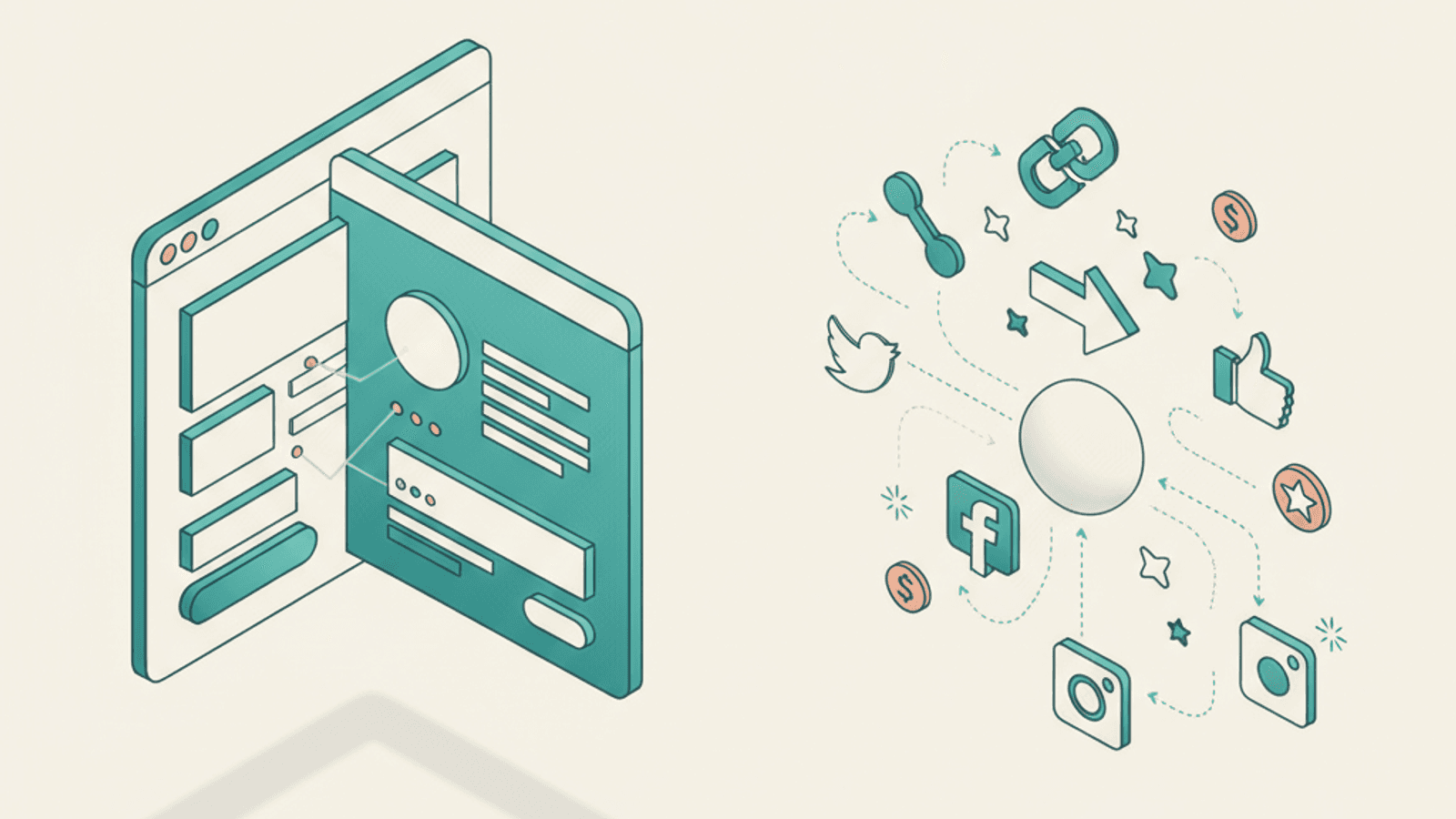
Every SEO strategy divides into two domains: what happens on your pages and what happens everywhere else. On-page SEO is the first domain — content, titles, structure, internal links. Off-page SEO is the second — backlinks, brand mentions, external authority signals.
Both matter. Neither is sufficient alone. And in 2026, the relationship between them has grown more nuanced as E-E-A-T signals blur the traditional boundary between on-page quality and off-page reputation.
This guide explains what each discipline covers, how they interact, and how to decide where to invest your SEO effort.
What Is On-Page SEO?
On-page SEO refers to everything you do directly on your web pages to improve their search visibility. It includes elements visible to users and elements in your page's HTML that users don't see.
Visible on-page elements:
- Page content (body text, headings, image captions)
- Heading structure (H1, H2, H3)
- Images and their alt text
- Internal links and anchor text
- Page layout and readability
HTML/metadata elements:
- Title tags
- Meta descriptions
- URL structure
- Canonical tags
- Schema markup and structured data
On-page SEO is entirely within your control. You can change any of these elements today and see Google re-evaluate them within days or weeks. For a full breakdown of every on-page element, see complete on-page SEO guide.
What Is Off-Page SEO?
Off-page SEO covers everything that affects your search rankings from outside your own website. The dominant off-page signal remains backlinks — links from external websites pointing to your pages — but the category has expanded significantly.
Core off-page signals:
- Backlinks from external sites (quantity, quality, relevance)
- Referring domain diversity
- Anchor text distribution of incoming links
Expanded off-page signals in 2026:
- Unlinked brand mentions (Google can associate mentions of your brand name with your site)
- Social media signals and brand activity
- Reviews and ratings on third-party platforms
- Local citations (Name, Address, Phone consistency across directories)
- E-E-A-T reputation signals — expert mentions, press coverage, citations in authoritative content
Off-page SEO is harder to control directly than on-page SEO because it depends on what other sites, publications, and platforms do. Building it requires outreach, content that earns links naturally, digital PR, and time.
For businesses actively building their off-page presence, see link building services page.
The Core Distinction
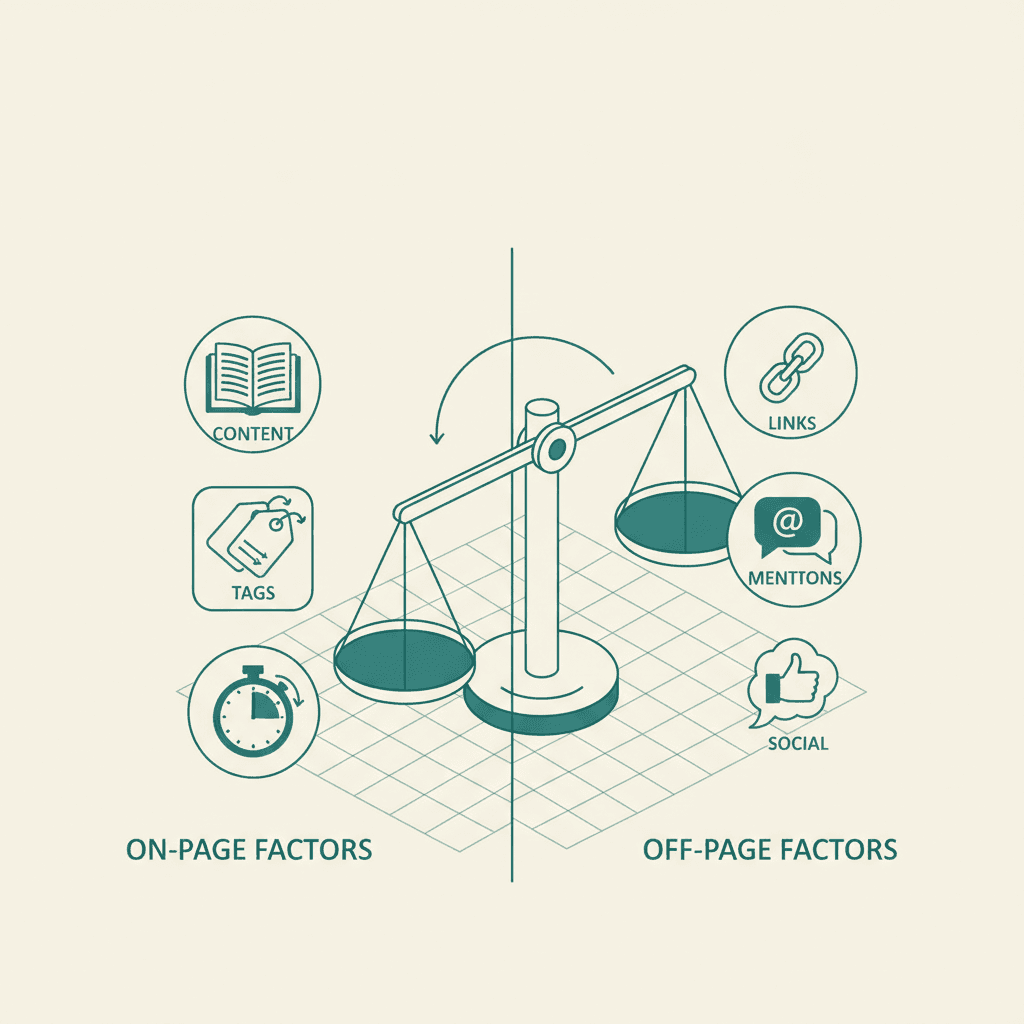
The clearest way to understand the difference: on-page SEO controls your relevance signals. Off-page SEO builds your authority signals.
Relevance answers: "Is this page about what the user is searching for?"
Authority answers: "Should Google trust this page enough to rank it prominently?"
A page can be perfectly relevant (excellent on-page SEO) but rank poorly because it has no authority — no backlinks, no external signals that other sites find it credible. Conversely, a highly authoritative domain with weak on-page optimization will underperform its potential because Google can't clearly map the page to specific user intent.
The best rankings come from both dimensions working together.
How They Interact in Practice
Here's where the traditional separation becomes blurry: Google's E-E-A-T framework (Experience, Expertise, Authoritativeness, Trustworthiness) draws from both on-page and off-page signals simultaneously.
Your E-E-A-T score is built from:
On-page signals:
- Author credentials and bios
- First-hand experience language in content
- Accurate, well-sourced information
- Publication and update dates
Off-page signals:
- Who links to your content and why
- Whether your authors are cited in external publications
- Whether your brand is mentioned alongside other recognized authorities
- Review profiles and third-party endorsements
A business that optimizes only on-page SEO is leaving its authority dimension underdeveloped. A business that pursues backlinks without optimizing the pages being linked to is building on a weak foundation. Both investments reinforce each other.
On-Page vs Off-Page: A Comparison
On-Page SEO — Off-Page SEO
What it covers — Content, titles, structure, internal links — Backlinks, brand mentions, citations
Who controls it — You, directly — Others, partially influenced by you
Speed of impact — Weeks to months — Months to years
Primary signal to Google — Relevance — Authority
Main risk — Thin content, intent mismatch — Low-quality links, link schemes
Best tools — Ahrefs, SEMrush, Screaming Frog, GSC — Ahrefs, Moz, Majestic, HARO
When to Prioritize On-Page SEO
On-page SEO should be the starting point for every site. Without it, off-page investment is wasted. Specifically, prioritize on-page when:
Your site is new. Before building backlinks, ensure every page you want to rank has optimized titles, clear content, and correct technical foundations. Links pointing to poorly-optimized pages underperform their potential.
You're seeing ranking volatility. If pages that previously ranked well are losing positions, on-page issues — thin content, stale information, keyword cannibalization — are often the cause. Fix these before pursuing new links.
You have significant untapped content potential. If your site has pages that rank on page 2 or 3 for relevant keywords, on-page improvements to those pages often produce ranking gains faster than building additional backlinks. Pages close to page 1 respond well to on-page optimization.
Your industry has shifted. In the Philippines specifically, search behavior and intent patterns have changed with broader internet adoption. On-page content that was accurate in 2022 may now misalign with current search intent patterns. Annual on-page audits catch this drift.
When to Prioritize Off-Page SEO
Once your on-page foundations are solid, off-page investment accelerates results. Prioritize off-page when:
You're stuck on page 2 despite good on-page SEO. If your content is comprehensive, well-structured, and clearly relevant, but you're still outranked by competitors with fewer on-page signals, authority is likely the gap. Building backlinks to these pages is the right lever.
Entering a highly competitive market. In established niches, the top-ranking sites have significant link authority accumulated over years. Competing requires matching their backlink profile quality, not just matching their on-page optimization.
You're launching a new important page. A targeted link building push to a new service page or major piece of content can accelerate its initial indexing and ranking significantly.
The 2026 Reality: They're Less Separable Than Ever
In 2026, the cleanest framing is this: off-page SEO determines your ceiling in competitive SERPs. On-page SEO determines how close you get to that ceiling.
But the two disciplines increasingly share terrain. Structured data (on-page) affects how AI-powered search features attribute and cite your content — a function that used to be purely an off-page reputation question. Brand mentions (off-page) feed into E-E-A-T signals that affect how Google evaluates your on-page content quality.
For Philippine businesses, this means the most efficient SEO strategy integrates both from the start — building on-page quality that earns links naturally, while conducting targeted outreach that builds authority for specific pages. A full-spectrum SEO service approach covers both dimensions simultaneously.
Understanding what SEO covers overall — including the third pillar of technical SEO — gives you the complete picture of where these investments sit within a comprehensive strategy.
The off-page side relies heavily on link building strategies to build domain authority.
Frequently Asked Questions
Which is more important: on-page or off-page SEO?+
Neither is more important in isolation — both are necessary for sustainable rankings. On-page SEO is the foundation (relevance and quality signals). Off-page SEO builds authority and trust. Prioritize on-page first to ensure a solid foundation, then invest in off-page to build competitive authority.
Can I rank without backlinks using on-page SEO alone?+
Yes, for lower-competition keywords. Many long-tail and local intent queries can be ranked with strong on-page SEO and no backlinks, especially in Philippine markets where some niches remain undercompeted. For high-competition head terms, backlinks are typically necessary to reach page 1.
What counts as off-page SEO in 2026?+
In 2026, off-page SEO extends well beyond traditional backlinks. It includes unlinked brand mentions that Google associates with your domain, reviews on Google Business Profile and industry directories, citations in external publications, and E-E-A-T signals like your authors being referenced by authoritative external sources.
How do on-page and off-page SEO work together?+
On-page SEO tells Google what your page is about and signals its quality. Off-page SEO tells Google that other trusted sources vouch for your content. Together, they give Google both the relevance and authority signals needed to rank a page confidently. Strong on-page SEO also makes your pages more likely to earn backlinks naturally — well-structured, authoritative content attracts more external references than thin, generic pages.
How much of my SEO budget should go to each?+
For a new site or one with significant on-page gaps, 70-80% of initial SEO investment should go toward on-page optimization and content development. As on-page foundations solidify, shift more budget toward link building and off-page authority development. Established sites with strong content may benefit from an inverse ratio.