Will AI Replace SEO? What's Actually Happening in 2026
AI is reshaping search, but it hasn't replaced SEO — it's raised the bar. Here's what's really changing for SEO professionals in 2026.
Every few years, someone predicts that SEO is dead. First it was social media. Then voice search. Now it is AI — and this time, the disruption is real enough that the question deserves a serious answer instead of a dismissive one.
So let us be direct: AI will not replace SEO. But it has permanently changed what SEO looks like, who does it well, and what clients should expect from it. If you are a business owner in the Philippines wondering whether to keep investing in organic search, or an SEO professional wondering whether your skills still matter, this article gives you the unvarnished picture.
Understanding what SEO actually involves is a good starting point — because the tasks most at risk from AI are not the ones most people think.
What Sparked the "AI Will Kill SEO" Debate
The panic intensified in 2025 when Google launched AI Overviews at scale. Instead of ten blue links, searchers started seeing AI-generated summaries at the top of results — pulling from multiple sources, answering the question directly, and often removing the need to click through to any website at all.
Studies tracking organic click-through rates documented drops of 15 to 30 percent on informational queries where AI Overviews appeared. For some content-heavy websites, the traffic hit was immediate and significant.
Add to this the availability of tools like ChatGPT-4o, Claude 3.7, and Gemini 2.0 that can generate SEO-formatted articles in seconds, and the anxiety becomes understandable. If AI can write the content and AI is also reading the content before users even see organic results, where does the human SEO professional fit?
The answer requires separating what AI has genuinely taken over from what it simply cannot do.
Which SEO Tasks AI Has Already Changed
Let us be honest about what AI does well in an SEO context.
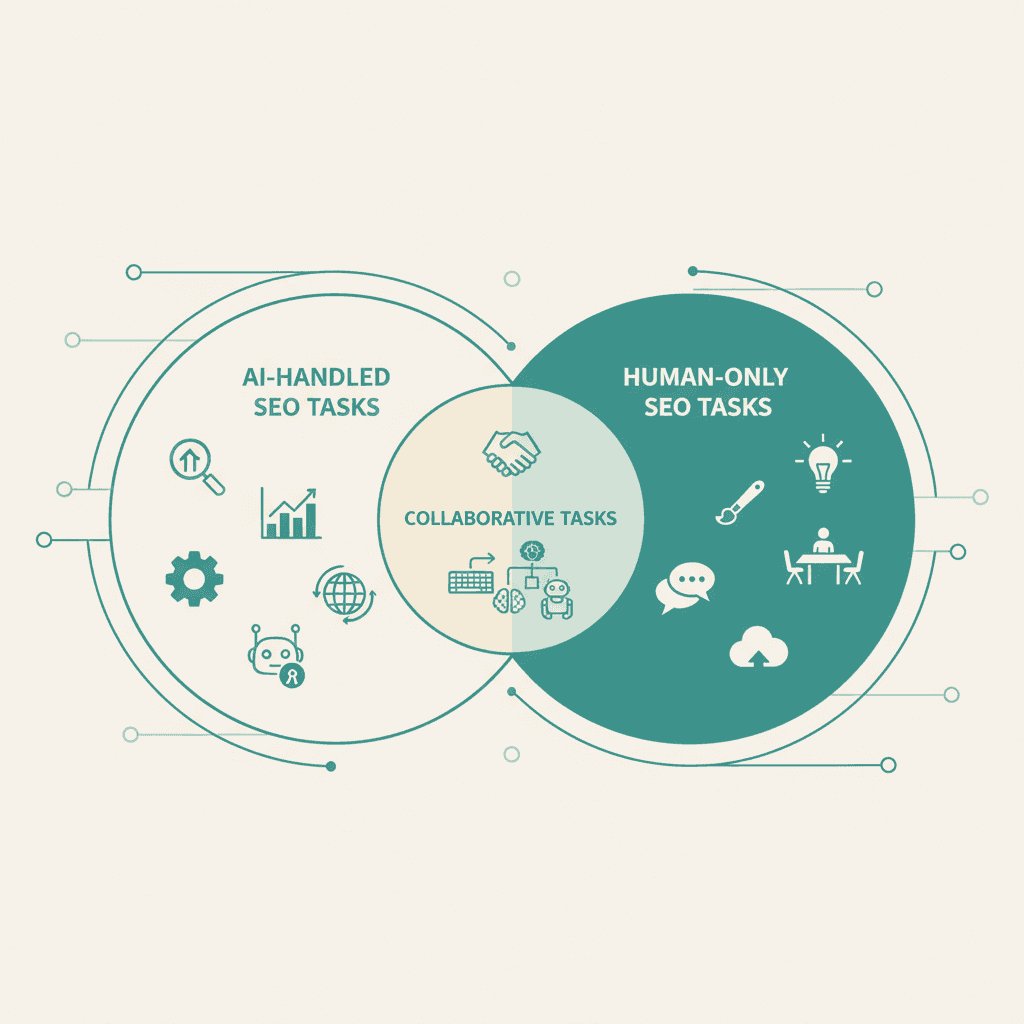
Content drafting at scale. AI tools produce readable first drafts, meta descriptions, title tag variations, and structured data markup faster than any human team. Agencies and in-house SEO teams that once spent days on content briefs now spend hours. This is not hypothetical — it is standard practice in 2026.
Keyword clustering and intent mapping. AI tools like Ahrefs' AI keyword grouper and custom ChatGPT workflows can cluster hundreds of keywords by topical similarity and search intent in minutes. A task that once required a senior SEO analyst and a spreadsheet now runs in the background.
Technical SEO auditing. Crawl tools have incorporated AI to flag issues, prioritize fixes by estimated traffic impact, and generate fix recommendations. The audit itself is faster; the judgment about what to fix first still benefits from human experience.
Rank tracking and anomaly detection. AI monitoring tools alert teams to ranking drops, SERP feature changes, and competitor movements without manual checking. The signal is automated; the response still requires strategic thinking.
These are real efficiency gains. They also explain why the number of SEO tasks one person can manage has increased dramatically — not why SEO professionals are being replaced.
What AI Cannot Do in SEO
Here is where the replacement thesis falls apart.
Brand strategy and positioning. No AI tool understands a company's competitive differentiation, client relationships, or reputation in a specific market the way an embedded strategist does. SEO decisions — which keywords to pursue, which content angles to own, which competitors to target — are downstream of business strategy. AI can execute once the strategy is set; it cannot set the strategy.
Earning genuine authority and links. Google's ranking systems, even with heavy AI integration after its March 2025 core update, still weight editorial links from real publishers as primary trust signals. Earning those links requires relationship-building, pitching, and producing research or perspective that other publications want to reference. AI can help with the content; it cannot replace the outreach and credibility-building.
Navigating client relationships. An SEO agency serves clients with specific concerns, timelines, and politics. Managing expectations, explaining algorithm changes, advising on content investments during uncertainty — this is relationship work that AI does not handle.
Judgment under ambiguity. The SEO environments that drive the most value are also the most competitive and least predictable. When Google rolls out a significant algorithm change — like its March 2025 core update, which penalized AI-generated content lacking genuine expertise — the right response is not algorithmic. It requires reading the signals, understanding the direction, and making calls about where to invest.
AI Overviews Changed the Game — But Not in the Direction You Think
Google AI Overviews created a new SEO challenge and a new SEO opportunity simultaneously.
The challenge: informational content that previously earned traffic from "what is" and "how to" queries now competes with AI-generated summaries that answer the question without requiring a click. The traffic value of being ranked third for "how does SEO work" is lower than it was in 2024.
The opportunity: being cited as a source within AI Overviews. When Google's AI summarizes a topic, it draws from pages it considers authoritative. Sites that demonstrate genuine expertise, cite original data, use proper structured markup, and cover topics with depth are the ones getting referenced — even when users never click through, the brand visibility has value.
This is precisely where Generative Engine Optimization comes in as a distinct discipline. GEO is the practice of structuring content and building authority specifically to appear within AI-generated results across Google, Perplexity, and other LLM-powered search surfaces. It is a new skill layer built on top of traditional SEO, and it is one that requires human editorial judgment to execute well.
Our AI SEO services are built around exactly this — combining technical SEO foundations with GEO-specific tactics to ensure clients remain visible across both traditional and AI-powered search results.
The Philippine SEO Market: What AI Actually Means Here
For businesses and agencies in the Philippines, the AI disruption in search is playing out differently than in mature markets.
AI Overviews have a limited rollout in the Philippines as of early 2026. Filipino searchers using Google primarily see traditional results with occasional AI features, which means the organic traffic impact is more modest here than in the US or UK. This is a window — a period to build topical authority before the full AI Overview rollout arrives.
The cost argument for AI tools is also different in a Philippine context. Many small and medium businesses cannot afford enterprise SEO subscriptions, but AI tools have democratized access to capabilities that previously required expensive tools or large teams. A local business can now use ChatGPT for content ideation, Ahrefs' free tier for keyword research, and Google Search Console for performance data — and get meaningful results with a fraction of the historical investment.
What this does not replace is strategic expertise. Knowing how to interpret the data, prioritize the work, and build a campaign that compounds over time is still the differentiating factor. The different types of SEO that drive results for Philippine businesses — local, technical, and content-driven — all require human direction to execute effectively.
The Skills That Matter More in 2026
If AI has raised the floor by automating execution, it has also raised the ceiling by requiring deeper strategic and analytical skills from the people who use it.
The SEO professionals thriving in 2026 are those who:
Understand AI-era ranking signals. This means knowing how Google's systems evaluate E-E-A-T (Experience, Expertise, Authoritativeness, Trustworthiness) in the context of AI-generated content, and knowing how to demonstrate genuine expertise in content that AI tools could otherwise commoditize.
Can work across disciplines. The line between SEO, content strategy, PR, and digital PR has blurred. Building the kind of authority that earns citations in AI Overviews requires coordinated work across content, link acquisition, and brand-building.
Use AI as a multiplier, not a replacement for judgment. The best SEO teams use AI to handle volume while human strategists focus on decisions. The agencies and freelancers still treating AI as a curiosity rather than a core workflow tool are falling behind.
Understand the technical layer. Core Web Vitals, structured data, crawl budget management — the technical fundamentals have not changed, but the tools for diagnosing and fixing issues have become AI-assisted. Understanding the "why" behind technical requirements remains essential even when the tooling handles the "what."
The benefits of sustained SEO investment have not diminished — organic traffic still converts better than most paid channels, and compounding content assets still build long-term value. What has changed is the sophistication required to capture that value when AI-powered search results occupy the top of the page.
The Honest Assessment
AI will not replace SEO. It will replace SEO professionals who refuse to adapt, in the same way that spreadsheets replaced accountants who refused to learn them.
The search landscape in 2026 is more complex than it was three years ago. There are more surfaces to optimize for — traditional blue links, AI Overviews, featured snippets, Google's AI-powered shopping results, Perplexity citations. There are more tools to use effectively. And there is more noise from low-quality AI-generated content competing for the same rankings.
That complexity creates value for professionals who understand it. The Philippine businesses that take SEO seriously now — building genuine topical authority, investing in technical foundations, and adapting to AI-powered search features — will have a significant advantage over competitors who assume AI makes search optimization irrelevant.
Curious about what an AI-era SEO strategy looks like in practice? The companion piece on how to use AI for SEO walks through the specific tools and workflows that are producing results in 2026.
Frequently Asked Questions
Will AI completely replace SEO professionals?+
No. AI has automated many SEO execution tasks — content drafting, keyword clustering, technical auditing — but the strategic layer requires human judgment. Business strategy, competitive positioning, link acquisition, and adapting to algorithm changes all depend on expertise that AI tools cannot replicate.
What parts of SEO can AI already automate?+
Content drafting, meta description generation, keyword grouping, rank tracking, crawl analysis, and structured data generation are all areas where AI tools are now standard. These efficiency gains let SEO professionals manage more without expanding team size, rather than eliminating the need for practitioners.
How do Google AI Overviews affect SEO jobs?+
They created a new optimization surface — getting cited within AI Overviews — that requires the same skills as traditional SEO but applied differently. Informational content now competes with AI summaries for clicks, but appearing as a cited source in those summaries provides brand visibility and indirect traffic.
Should I invest in SEO services even with AI changing search?+
Yes. The complexity of the 2026 search landscape — with AI Overviews, Gemini integration, and evolving ranking signals — makes professional SEO expertise more valuable, not less. Businesses trying to navigate it without guidance are more likely to make costly mistakes.
What skills do SEO professionals need in 2026?+
Strategic thinking and competitive analysis, AI tool proficiency, understanding of E-E-A-T signals, GEO (Generative Engine Optimization) tactics, technical SEO fundamentals, and the ability to coordinate content, PR, and link acquisition into a unified authority-building strategy.