Types of SEO: Every Discipline You Need to Know in 2026
From on-page to GEO, SEO now covers more ground than ever. Here's a complete breakdown of every type of SEO and when each one matters.
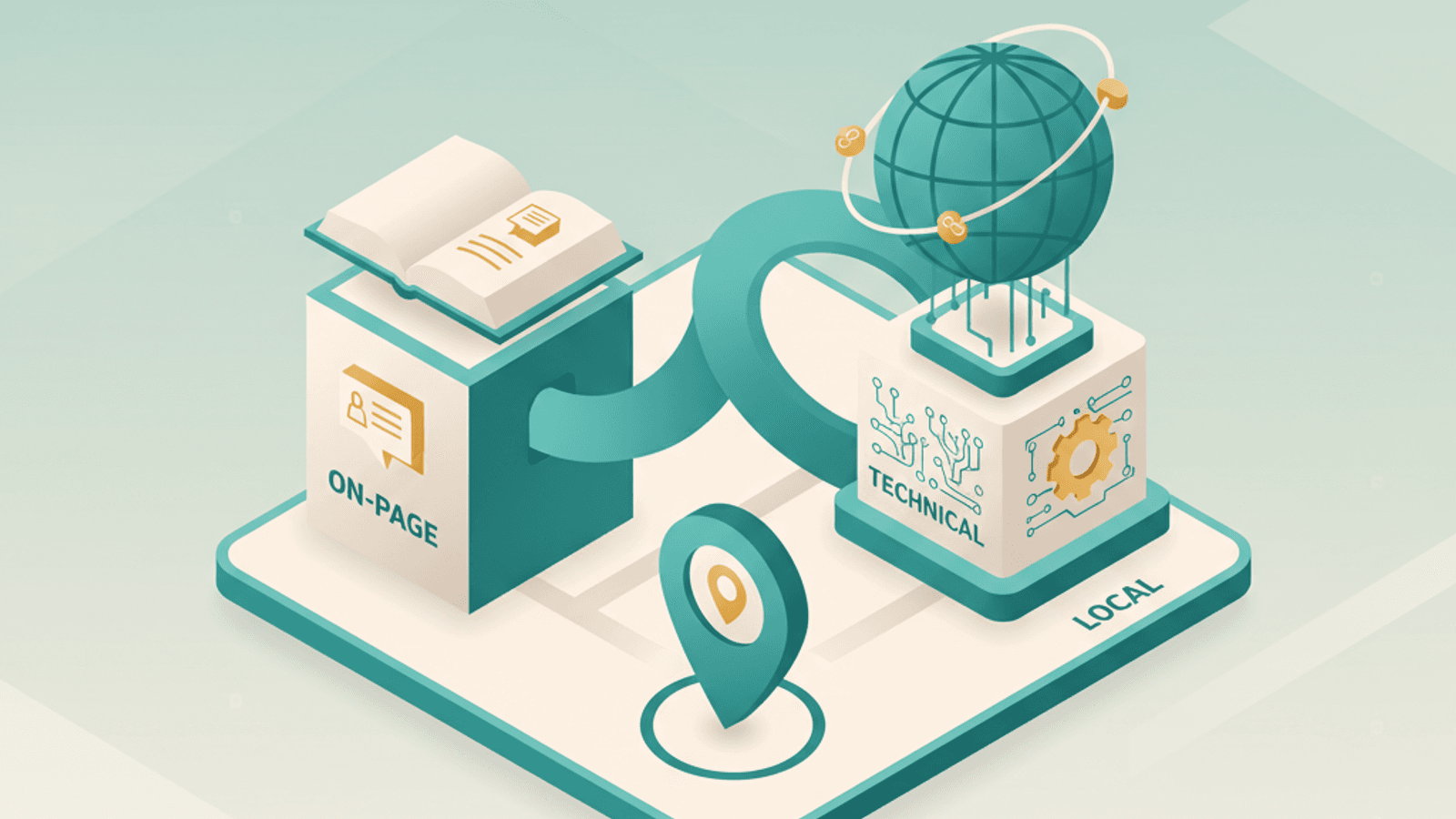
When people ask what SEO is, the short answer is that it is the practice of improving your website to rank higher in search engines. But as search has grown more complex, SEO has branched into a range of distinct disciplines — each with its own techniques, tools, and focus areas.
Understanding the different types of SEO helps you diagnose what your site actually needs, communicate clearly with agencies and freelancers, and invest your budget in the right areas.
This guide covers every major SEO type, including two disciplines that have emerged as critical in 2026: AI SEO and Generative Engine Optimization.
Why SEO Has Branched Into Multiple Disciplines
Search engines have grown from simple keyword-matching engines into complex systems that evaluate content quality, user experience, site architecture, location signals, device type, and increasingly, how well your content performs in AI-generated answers.
No single approach covers all of this. A technically perfect site with poor content will not rank. A brilliantly written site on a slow, poorly structured server will struggle. A nationally ranked business may still be invisible to searchers in their own city if local SEO is neglected.
Each type of SEO addresses a different dimension of how search engines evaluate and rank your website.
The Core Types of SEO
On-Page SEO
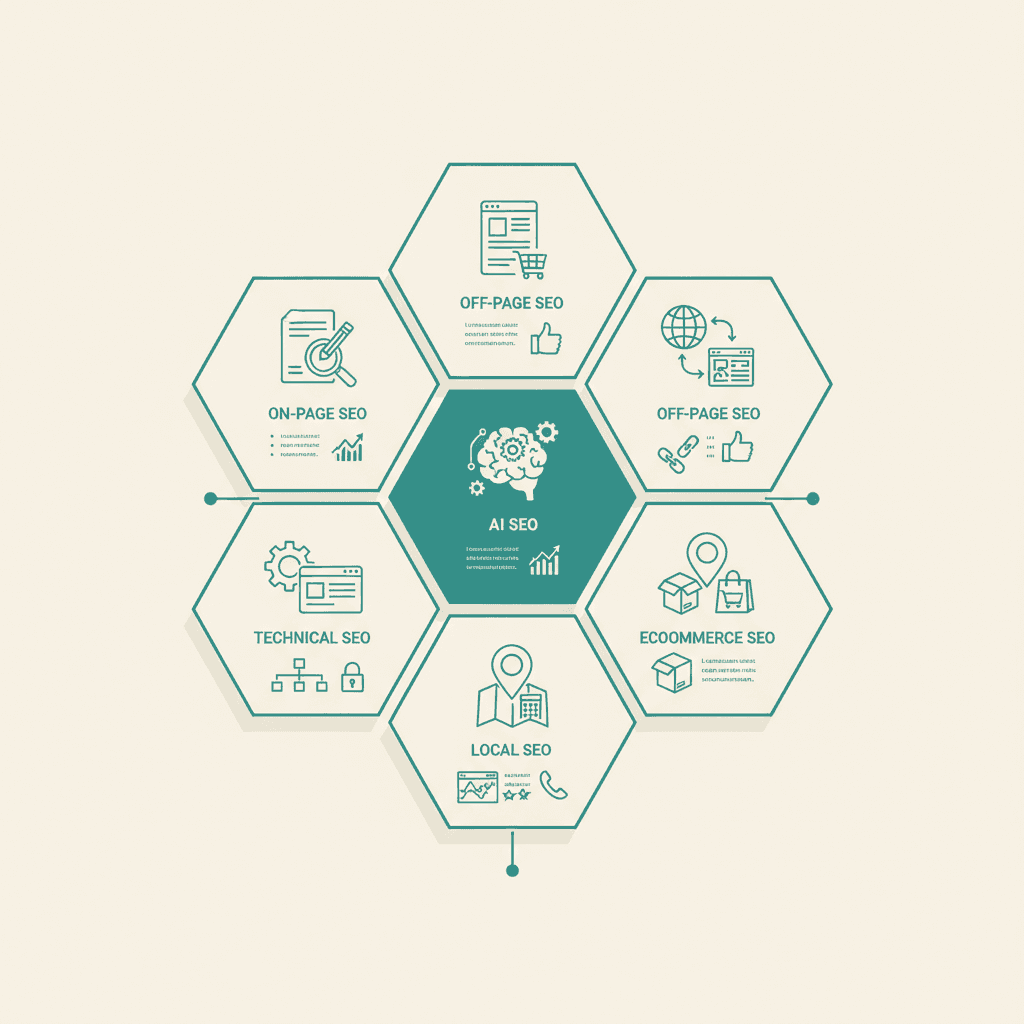
On-page SEO covers all the optimizations you make directly on your web pages to make them more relevant to target queries.
This includes:
- Writing clear, descriptive title tags (the text shown in search results)
- Crafting useful meta descriptions that improve click-through rates
- Structuring content with logical heading hierarchies (H1, H2, H3)
- Integrating target keywords naturally into headings and body copy
- Optimizing images with descriptive file names and alt text
- Building a clear internal linking structure so both users and crawlers can navigate your site
On-page SEO is foundational. Every other type of SEO is built on top of it. If your page does not clearly communicate its topic and value to both users and search engines, stronger technical performance and more backlinks will only take you so far.
Learn more in our guide to on-page SEO.
Technical SEO
Technical SEO addresses the infrastructure of your website — the aspects that determine whether search engines can efficiently crawl, index, and understand your content.
Key technical SEO areas include:
- Site speed and Core Web Vitals — Google uses page experience signals (LCP, INP, CLS) as ranking factors
- Mobile-first readiness — Google indexes the mobile version of your site first
- Crawl architecture — ensuring Googlebot can reach all important pages without wasting crawl budget on low-value URLs
- Structured data (schema markup) — helping Google understand page content for rich results
- HTTPS — a confirmed ranking signal; HTTP sites are flagged as insecure in browsers
- Canonical tags and duplicate content management — preventing dilution of ranking signals
- XML sitemaps — guiding crawlers to your most important pages
Technical SEO tends to require developer involvement for implementation, but the analysis can be done with tools like Screaming Frog, Ahrefs, or Google Search Console.
Off-Page SEO
Off-page SEO encompasses everything outside your website that influences how authoritative and trustworthy Google considers you to be.
The dominant off-page factor is link building — earning backlinks from other websites. A link from a credible, relevant site acts as an editorial endorsement. Google's PageRank algorithm, which remains a core part of its ranking system, treats these links as votes of confidence.
Other off-page factors include:
- Brand mentions and unlinked citations
- Digital PR and earned media coverage
- Review profiles on Google, Trustpilot, and industry directories
- Social signals (content shares and engagement on social platforms)
Off-page SEO is often the hardest discipline to scale because it requires influence beyond your own website. Tactics like guest posting, digital PR, broken link building, and original research help earn links naturally.
Specialty Types of SEO
Local SEO
Local SEO helps businesses appear in location-based search results — including Google Maps listings and the "local pack" that appears for searches like "SEO agency Manila" or "restaurant near me."
Local SEO involves:
- Claiming and optimizing your Google Business Profile
- Building consistent NAP (Name, Address, Phone) citations across directories
- Earning local reviews and responding to them
- Creating location-specific landing pages
- Using local schema markup
For businesses serving specific geographic areas — retail stores, restaurants, clinics, law firms, local service providers — local SEO is one of the highest-ROI disciplines. Our local SEO guide covers the full process for Philippine businesses.
Mobile SEO
Mobile SEO focuses on optimizing your site's performance and usability on smartphones and tablets. Since Google now uses mobile-first indexing universally — meaning it evaluates the mobile version of your site for rankings — mobile SEO is no longer a specialty concern. It is a baseline requirement.
Key considerations include responsive design, fast mobile page load times, tap-target sizing, and eliminating intrusive interstitials that degrade mobile user experience.
eCommerce SEO
eCommerce SEO addresses the unique challenges of product-based websites: massive page counts, duplicate product descriptions, faceted navigation that creates URL proliferation, and highly competitive transactional keywords.
Specialized tactics include product schema markup, optimizing category pages as landing pages, managing thin or manufacturer-duplicated product descriptions, and building authority for competitive commercial keywords.
Voice Search SEO
Voice search optimization focuses on the conversational, question-based queries that users make via Siri, Google Assistant, and similar tools. Voice queries tend to be longer, more natural in phrasing, and more locally oriented. Optimizing for featured snippets and FAQ schema improves voice search visibility.
Video SEO
Video SEO covers optimization of video content on YouTube and other platforms for both platform-native search and Google's video search results. Title optimization, timestamps, transcripts, and engagement signals (watch time, likes, comments) all factor into video rankings.
Emerging Types of SEO in 2026
AI SEO
AI SEO refers to two related but distinct concepts.
The first is the use of AI tools in the SEO process — using large language models for content ideation, keyword clustering, competitor analysis, and content briefs. AI tooling has become a standard part of most agencies' workflows.
The second, more strategic meaning is optimizing your content specifically to rank and be cited in AI-generated answers — including Google's AI Overviews, Perplexity, and ChatGPT search. This involves content structure, E-E-A-T signals, citation-worthy data, and schema markup that makes your content machine-readable.
Our AI SEO services help businesses position their content for both traditional rankings and AI-cited results.
Generative Engine Optimization (GEO)
Generative Engine Optimization is the newest and arguably most consequential development in the SEO discipline.
GEO is the practice of optimizing your content, brand, and digital presence to appear in AI-generated responses — not just traditional search results pages. As users increasingly turn to ChatGPT, Perplexity, Gemini, and Google's AI Overviews for answers, the businesses cited in those AI responses gain significant visibility and credibility.
GEO strategies include:
- Building brand authority and citation patterns that AI models recognize
- Publishing original data and research that AI models reference
- Structured content that clearly answers specific questions
- High-authority backlinks from sources that AI training data trusts
- Schema markup that makes entity relationships clear to AI systems
GEO does not replace traditional SEO — it extends it. Brands that rank well organically tend to be better positioned for AI citation as well, but the correlation is not automatic. Specific GEO work is required to optimize for this new channel.
Learn more about Generative Engine Optimization services.
How to Decide Which Type of SEO You Need
Most businesses need all of the core types to some degree. But if you are prioritizing where to focus:
Business type — Highest-priority SEO types
Local service business — Local SEO, on-page SEO
eCommerce store — Technical SEO, on-page SEO, eCommerce SEO
National B2B company — On-page SEO, off-page SEO, AI SEO
Content publisher — On-page SEO, technical SEO, GEO
Enterprise brand — All types, with GEO as emerging priority
A good SEO services engagement typically begins with an audit that identifies the highest-impact gaps across all dimensions before committing resources to any single type.
Frequently Asked Questions
Which type of SEO is most important?+
On-page SEO is foundational — nothing else works well without it. Beyond that, the priority depends on your business model. Local businesses need local SEO. Technically complex sites need technical SEO first. Off-page authority matters most in competitive markets where content quality is already comparable across competitors.
Is GEO the same as SEO?+
No, but they overlap significantly. Traditional SEO targets blue-link rankings on search results pages. GEO targets visibility in AI-generated responses, which now appear above organic results on many queries. A strong SEO foundation improves GEO performance, but GEO requires additional strategies specific to how AI models select and cite information.
Do I need all types of SEO at once?+
Not necessarily. Start with an audit to identify the biggest gaps. For most new or small sites, fixing on-page and technical foundations first delivers the fastest gains. Layer in off-page and specialty types as the foundation is solid.
What is the difference between on-page and off-page SEO?+
On-page SEO is what you control directly on your website — content, structure, meta tags. Off-page SEO is what happens elsewhere on the internet — backlinks, brand mentions, reviews. Both affect rankings, but through different mechanisms.
Is local SEO only for small businesses?+
No. Enterprise brands with multiple locations use local SEO to rank in every market they serve. Large companies can have dozens or hundreds of location-specific pages, each optimized for local search. Local SEO scales up as well as it works for single-location businesses.