Dynamic vs Static Websites: Which Is Better for SEO?
Dynamic and static websites have fundamentally different implications for SEO. This guide compares both approaches across speed, crawling, and real-world use cases.

The choice between a dynamic and a static website carries significant SEO consequences. In 2026, with Core Web Vitals firmly established as ranking signals and Google's crawler still encountering JavaScript rendering challenges, the rendering architecture of a website directly affects how search engines discover, index, and rank its content.
For businesses in the Philippines — where mobile internet is the primary access method and page speed can make or break user experience on bandwidth-constrained connections — this decision has added weight. This guide breaks down the technical distinctions, SEO implications, and the cases where each approach is the right choice.
What Is a Static Website?
A static website serves pre-built HTML, CSS, and JavaScript files directly to the browser. The server does not generate the page at request time — it simply delivers a file that was built once (at build time) and stored on a CDN or file server.
When a user visits a static site, the browser receives a complete HTML document immediately. There is no database query, no server-side processing, and no waiting for a rendering engine to compile the page. The content is already there.
Classic static sites are built in plain HTML and CSS. Modern static sites are typically built with static site generators (SSGs) like Next.js (in static export mode), Gatsby, Astro, or Hugo, which take content from files or CMSes and produce pre-built HTML at build time.
What Is a Dynamic Website?
A dynamic website generates page content at request time. When a user visits a dynamic page, the server receives the request, queries a database, compiles the content into an HTML response, and sends that response to the browser.
WordPress is the most common dynamic website platform: each page visit triggers PHP to query the MySQL database, render the template, and return HTML. Other dynamic platforms include Drupal, Joomla, Magento, and custom-built web applications.
Dynamic sites enable real-time personalization, live inventory data, user-specific content, and complex applications that static sites cannot provide. The trade-off is performance overhead and server dependency.
Server-Side Rendering, Client-Side Rendering, and Static Generation
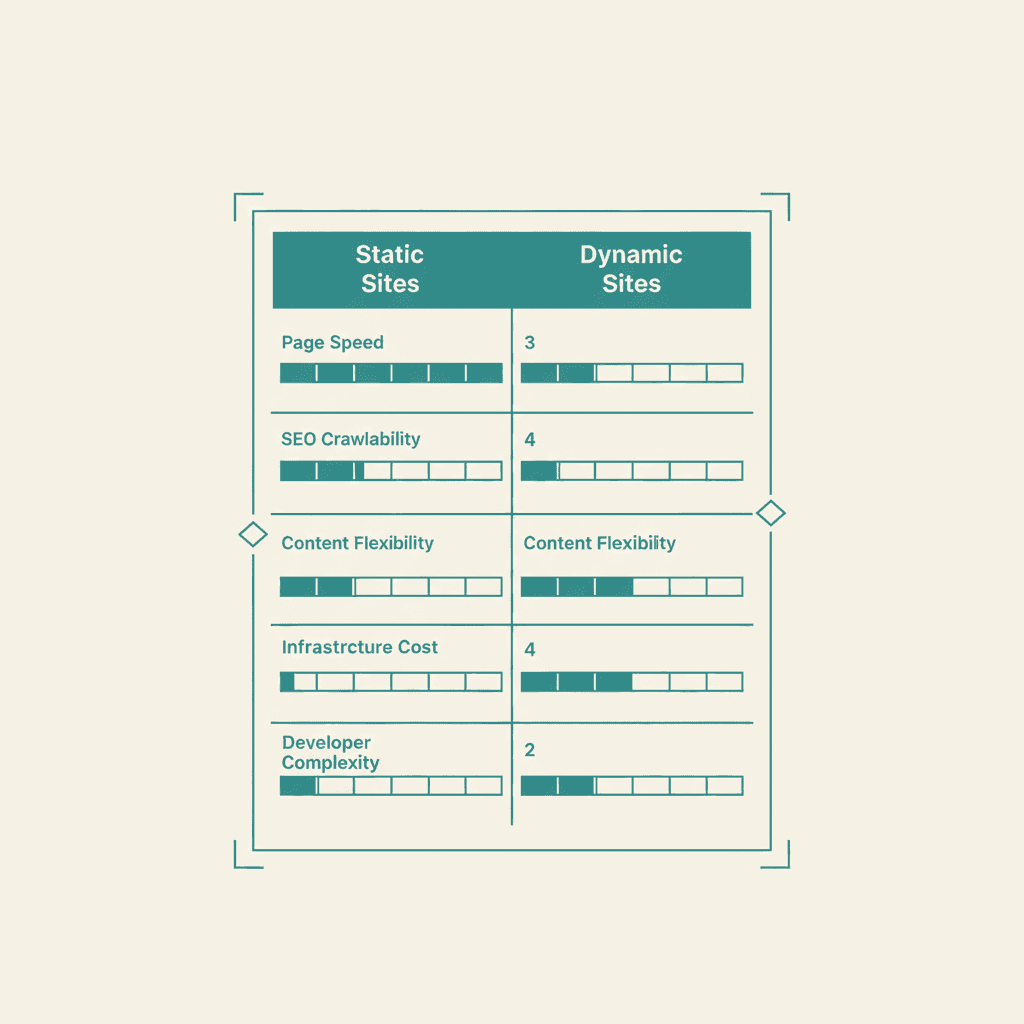
Modern web development has fragmented the static/dynamic distinction into a more nuanced spectrum:
Static Site Generation (SSG): Pages are pre-built at build time. Maximum performance. Limited to content that does not change between builds. Examples: Gatsby, Next.js static export, Hugo.
Server-Side Rendering (SSR): Pages are rendered on the server at request time and served as complete HTML. Combines the SEO-friendliness of static HTML with the ability to serve fresh, dynamic data. Examples: Next.js with `getServerSideProps`, traditional WordPress.
Client-Side Rendering (CSR): The server sends a minimal HTML shell. JavaScript runs in the browser to fetch data and render the page. Poor for SEO because Google's crawler must execute JavaScript to see the content — a process that can delay indexing significantly. Examples: Single-Page Applications built in React, Vue, or Angular without SSR.
Incremental Static Regeneration (ISR): A hybrid approach popularized by Next.js. Pages are pre-built statically but automatically regenerated at configurable intervals when content changes. Combines performance benefits of SSG with content freshness.
The SEO implications of this spectrum are significant. CSR applications — where Google must render JavaScript to see content — are consistently indexed more slowly and sometimes incompletely compared to pages that serve complete HTML directly.
SEO Implications of Static Websites
Page Speed
Static sites are the fastest available architecture. Pre-built HTML files served from a CDN deliver in milliseconds, with no server processing time. This directly improves Core Web Vitals scores — particularly Largest Contentful Paint (LCP) and First Contentful Paint (FCP) — which are ranking signals.
Google's 2026 ranking data continues to show a correlation between Core Web Vitals performance and ranking position. Sites in the top five positions for competitive keywords consistently show better LCP and Cumulative Layout Shift (CLS) scores than lower-ranked pages. Static architecture is the most reliable path to excellent Core Web Vitals.
Crawl Efficiency
Search engine crawlers are allocated a crawl budget per domain. Static pages are delivered instantly, so Googlebot can crawl more pages per crawl budget allocation. For large sites, this translates to faster discovery of new or updated content.
SEO Limitations of Pure Static Sites
Pure static sites have limitations that affect SEO strategy:
- Content updates require a rebuild and redeploy, which creates a delay between content changes and their appearance on the live site. For news sites or high-frequency publishing operations, this overhead is a constraint.
- Personalization and A/B testing are harder to implement without client-side JavaScript, which can conflict with core web performance goals.
- Dynamic sitemaps that automatically update as content is added require additional tooling.
SEO Implications of Dynamic Websites
Flexibility for Complex Sites
Dynamic sites naturally handle the complexity of e-commerce catalogs, user accounts, real-time inventory, and applications that would be impractical to rebuild statically. The ecommerce SEO requirements for large catalogs — dynamic category pages, faceted navigation, real-time availability — are better served by dynamic or hybrid architectures.
Crawling Challenges with CSR
The primary SEO risk with dynamic sites is client-side rendering. If a dynamic application renders content using JavaScript executed in the browser — and does not also serve server-rendered HTML — Googlebot may not see the content at the time of its first crawl. Google does eventually process JavaScript, but this can delay indexing by days to weeks.
Signs that CSR is causing indexing problems: Google Search Console showing pages as "crawled but not indexed," or thin content appearing in cached versions of pages that should have substantial text.
Performance Overhead
A WordPress site on typical shared hosting generates each page dynamically. Without caching plugins (WP Rocket, W3 Total Cache) and a CDN (Cloudflare), page generation times of 500ms to 2+ seconds are common. Compared to a static site served from a CDN at 50–100ms, this is a meaningful performance gap that affects both user experience and Core Web Vitals scores.
Optimized dynamic WordPress sites with full-page caching can approach static-site performance, but they require more configuration and maintenance overhead.
Next.js and Modern Frameworks: The Best of Both
Next.js — and similar frameworks like Nuxt for Vue and SvelteKit for Svelte — resolve the static/dynamic tension by supporting multiple rendering modes simultaneously within a single application:
- Marketing pages (homepage, service pages, about) can be statically generated at build time
- Blog posts can use ISR for fast delivery with automatic updates
- User-facing application pages can use SSR for fresh, personalized data
- API routes handle dynamic data operations without requiring a separate backend
This hybrid approach is why Next.js has become the architecture of choice for performance-conscious web projects in 2026. A Philippine business running its website on Next.js deployed to Vercel or a comparable edge platform can achieve static-page performance for all content-focused pages while maintaining dynamic capabilities for application features.
For businesses evaluating website architecture in the Philippines, web design services that specialize in modern frameworks offer a measurable performance and SEO advantage over traditional WordPress-only agencies. The technical SEO implications of rendering architecture should be part of any web design brief.
Mobile SEO and Rendering Architecture
Mobile SEO is particularly sensitive to rendering architecture choices. Philippine internet users access the web heavily on mobile devices and frequently on mobile data connections with real-world speeds lower than advertised. Page load time on mobile data is significantly more performance-constrained than on broadband.
Core Web Vitals are measured predominantly from real-user mobile data in CrUX (Chrome User Experience Report). A site that performs well on desktop but loads slowly on mobile data connections will have poor CrUX scores, which affects ranking.
Static sites served from CDN edge nodes close to Philippine users (Cloudflare operates edge nodes in Manila) can deliver pages in under 200ms. Dynamic sites without CDN caching may take one to three seconds to deliver the first byte.
When to Choose Static
A static or statically generated architecture is the right choice when:
- The site is primarily content-focused (blog, portfolio, documentation, landing pages)
- Content changes are infrequent enough to tolerate rebuild cycles
- Maximum performance is the priority
- The team has development resources to manage a build pipeline
- Personalization requirements are minimal
When to Choose Dynamic (with SSR)
A dynamic site with server-side rendering is the right choice when:
- The site has a large, frequently changing product catalog (e-commerce)
- Content is personalized per user (account portals, dashboards)
- Real-time data is essential (live inventory, pricing, availability)
- The content management team needs immediate publishing without build delays
- The team's technical stack is already centered on a traditional CMS
When NOT to Use Pure CSR
Client-side rendering without server-side HTML delivery is almost never the right choice for pages intended to rank in organic search. If a page's content is invisible in its initial HTML response and requires JavaScript to populate, it is at systematic risk of delayed or incomplete indexing regardless of its content quality.
If a development team proposes a CSR-only architecture for an SEO-important site, the correct response is to require server-side rendering or static generation for all content pages, with CSR limited to dynamic application interfaces behind authentication.
Philippines Market Considerations
For Philippine businesses, several market-specific factors favor static or ISR architecture for marketing and content sites:
- High mobile-first usage means Core Web Vitals on mobile networks are critical
- Variable connection quality in provincial areas makes fast initial page delivery disproportionately valuable
- CDN edge nodes in Manila are well-developed, making static CDN delivery highly effective
- The growing local developer ecosystem around Next.js and modern JAMstack tools means more available expertise
A comprehensive SEO strategy for Philippine businesses should treat website architecture as an SEO decision, not purely a development decision. The rendering architecture choice also has direct implications for on-page SEO — client-side rendering can prevent Google from reading title tags, H1s, and schema markup on the initial crawl, undermining on-page optimization entirely. The rendering architecture, hosting infrastructure, and CDN configuration are all SEO variables with measurable ranking implications. When businesses change platforms — migrating from WordPress to Next.js, for example — the site migration SEO checklist becomes essential to protecting rankings through the transition.
Frequently Asked Questions
Is WordPress good for SEO?+
WordPress with proper optimization (caching plugins, CDN, updated themes, correct schema markup, and clean URL structure) can be highly effective for SEO. Its main limitations are performance overhead compared to static sites and the CSR risks that come with some page builder plugins. Well-configured WordPress sites rank competitively in every major market.
Do static sites rank better than dynamic sites?+
Static sites tend to score better on Core Web Vitals due to their inherent performance advantages, and Core Web Vitals are ranking signals. However, ranking depends primarily on content quality, backlink authority, and relevance — not architecture alone. A well-configured dynamic site with strong content will outrank a poorly structured static site.
Can Google crawl JavaScript-heavy sites?+
Google can process JavaScript, but it does so through a secondary rendering queue that introduces delays compared to crawling traditional HTML pages. Pages that rely entirely on client-side JavaScript for their content are at risk of slow or incomplete indexing. SSR or SSG is recommended for all pages intended to rank.
What is Incremental Static Regeneration and why does it matter for SEO?+
ISR (Incremental Static Regeneration) is a Next.js feature that serves pre-built static HTML while automatically regenerating pages in the background at configurable intervals. For SEO, this means content can be updated without a full site rebuild, while still serving the performance benefits of static HTML. It is particularly valuable for content-heavy sites with frequent updates.
Which is better for Philippine businesses — static or dynamic websites?+
For content and marketing sites in the Philippines, static or ISR-based architecture offers meaningful SEO advantages, particularly for mobile performance on variable network connections. For e-commerce or application sites requiring real-time data, server-side rendering with aggressive caching is the practical choice. Most modern Philippine web projects benefit from a hybrid approach using Next.js or similar frameworks.