How to Optimize Content for ChatGPT and Perplexity
Learn how ChatGPT and Perplexity retrieve and cite web content, and what concrete steps make your pages more likely to appear as sources in AI answers.

ChatGPT and Perplexity now function as primary research tools for millions of people. When a user asks either platform a question and gets an AI-generated answer with source citations, those citations deliver brand exposure, referral traffic, and authority signals that compound over time. Earning those citations is not a matter of luck — it follows a logic that, once understood, can be optimized systematically.
This guide breaks down how each platform retrieves and selects content, what content formatting improves citation rates, and how to track whether your optimization is working.
How ChatGPT Retrieves Information
ChatGPT — specifically versions with web browsing enabled — uses Microsoft Bing's search index as its primary retrieval source. The process works through retrieval-augmented generation (RAG): when a user submits a query that the system determines requires current or external information, it performs a Bing search, retrieves a set of candidate pages, reads those pages, and synthesizes an answer with citations pointing to the sources it found most useful.
This has a direct implication: Bing optimization matters for ChatGPT citation. Pages that rank well in Bing for relevant queries are more likely to be in the candidate pool that ChatGPT evaluates. Since Bing's ranking signals overlap substantially with Google's — quality backlinks, content relevance, technical health, page speed, schema markup — strong traditional SEO is a prerequisite.
Within the candidate pool, ChatGPT tends to favor:
- Pages with clear, extractable answers to the specific question asked
- Pages with structured content (headings, lists, definitions) that the model can parse without ambiguity
- Pages with high domain authority or strong brand recognition in the topic area
- Recently updated pages for time-sensitive queries
Understanding generative engine optimization in full gives context for why these signals matter across all AI platforms, not just ChatGPT.
How Perplexity's RAG Works
Perplexity AI operates differently from ChatGPT. It runs its own web crawler (PerplexityBot) and builds its own independent index, separate from Google or Bing. This means Perplexity SEO requires ensuring that:
- PerplexityBot is not blocked in robots.txt. Some sites that block AI crawlers also accidentally block Perplexity, removing themselves from its index entirely.
- Pages are technically crawlable: no JavaScript-only rendering that the crawler cannot parse, clean internal linking, and fast server response times.
- Content is fresh: Perplexity weights recency more visibly than traditional search engines. Pages updated within the past six to twelve months appear more frequently in Perplexity citations than stale pages.
Perplexity's ranking layer within its RAG system prioritizes:
- Factual density — more verifiable facts per paragraph means a higher probability of being cited
- Source credibility signals — domains that are frequently cited by other authoritative pages in Perplexity's index
- Structured answer format — content that addresses a specific question in a scannable way
- Multi-source corroboration — if multiple credible pages agree on a fact, Perplexity is more confident citing any of them
A clear path to appearing in Perplexity results starts with strong on-page SEO foundations — clean structure, clear authorship, factual content with verifiable sources. It also helps to understand how AI Overviews work, since many of the same content quality signals apply across AI platforms.
Content Formatting for LLM Citation
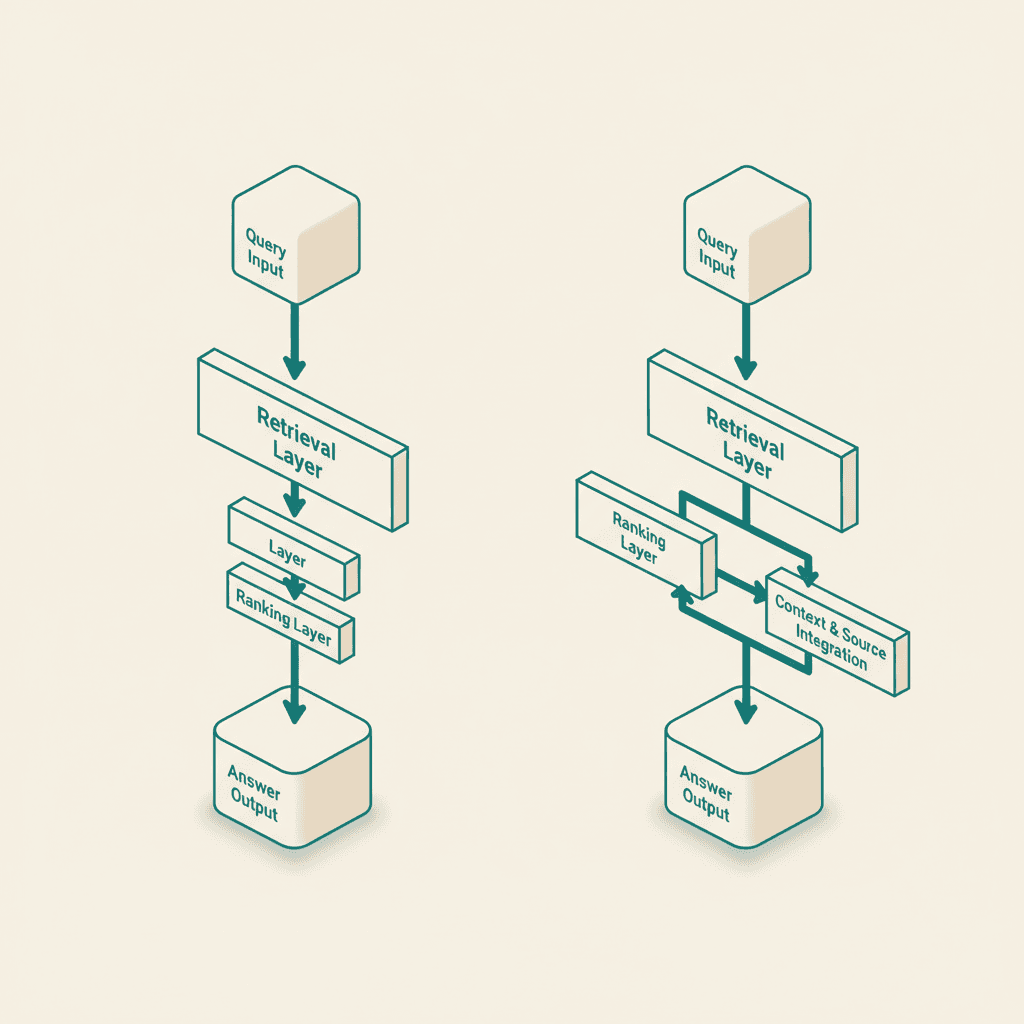
Both ChatGPT and Perplexity use language models to parse retrieved documents. Formatting that helps the model extract discrete, accurate facts improves citation rates on both platforms.
Lead with the Answer
The most consistently cited content leads with a direct answer to the likely query, then expands. A section titled "How does X work?" should open with a one or two sentence answer to that question before diving into nuance. This matches the model's retrieval pattern: it extracts the answer from near the heading, then optionally pulls supporting detail.
Use Numbered Lists and Bullet Points for Process Content
Step-by-step processes and lists of considerations are more reliably extracted as formatted answers when marked up as lists rather than embedded in prose. "There are three main factors: the first is X, the second is Y, and the third is Z" is harder for a model to cite accurately than:
- Factor X — explanation
- Factor Y — explanation
- Factor Z — explanation
Define Terms Explicitly
AI models are more likely to cite a page for a query asking "what is X" when the page contains an explicit definition formatted as "[Term] is [definition]." Implicit or contextual definitions are harder to extract cleanly.
Include Verifiable Statistics
The Princeton and Georgia Tech GEO research demonstrated that adding specific, attributed statistics meaningfully increased citation frequency. For Philippine market content, citing data from the Philippine Statistics Authority, BSP reports, DICT digital economy surveys, or respected regional research firms adds credibility that both the model and its users can verify.
Keep Paragraphs Short
AI models parse content more accurately when paragraphs contain a single focused idea. Long, dense paragraphs covering multiple points are more likely to be summarized imprecisely. Short, focused paragraphs are easier to cite accurately.
Use Clear H2 and H3 Structure
Both platforms match retrieved documents to queries at the section level. A section with a heading that closely matches the user's query is more likely to be cited for that query. Creating a heading for every major sub-question within a topic — then answering that sub-question directly in the following paragraph — is an effective structural approach.
Entity Building for AI Citation Authority
Getting cited once is valuable. Getting cited repeatedly, across many queries and users, requires entity authority — the degree to which AI systems recognize your brand or domain as a reliable, well-understood source in a topic area.
Entity building for AI citation involves:
Brand Consistency: Using your exact brand name consistently across your website, social profiles, structured data, and external mentions helps AI systems correctly attribute content to a single entity. Variations in naming create ambiguity.
Structured Data: JSON-LD schema on your website — particularly Organization schema, Author schema, and Article schema — gives AI systems machine-readable metadata about who you are, what you publish, and what topics you cover. This reduces ambiguity for the model's entity resolution process.
External Mentions at Authoritative Sources: When credible publications in your industry cite or quote your brand, that mention becomes part of the retrieval index that AI systems query. Being interviewed by, quoted in, or linked from recognized publications in your category builds entity authority faster than any on-site optimization.
Wikidata and Knowledge Graph Presence: Having a Wikidata entry for your organization or key individuals associated with your brand creates a stable, AI-readable reference point. Many AI systems consult Wikidata as a structured knowledge source alongside web retrieval.
Consistent Author Profiles: Named authors who publish consistently on a topic, with linked profiles on your site and consistent profiles on LinkedIn or Google Scholar, build individual entity authority that transfers to every page they contribute to.
For Philippine businesses, establishing entity presence in English-language industry publications — both global and regional Southeast Asian publications — is one of the highest-leverage GEO investments available. The AI SEO service landscape in the Philippines is evolving quickly, with specialized practitioners now offering entity-building programs as distinct services.
Structured Data That Helps with AI Citations
While AI systems do not rely exclusively on structured data, several schema types consistently support citation authority:
Article schema: Marks the page as editorial content, identifies the author, publisher, and publication date. This directly populates the metadata that RAG systems use to evaluate source credibility.
FAQPage schema: Marks up question-and-answer pairs on the page. AI systems querying for specific questions find FAQ schema highly parseable, and FAQ content frequently appears in citation excerpts.
HowTo schema: Marks up step-by-step instructions. Perplexity in particular frequently cites HowTo-structured content for procedural queries.
SameAs property: Linking your organization or person entities to their canonical representations on Wikidata, Wikipedia, LinkedIn, and other authority sources helps AI systems resolve your entity confidently.
Schema implementation is part of the broader GEO service stack that forward-looking agencies are building in 2026. Getting the structured data layer right supports citation performance across every AI platform simultaneously.
Authority Signals: What NOT to Do
Several common tactics actively hurt AI citation rates:
Blocking AI crawlers broadly: Some site owners, concerned about AI training data scraping, block all AI bots via robots.txt. This removes the site from Perplexity's index entirely and may affect other AI crawlers as well. Blocking training data scrapers is reasonable; blocking retrieval crawlers costs you citation opportunities.
Thin or padded content: AI models are better than traditional keyword-matching at detecting content that has high word count but low informational density. Pages padded with filler text to hit a word count threshold are less likely to be cited.
Misleading claims: RAG systems increasingly incorporate fact-checking signals. Pages that make factual claims contradicted by other credible sources in the index are cited less frequently and may be actively downgraded.
Over-optimization artifacts: Content that reads unnaturally because of keyword insertion or manipulative structural tricks is harder for language models to parse cleanly and may trigger quality filters.
Ignoring link building: Backlinks remain a core trust signal for both Bing (which feeds ChatGPT) and for domain reputation signals that Perplexity uses. Link building quality remains essential for AI citation performance.
Monitoring AI Citations
Tracking whether optimization is working requires tools beyond standard rank tracking:
Perplexity manual queries: Running your target queries in Perplexity and recording which pages are cited gives ground-truth data. For scale, use a structured query list and track citation status weekly.
ChatGPT manual queries: Similarly, querying ChatGPT (with browsing enabled) for target topics and recording citation presence. Note that ChatGPT results vary by user session, so multiple samples give more reliable data.
DataForSEO AI mentions API: DataForSEO's AI optimization endpoints track domain and brand mentions across AI-generated responses, providing aggregated metrics rather than requiring manual query-by-query auditing.
Referral traffic from AI platforms: Google Analytics 4 shows referral traffic from chat.openai.com, perplexity.ai, copilot.microsoft.com, and other AI platforms. This is incomplete — many AI interactions are zero-click — but provides a concrete traffic signal that can be trended over time.
Google Search Console for AI Overview citations: GSC does not yet distinguish AI Overview click traffic from organic clicks, but impression volume changes on pages you know are being cited provide indirect signal.
The Philippines Context
Filipino businesses competing in English-language digital search are well-positioned to benefit from AI citation optimization. The Philippine market has high English literacy among professional and commercial audiences, which means that well-written, factually accurate English-language content from Philippine publishers can compete for AI citations at a regional and global level.
The GEO service category is emerging in the Philippines in 2026 as businesses recognize that AI-powered search assistants are increasingly how their customers research purchases, compare providers, and evaluate options. Building AI citation presence now, while the field is less competitive than traditional SEO, represents a significant early-mover opportunity.
Frequently Asked Questions
Does ChatGPT use Google's index?+
No. ChatGPT with web browsing uses Microsoft Bing's index as its primary retrieval source. Bing optimization — strong backlinks, technical health, structured data, content quality — is therefore the most direct path to ChatGPT citation.
How does Perplexity find pages to cite?+
Perplexity operates its own crawler (PerplexityBot) and builds its own index. Pages that block PerplexityBot in robots.txt will not appear in Perplexity citations regardless of their quality or authority elsewhere.
What content format is most often cited by AI systems?+
Clearly structured content with explicit definitions, verifiable statistics, numbered lists for process content, and short focused paragraphs under informative headings consistently shows higher citation rates than dense, unstructured prose.
Do backlinks affect AI citation rates?+
Yes. Backlink authority affects Bing rankings (which feed ChatGPT) and domain credibility signals used by Perplexity. Strong link profiles correlate with higher citation rates across AI platforms.
How long does it take to see results from AI citation optimization?+
Results vary significantly. Technical fixes like unblocking AI crawlers can show results within days. Content restructuring typically takes weeks to months as updated pages are recrawled and re-evaluated. Entity building through external mentions is the longest-horizon effort, with meaningful impact often taking three to six months of consistent effort.