What Is PPC Management? A Business Owner's Guide
PPC management covers everything needed to run profitable paid ad campaigns — from setup and strategy to ongoing optimization and reporting. Here's what it actually includes.

Pay-per-click advertising is one of the most accessible forms of digital marketing for businesses of any size. Setting up a Google Ads or Meta Ads account takes less than an hour. Running campaigns effectively — in ways that generate real returns over time — is considerably more involved.
PPC management is the discipline of strategy, execution, and ongoing optimization that makes the difference between campaigns that drain budget and campaigns that produce predictable, scalable revenue. For Philippine business owners evaluating whether to manage campaigns themselves or work with a professional, understanding what PPC management actually includes is the essential first step.
This guide covers what PPC management involves in practice, how to evaluate the DIY-versus-managed question, what to look for in a PPC agency, which metrics matter, and what pricing models are realistic in the Philippine market.
What PPC Management Actually Includes
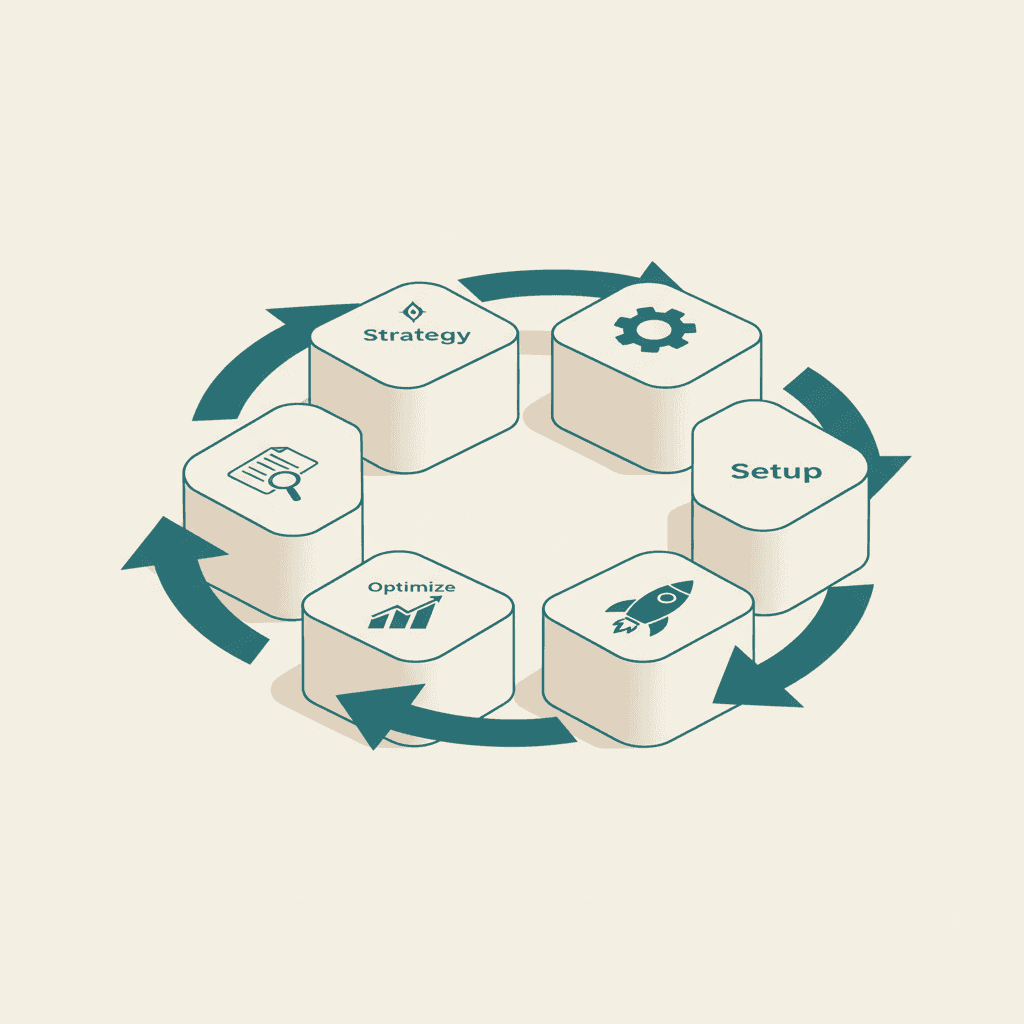
Effective PPC management is not just clicking the "launch campaign" button and watching traffic arrive. It is a continuous cycle of strategy, configuration, creative production, monitoring, testing, and reporting. Here is what that cycle looks like in practice.
Account Strategy and Structure
Before any campaign goes live, account architecture decisions significantly affect long-term performance. A well-structured account organizes campaigns by business goal, ad groups by tightly themed keyword clusters, and landing pages by the specific intent each ad group serves.
For example, a Philippine manufacturing company might structure campaigns as:
- Campaign 1: Steel Fabrication Services (keywords clustered around steel fabrication)
- Campaign 2: Custom Metal Works (keywords clustered around custom metalwork)
- Campaign 3: Industrial Equipment Repair (keywords clustered around repair services)
Each campaign has its own budget, geographic targeting, and bid strategy. Within each campaign, ad groups are further segmented by specific service variant. This structure ensures that ad copy is maximally relevant to the keywords triggering it, which improves Quality Scores and reduces cost-per-click.
Keyword Research and Selection
PPC management begins with identifying the right keywords — the terms actual customers use when searching for what a business offers. This requires:
- Volume analysis: How many people search for this term monthly?
- Intent classification: Is this term informational ("what is PPC") or commercial ("hire PPC agency Philippines")?
- Competitive analysis: How many advertisers are bidding, and at what CPC?
- Relevance scoring: How closely does this term align with what the business offers?
Keyword selection also includes building negative keyword lists — terms that should be excluded from triggering ads. A kitchen remodeling company would add "DIY," "free," and "YouTube tutorial" as negatives to prevent paying for clicks from users who want to do the work themselves.
Negative keyword management is one of the most impactful but most neglected aspects of PPC management.
Ad Copy Creation and Testing
Ad copy must simultaneously be relevant to the keyword, compelling to the user, and compliant with Google's ad policies. Effective search ads:
- Include the keyword in the headline (for relevance signals)
- Highlight a specific value proposition (not just "best quality")
- Include a clear call to action
- Use all available asset extensions (sitelinks, callouts, structured snippets, image assets)
Professional PPC management includes systematic A/B testing of ad copy variants. Even small differences in headlines — "Affordable Accounting Services in Manila" versus "Manila Accounting Firm | Free Consultation" — can produce conversion rate differences of 30–50%.
Bid Management and Optimization
Bids determine how competitive the ads are across the auction. Modern Google Ads campaigns offer automated bidding strategies (Target CPA, Target ROAS, Maximize Conversions) that use machine learning to adjust bids in real time based on hundreds of signals. But automated bidding requires proper setup, correct conversion tracking, and periodic human oversight to catch when the algorithm is optimizing toward the wrong goal.
Manual bid management — setting and adjusting bids by keyword, device, location, time of day, and audience segment — remains relevant for campaigns with low conversion volume that cannot feed automated bidding adequately. Knowing when to use manual versus automated bidding, and how to transition between them, is a core PPC management skill.
Landing Page Coordination
Ads drive traffic. Landing pages determine whether that traffic converts. A PPC manager who only optimizes ads without attention to landing page performance is solving half the problem.
Effective PPC management includes:
- Identifying landing page weaknesses through heatmap and session recording analysis
- A/B testing headline and CTA variations
- Recommending design changes to reduce friction
- Ensuring page load speed on mobile meets performance thresholds (under two seconds)
- Coordinating with web teams to implement changes
Web design quality is not separable from PPC ROI. The same ad budget produces very different results on a high-converting landing page versus a poorly designed one. This is why the best PPC management for Facebook Ads and Google always includes landing page review as part of the core workflow.
Conversion Tracking Setup
Without conversion tracking, PPC campaigns cannot optimize toward what matters. Conversion tracking captures user actions — form submissions, phone calls, purchases, app installs — and passes that data back to Google and Meta so the algorithms can optimize toward users most likely to complete those actions.
Proper setup requires:
- Google Tag Manager or direct tag implementation
- Google Ads conversion actions linked to the correct events
- Google Analytics 4 integration for cross-channel attribution
- Call tracking for businesses that receive inquiries by phone
- Server-side tracking for e-commerce to capture purchase values accurately
Campaigns running without proper conversion tracking are spending blind. The algorithm will optimize for clicks, which is the default, rather than for the conversions that actually matter.
Reporting and Performance Analysis
PPC management includes regular reporting that connects campaign activity to business outcomes. A useful PPC report covers:
- Spend by campaign and comparison to previous period
- Impressions, clicks, CTR, and average CPC
- Conversions, conversion rate, and cost per conversion
- ROAS (for e-commerce) or cost per lead (for lead generation)
- Quality Score trends by keyword
- Top-performing and underperforming ad groups
- Recommendations for the next optimization cycle
Reporting that only shows impressions and clicks without conversion data is not useful for making business decisions. The metrics that matter are always downstream of the click.
DIY vs Managed PPC: The Honest Assessment
Google makes PPC accessible to self-managing advertisers. Smart Campaigns and Performance Max reduce the complexity significantly. But "accessible" is not the same as "equally effective."
The case for DIY PPC:
- Full control and immediate feedback on changes
- No management fees (though the cost in time and mistakes often exceeds what management fees would have been)
- Deep familiarity with the specific business context that an external agency may take time to develop
- Appropriate for very small budgets (under ₱20,000/month in ad spend) where management fees would consume a disproportionate share
The case for professional management:
- Expertise developed across many campaigns and industries, not just one account
- Dedicated time: PPC optimization is a full-time job at meaningful spend levels
- Tooling: Agencies have access to professional-grade software that individual advertisers rarely invest in
- Error cost: Mistakes in PPC are expensive (money spent on irrelevant clicks, accounts suspended for policy violations, algorithms stuck in bad local optima). An experienced manager catches and corrects these faster
The realistic assessment: for budgets above ₱30,000–40,000/month in ad spend, professional management almost always pays for itself through improved efficiency. Below that threshold, the math is less clear and depends heavily on the individual's technical capability.
How to Choose a PPC Agency in the Philippines
Not all agencies offering PPC management deliver the same quality. Key evaluation criteria:
Google Partner or Premier Partner status: Google certifies agencies that meet spending thresholds and pass competency exams. Premier Partner status indicates the agency is in the top 3% of Google partners by performance. Look for this as a baseline qualifier.
Meta Business Partner status: For agencies managing Facebook and Instagram campaigns.
Transparency about who manages the account: Ask specifically who will manage the campaigns day-to-day and what their experience level is. Agencies that pitch senior staff but execute with juniors are common.
Case studies with specific numbers: Request case studies that include starting position, strategy, timeline, and measurable outcomes — not just logo grids.
Access to all campaign data: The business should own its Google Ads account and have full admin access. Any agency requiring otherwise is creating lock-in.
Clear reporting cadence and format: Understand before signing how often you'll receive reports, what they'll contain, and who to call with questions.
Understanding how to choose a digital marketing agency in the Philippine context covers the full evaluation process, including red flags and questions to ask during the selection process.
Key PPC Metrics Every Business Owner Should Understand
Click-Through Rate (CTR): Impressions to clicks ratio. A low CTR suggests ads are not compelling or not relevant to the keywords triggering them. Benchmark: 3–5% for well-optimized search campaigns.
Cost Per Click (CPC): Average cost for each click. Context-dependent — a ₱300 CPC is expensive for a ₱5,000 product sale but fine for a ₱200,000 service engagement.
Quality Score: Google's 1–10 rating of ad relevance, keyword relevance, and landing page quality. Higher scores reduce CPCs and improve position. Target 7+ for priority keywords.
Conversion Rate: Percentage of clicks that complete the target action. Benchmark varies by industry; 2–5% is typical for most lead generation campaigns.
Cost Per Conversion: Total spend divided by conversions. The most important cost metric — it directly answers "how much does it cost to generate a lead?"
Return on Ad Spend (ROAS): Revenue divided by ad spend. Target ROAS depends on margins; 4× is a common minimum target for many businesses.
Impression Share: What percentage of available impressions the campaign is capturing. Low impression share combined with "lost due to budget" indicates underspending; "lost due to rank" indicates bid or Quality Score issues.
Common PPC Management Mistakes
Not defining conversion tracking before launch: Running campaigns without conversion tracking is the single most common and costly mistake. Without conversion data, optimization is guesswork.
Setting too-small budgets: Campaigns that spend ₱300 per day generate insufficient data to optimize toward conversion. Algorithms need volume to learn; minimum effective daily budgets depend on CPC, but generally require 5–10 clicks per day minimum.
Neglecting negative keywords: Broad match and phrase match keywords capture unintended queries. Without ongoing negative keyword additions, budget leaks to irrelevant traffic.
Identical ads in every ad group: Each ad group should have ads written for the specific keywords and intent in that group. Generic ads across many ad groups consistently underperform.
Focusing on CTR at the expense of conversion rate: High CTR is good only if those clicks convert. Ads that generate lots of clicks but few conversions are burning budget, not producing results.
Ignoring mobile performance: In the Philippines, where 85%+ of searches happen on mobile, landing pages that perform poorly on mobile will convert poorly regardless of how well the ads are optimized.
Pricing Models for PPC Management
Philippine agencies and consultants typically offer PPC management on one of these structures:
Flat monthly retainer: A fixed fee for a defined scope of management work. Predictable costs; common for established ongoing programs. Range: ₱15,000–60,000/month depending on account complexity.
Percentage of ad spend: A percentage of the monthly media spend, typically 10–20%. At low spend levels (under ₱50,000/month), this may not generate enough fee to motivate quality management. At high spend levels, it can become expensive.
Performance-based: Fees tied to specific outcomes — cost per lead, cost per acquisition, or revenue targets. Aligns incentives but creates complex attribution discussions. Less common in the Philippine market.
Hybrid: A base retainer plus a smaller percentage of ad spend. Provides baseline commitment on both sides while partially aligning incentives.
For most Philippine businesses, a flat monthly retainer with clearly defined deliverables and KPIs is the most straightforward structure.
The broader question of how much digital marketing costs across all service types is covered in the digital marketing services guide.
What to Expect Month by Month
Month 1: Campaign setup, conversion tracking implementation, initial keyword research, campaign and ad group structure, first ad copy. Performance will be limited while the algorithm learns.
Months 2–3: Learning phase data accumulates. Performance improves as the algorithm identifies which users convert. Active optimization of keywords, bids, and ad copy. Negative keyword list builds.
Months 3–6: Mature campaigns reach stable performance. Clear ROAS or CPL trends emerge. Budget allocation shifts toward highest-performing campaigns and keywords.
Months 6+: Expansion — new campaigns for additional services or markets, new ad formats, seasonal strategy adjustments, competitive response to new entrants. At this stage, data from managed campaigns also informs longer-term organic strategy — the Google Ads guide for Philippine businesses covers how search campaigns and SEO complement each other over time.
Frequently Asked Questions
What is the difference between PPC management and running your own ads?+
Self-managed campaigns give the business owner direct control but require significant time investment and expertise to run effectively. Professional PPC management brings dedicated expertise, continuous optimization, and tooling across the full cycle — strategy, setup, testing, and reporting — with the manager's full attention on maximizing campaign performance.
How much does PPC management cost in the Philippines?+
Professional PPC management ranges from ₱15,000 to ₱60,000+ per month depending on the number of platforms, campaign complexity, and agency reputation. This is separate from media spend (the money paid to Google or Meta for clicks). Freelancers typically charge ₱5,000–15,000 per month for basic management.
How long does it take to see results from professionally managed PPC?+
Unlike SEO, PPC generates traffic immediately. However, campaigns typically require four to eight weeks to exit the learning phase and reach stable, optimizable performance. Meaningful ROI trends emerge at two to three months for well-managed accounts.
Should a small Philippine business manage its own Google Ads?+
For very small budgets (under ₱20,000/month in ad spend), DIY management may be appropriate — especially through simplified campaign types like Google's Smart Campaigns. Above that threshold, the efficiency gains from professional management typically exceed the management fee cost, making professional management the better economic choice.
What should be in a monthly PPC management report?+
A useful monthly report covers spend versus budget, impressions, clicks, CTR, average CPC, conversions, conversion rate, cost per conversion, ROAS, Quality Score trends for top keywords, key optimization actions taken during the month, and recommendations for the next month. Reports that lack conversion and revenue data are not providing the information needed to evaluate campaign ROI.