How to Measure Social Media ROI: A Practical Guide
Likes and followers aren't ROI. Learn how to connect social media activity to real business revenue — metrics, attribution models, and reporting frameworks for 2026.

Social media ROI is the metric that separates businesses with a social media presence from businesses with a social media strategy. The difference is not platform selection, posting frequency, or follower count — it is whether the activity can be connected to a business outcome that justifies the investment.
This guide addresses the mechanics of measuring social media return on investment: what metrics actually matter, how attribution models work, which tools provide the most reliable data, and how to build a reporting structure that turns social media from a cost center into a trackable growth lever.
The challenge is real. Unlike paid search advertising, where a click generates a conversion and the path is direct, social media operates across longer time horizons, multiple touchpoints, and channels that do not always generate measurable last-click attribution. The solution is not to give up on measurement — it is to use the right frameworks.
Defining ROI for Social Media
Return on investment has a simple formula: (Revenue from social – Cost of social) / Cost of social × 100. The challenge in social media is that both variables are harder to isolate than they appear.
Cost of social includes: staff time (content creation, community management, strategy), paid distribution budgets, software and tool subscriptions, creative production (photography, video, design), and influencer or creator fees. Many businesses undercount the time variable, which leads to systematically understating the true cost.
Revenue from social is where attribution complexity enters. A customer who discovers a brand through a TikTok video, engages with it on Instagram Stories over two weeks, clicks a Facebook retargeting ad, and then searches the brand name directly before purchasing has interacted with social media meaningfully at multiple points. Crediting the "revenue" to the right touchpoints requires more than looking at Google Analytics' default last-click model.
Framing this alongside what a full digital marketing approach involves helps place social ROI within the broader picture — social is one channel among several, and its contribution is best understood in context, not isolation.
Vanity Metrics vs. Business Metrics
The first discipline in social media measurement is distinguishing between metrics that feel good and metrics that inform decisions.
Vanity metrics include follower counts, total impressions, reach, and raw likes. These numbers grow with activity but do not directly predict business outcomes. A post with 50,000 impressions that generates zero website visits or inquiries has not contributed to ROI regardless of how it looks in a social report.
Business metrics include:
- Website traffic from social — measured in Google Analytics 4 as the Social channel group, broken down by platform
- Lead volume — form completions, phone calls, chat initiations attributed to social traffic
- Cost per lead from paid social — particularly relevant for Facebook and Instagram ads
- Revenue attributed to social — requires multi-touch attribution or e-commerce tracking
- Customer acquisition cost (CAC) from social — total spend divided by new customers acquired through social channels
- Return on ad spend (ROAS) — for paid social campaigns, revenue divided by ad spend
- Branded search volume — the rise in people searching for the brand by name, indicating that social awareness is translating to search intent
The branded search volume metric deserves particular attention. When social media activity builds genuine brand awareness, the most reliable signal is that more people search for the brand directly. Tracking this through Google Search Console and correlating it with social activity periods gives a reliable awareness-to-intent signal even when last-click attribution is weak.
This connects to the importance of regular SEO reporting — branded search volume data lives in organic search reports, not social analytics, but it measures social media's impact on brand recognition.
Attribution Models: Which One to Use
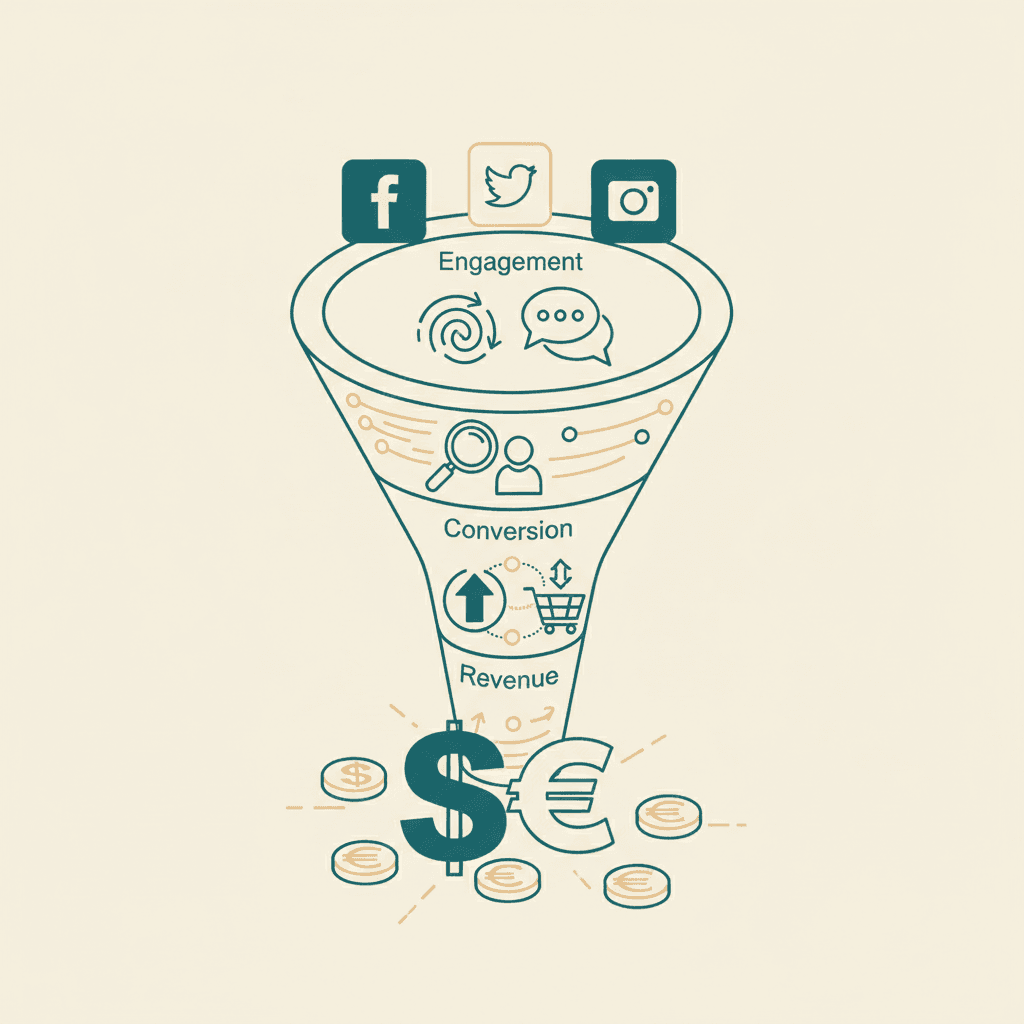
Attribution is the practice of assigning credit to marketing touchpoints that contributed to a conversion. For social media, the choice of attribution model dramatically changes how ROI appears.
Last-click attribution assigns 100% of the conversion value to the final touchpoint before purchase. This model systematically undervalues social media because social typically operates earlier in the funnel — creating awareness and building consideration — while the final click often comes from direct navigation or branded search. Most default GA4 setups use this model and will therefore underreport social's true contribution.
First-click attribution assigns 100% of the value to the first touchpoint. This overvalues social media for discovery channels like TikTok and systematically undervalues retargeting channels.
Linear attribution distributes credit equally across all touchpoints in the path. Better than single-touch models but still arbitrary in the equal distribution.
Time-decay attribution assigns more credit to touchpoints closer to conversion. Reasonable for short sales cycles but disadvantages social's awareness role in longer funnels.
Data-driven attribution (DDA) uses machine learning to assign credit based on the actual paths that lead to conversions in the specific account's data. This is the most accurate model for businesses with sufficient conversion volume (GA4 recommends 30+ conversions per month). It is the default model in GA4 for accounts that qualify and should be used when available.
For most Philippine businesses with moderate conversion volumes, a pragmatic approach combines DDA in GA4 with a manual analysis of assisted conversions — looking at which social channels appear in conversion paths even when they are not the final touchpoint.
Tools for Measuring Social Media ROI
No single tool captures everything. A functional measurement stack combines several sources.
Google Analytics 4 is the foundation. Properly configured, it tracks social media traffic, on-site behavior, goal completions, and e-commerce transactions attributed to social channels. The key setup steps: UTM parameters on all social links (not just paid ads), conversion event tracking for all meaningful actions (form submissions, calls, chat initiations, purchases), and the GA4 advertising workspace for multi-touch attribution analysis.
Native platform analytics provide data that GA4 cannot — reach, engagement rates, video completion rates, and audience demographic breakdowns. Facebook Insights, Instagram Insights, TikTok Analytics, and LinkedIn Analytics each offer channel-specific metrics that inform content optimization even when they cannot directly measure revenue.
Meta Ads Manager provides ROAS and conversion data for paid Facebook and Instagram campaigns, with its own attribution window settings (typically 7-day click, 1-day view). Comparing Meta's reported conversions with GA4's attributed conversions shows the gap between platform-reported and analytically verified results.
CRM integration is valuable for B2B businesses. When leads from social media are entered into a CRM (HubSpot, Salesforce, or similar), tracking the lead through to closed deal value gives the true long-term revenue picture that GA4 alone cannot provide.
Brand monitoring tools like Google Alerts, Mention, or more sophisticated platforms track brand mentions across social media. This provides a proxy for brand awareness growth and feeds into online reputation management efforts alongside ROI measurement.
Connecting Social to Revenue: Practical Methods
Beyond attribution models, several practical methods help connect social media activity to business outcomes.
UTM parameters on all links. Every link shared on social — in bios, captions, Stories, LinkedIn posts — should include UTM parameters that identify the source, medium, and campaign. This is the single most important technical step in social media measurement. Without UTMs, GA4 cannot distinguish between traffic from a TikTok bio link and direct traffic typed into a browser.
Social-specific landing pages. Creating landing pages that are only accessible from social media links (and not indexed by search engines) creates a clean measurement environment. Any traffic to that page came from the social source, making conversion tracking straightforward.
Promo codes for influencer campaigns. When working with creators or influencers, unique promo codes tied to each creator allow direct revenue attribution without relying on technical tracking. Customers using the code at checkout are unambiguously attributed to that creator's social content.
Surveys at point of conversion. Asking "How did you hear about us?" at the checkout or lead form stage captures conversions from customers who discovered the brand through social but converted through a different channel — a gap that technical attribution systems miss.
Cohort analysis. Comparing the behavior and lifetime value of customers acquired through social channels versus other channels reveals whether social-acquired customers are more or less valuable over time. This long-term perspective often reveals social media ROI that short-term attribution windows miss.
Reporting Frameworks for Social Media ROI
A useful social media ROI report covers four levels: activity (what was published), distribution (who saw it), engagement (who interacted), and conversion (who took a business action).
Monthly reporting should track:
- Content volume by platform and format
- Reach and engagement rate trends (compared to prior period)
- Traffic from social to website (sessions, users, page depth)
- Goal completions and conversion rate from social traffic
- Cost per result for any paid campaigns
- Branded search volume trend (from Google Search Console)
- Top-performing content by business metric (not just likes)
Quarterly reporting should include:
- CAC from social channels compared to other channels
- ROAS for paid social over the quarter
- Audience growth rate and composition
- Channel mix shift (what percentage of social-attributable conversions came from each platform)
- Attribution path analysis — which social touchpoints appear most in multi-touch conversion paths
This reporting cadence mirrors the structure of comprehensive SEO and digital marketing reports and should ideally be integrated with overall digital marketing performance rather than siloed in a social-only report.
ROI Benchmarks for Philippine Businesses
Context helps. Benchmarks vary significantly by industry, spend level, and business model, but some reference points for the Philippine market in 2026:
For paid social (Meta ads): A ROAS of 2–4x is typical for e-commerce brands in competitive categories. Service businesses targeting leads rather than purchases typically look for cost-per-lead benchmarks — ₱150–₱500 per qualified lead is common for local services, rising to ₱1,000–₱5,000 for professional services with longer sales cycles.
For organic social: Measuring organic ROI requires attributing value to activities that do not have direct spend. A useful approach is to calculate the equivalent paid media cost to generate the same reach or traffic organically, then subtract the cost of content production. If producing content costs ₱50,000 per month and generates ₱200,000 worth of reach at paid CPM rates, the effective ROI is positive.
Brands investing in professional social media management alongside paid advertising through PPC tend to see compound returns — organic content builds the audience and retargeting lists that make paid advertising more efficient over time.
The Role of Social in Full-Funnel ROI
Social media's greatest weakness in ROI measurement is also its greatest strength in marketing strategy: it operates throughout the entire funnel, not just at the conversion stage. It builds the brand awareness that makes all other marketing more efficient. It creates the trust that reduces resistance at the point of sale. It generates the content that appears in search results, drives word-of-mouth, and feeds retargeting audiences.
Brands that measure social media ROI purely on last-click conversions will consistently underinvest in it. Brands that use multi-touch attribution, track branded search trends, measure customer lifetime value by acquisition channel, and integrate social reporting with overall business metrics will make better investment decisions — and see better returns.
For a deeper look at how social fits within platform-specific decisions, the guide on choosing the best platform for your business and the comprehensive breakdown of social media marketing in the Philippines provide the strategic context that makes ROI measurement meaningful.
Frequently Asked Questions
What is a good social media ROI benchmark?+
There is no universal benchmark, but a commonly used threshold is 3:1 — every peso invested in social (including staff time and production costs) should generate at least three pesos in attributed revenue. Paid social campaigns typically target higher ROAS thresholds: 2–4x for e-commerce, higher for low-cost-of-goods categories.
How do I track ROI from organic social media?+
Organic ROI requires tracking website traffic from social (via GA4 with UTM parameters), converting that traffic into leads or purchases, and comparing the value generated against the cost of content production and community management. Branded search volume growth is also a valuable proxy metric.
Do follower counts affect social media ROI?+
Follower count influences organic reach potential — more followers means more people see each post without paid amplification. But raw follower count is a poor ROI predictor. Engagement rate (interactions divided by reach) and the quality of the audience relative to the target customer profile matter far more.
Which platform has the best ROI for Philippine businesses?+
It depends on the business model. Philippine e-commerce brands typically see the strongest paid ROI from Meta (Facebook and Instagram) due to TikTok Shop's still-maturing attribution. B2B companies report the best lead quality ROI from LinkedIn. For organic content, TikTok's algorithm provides the highest reach-per-post for brands with strong video content.
How does social media ROI connect to overall SEO performance?+
Social media activity influences branded search volume, which is tracked in organic search reports. It also generates backlinks when content gets shared on other sites — an indirect SEO benefit. Brands investing in both channels see compounding returns: social builds awareness that drives branded search, and strong search presence builds the trust that makes social ads convert at lower cost.