Schema Markup Guide: Structured Data for SEO
A complete guide to schema markup: what it is, why it matters for SEO and AI, the most useful types, how to implement it, and how to avoid common mistakes.

Schema markup is one of the most technically straightforward, highest-impact improvements available in SEO — yet it is consistently underimplemented. A 2025 analysis of Philippine e-commerce and service sites found that fewer than 35% had implemented any structured data beyond the basics auto-generated by their CMS. In 2026, with structured data playing a role not just in traditional rich results but also in AI Overview citations, the implementation gap represents a growing competitive disadvantage.
This guide covers everything needed to implement schema markup effectively: what it is, why it matters, which types to prioritize, how to implement it correctly in JSON-LD, and how to test and maintain it.
What Is Schema Markup?
Schema markup — also called structured data — is code added to the HTML of a webpage that communicates the meaning of the page's content to machines. While HTML tells browsers how to display content visually, schema markup tells search engines and AI systems what the content means semantically.
Schema vocabulary is defined at Schema.org, a collaborative maintained by Google, Microsoft, Yahoo, and Yandex. It provides a shared set of types (Article, Product, Organization, Person, Event, and hundreds more) and properties that describe the attributes of each type.
The most common implementation format is JSON-LD (JavaScript Object Notation for Linked Data), a script block embedded in the `<head>` or `<body>` of the page. Google strongly recommends JSON-LD because it is separate from the visible HTML, easy to add without modifying content markup, and straightforward to validate.
Why Schema Markup Matters for SEO in 2026
Schema markup creates value across two distinct surfaces in 2026:
Rich Results in Traditional Search
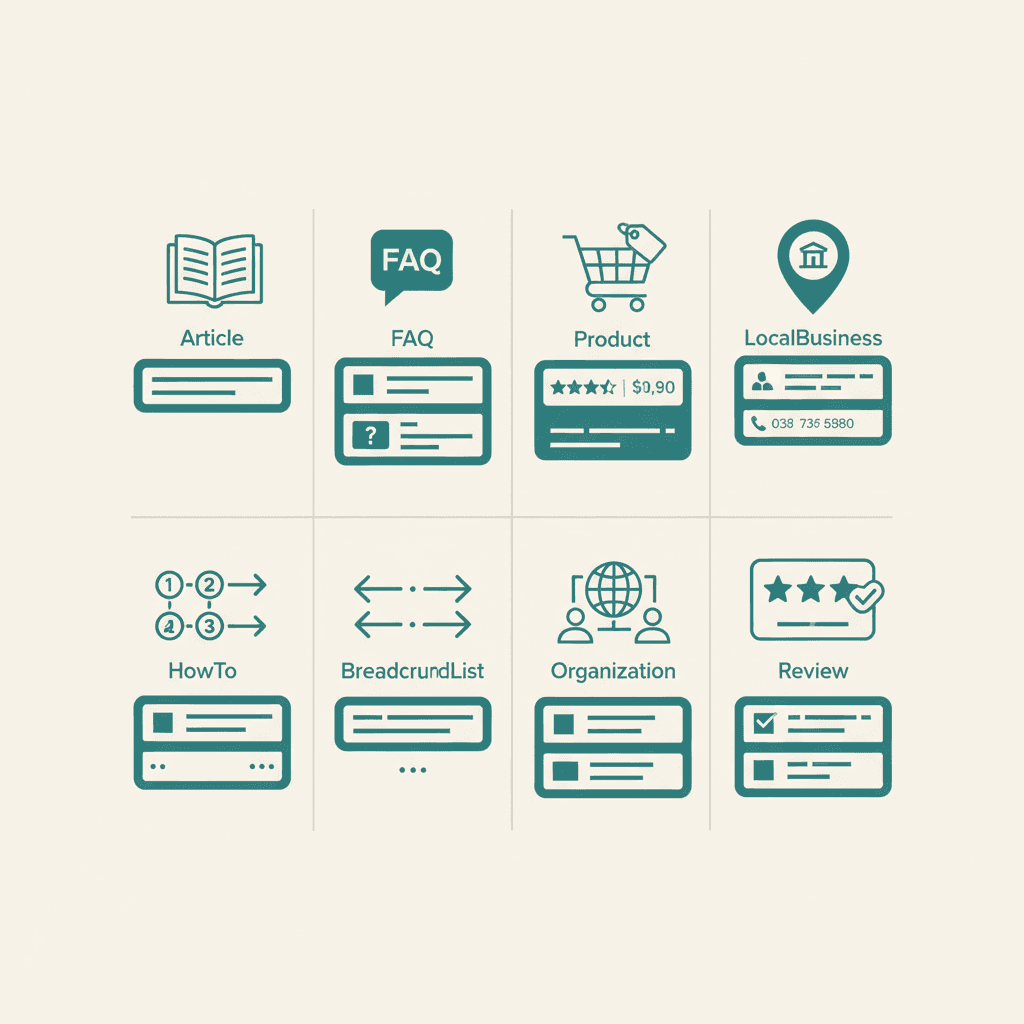
Correctly implemented schema can unlock rich results — enhanced SERP features that improve visual prominence and click-through rate. These include:
- Star ratings on product and review pages
- FAQ dropdowns in the SERP
- Breadcrumb navigation trails
- Site links search boxes
- Event cards with date, location, and ticket information
- Recipe cards with images, cooking time, and ratings
- HowTo step previews
Rich results do not guarantee higher rankings, but they improve organic CTR. A page in position four with a star rating and FAQ expansion often outperforms a position-two result with no rich results on click share.
AI Overview and LLM Citation
Google AI Overviews use schema markup as a machine-readable signal about content type and structure. A page with correctly implemented Article schema — including author, publisher, datePublished, and dateModified fields — gives the AI system clean metadata to evaluate and cite. FAQ schema, in particular, is directly used by AI Overviews to surface question-and-answer pairs.
The relationship between structured data and AI citation is becoming a first-order consideration in on-page SEO work. Pages without schema are harder for AI systems to categorize accurately, which reduces citation probability.
The relationship between what appears on-page and how AI systems perceive content is detailed further in on-page vs technical SEO — schema sits at the boundary between both disciplines.
The Most Important Schema Types
Article
Article schema is the foundational schema type for editorial, blog, and news content. Key properties:
```json
{
"@context": "https://schema.org",
"@type": "Article",
"headline": "Schema Markup Guide: Structured Data for SEO",
"author": {
"@type": "Person",
"name": "Author Name",
"url": "https://example.com/author"
},
"publisher": {
"@type": "Organization",
"name": "Publisher Name",
"logo": {
"@type": "ImageObject",
"url": "https://example.com/logo.png"
}
},
"datePublished": "2026-03-14",
"dateModified": "2026-03-14",
"image": "https://example.com/featured-image.jpg"
}
```
The `author` and `datePublished` fields are particularly important for E-E-A-T signaling. Publishing an article without author schema leaves the authorship ambiguous for machine readers.
FAQPage
FAQPage schema marks up question-and-answer content, enabling FAQ rich results in Google Search and making the Q&A pairs directly extractable for AI Overview generation.
```json
{
"@context": "https://schema.org",
"@type": "FAQPage",
"mainEntity": [
{
"@type": "Question",
"name": "What is schema markup?",
"acceptedAnswer": {
"@type": "Answer",
"text": "Schema markup is structured data added to webpage HTML that communicates content meaning to search engines and AI systems."
}
}
]
}
```
FAQPage schema is one of the highest-ROI schema types for content pages. Adding it to existing blog posts and service pages that already include FAQ sections requires minimal effort and directly improves both traditional rich results and AI Overview citation potential.
LocalBusiness
For Philippine businesses with physical locations, LocalBusiness schema is critical. It tells search engines the business name, address, phone number, hours, geographic coordinates, and service area. This data directly feeds the local knowledge panel and influences local pack rankings.
Subtypes like `MedicalBusiness`, `Restaurant`, `LegalService`, and `FinancialService` provide more specific signals for businesses in those categories.
Product and Review
E-commerce pages benefit substantially from Product schema (name, image, price, availability, SKU) and Review or AggregateRating schema (rating value, review count). These unlock star ratings in organic results and shopping panels, and help AI shopping assistants surface the product accurately.
HowTo
HowTo schema marks up step-by-step instruction content. Google can display individual steps as rich results. More importantly for 2026, Perplexity AI and other AI answer engines frequently cite HowTo-structured content for procedural queries — "how to do X" questions — because the step structure is directly usable in their answer format.
BreadcrumbList
BreadcrumbList schema marks up a page's position in the site hierarchy, enabling breadcrumb display in SERPs. Beyond the visual benefit, breadcrumbs help search engines and AI systems understand site structure and topic hierarchy — which topics are subtopics of which broader categories.
Well-structured URLs combined with BreadcrumbList schema give a clear, machine-readable picture of site architecture. SEO-friendly URL structures and breadcrumb schema work together to communicate information hierarchy.
Organization and WebSite
Organization schema on the homepage (and ideally sitewide) establishes the publisher entity — name, logo, founding date, social profiles, contact information. WebSite schema enables the sitelinks search box in branded SERPs. Both types are foundational entity authority signals that AI systems use to establish confidence in the domain.
Implementation Method: JSON-LD
Google recommends JSON-LD as the implementation format for all schema markup. JSON-LD is a `<script>` block inserted into the page `<head>` with `type="application/ld+json"`. It contains the structured data as valid JSON.
Advantages of JSON-LD:
- Completely separate from the visible HTML — no risk of breaking visual content
- Easy to update and maintain
- Can be injected via Google Tag Manager without CMS changes
- Can be generated dynamically by CMS templates for consistent coverage at scale
- Validates cleanly in Google's Rich Results Test
Microdata (embedding schema attributes directly in HTML elements) and RDFa (a more complex embedding format) are also valid but are harder to maintain and audit. Most modern implementations use JSON-LD exclusively.
For WordPress sites, plugins like Yoast SEO, Rank Math, and Schema Pro generate JSON-LD automatically for standard content types. For custom-built sites — including those built in Next.js, which is popular among Philippine tech businesses — JSON-LD is injected programmatically in the page `<head>` using the `next/head` component or Next.js 13+ metadata API.
Testing and Validation
Every schema implementation must be validated before relying on it for SEO performance.
Google's Rich Results Test (search.google.com/test/rich-results): The authoritative tool for checking whether schema is correctly implemented and which rich results it qualifies for. Accepts either a URL or direct HTML input.
Schema.org Validator: Validates JSON-LD against the Schema.org specification. Catches property and type errors that Google's tool may not flag.
Google Search Console: The "Enhancements" section of GSC reports errors, warnings, and valid items for all schema types detected across the site. This is the only tool that provides site-wide schema health data at scale, making it essential for monitoring ongoing schema integrity.
After validating schema, it typically takes several days to a few weeks for Google to recognize and display rich results for a newly implemented schema type. Rich results are not guaranteed — Google applies additional quality criteria beyond schema validity.
Common Schema Markup Mistakes
Marking up content that does not appear on the page: Schema must describe content that is visible to users. Marking up a five-star rating when no user reviews are shown on the page violates Google's guidelines and can result in manual action.
Using the wrong schema type: Using Article schema on a product page or Product schema on an editorial page sends conflicting signals. Match the schema type precisely to the content type.
Missing required properties: Each schema type has required and recommended properties. The Rich Results Test explicitly flags missing required properties. Incomplete schema may not trigger rich results even if it validates.
Duplicate schema types on the same page: Having multiple conflicting instances of the same schema type (e.g., two different Organization schemas) causes ambiguity. Each page should have one clearly defined primary schema graph.
Not updating schema after content changes: Schema that references a stale publication date, outdated contact information, or no-longer-active product pricing creates inaccuracies that damage trust signals over time.
Forgetting the `sameAs` property: The `sameAs` property links entities to their canonical representations on Wikipedia, Wikidata, LinkedIn, and social profiles. Without it, the entity definition is less authoritative and harder for AI systems to resolve confidently.
Schema Markup and the AI Citation Stack
In 2026, schema markup is no longer primarily about rich results in traditional SERPs. It is a core signal in the AI citation stack. AI Overview panels use Article schema metadata to display source attribution. FAQPage schema feeds directly into Q&A citation patterns. Organization and Person schema establish the entity authority that determines how confidently an AI system treats a domain as a reliable source.
Technical SEO practitioners are now building schema audits as a standard component of site audits, separate from and complementary to traditional technical audits. A clean technical foundation — crawlability, indexing, page speed — creates the conditions for schema to work. Schema then optimizes how the indexed content is understood and cited.
A full SEO strategy in 2026 treats schema markup as a persistent infrastructure investment rather than a one-time configuration task. As new schema types are released, as content categories expand, and as AI platforms develop new citation surfaces, maintaining an accurate and comprehensive structured data layer becomes an ongoing responsibility.
For AI SEO services, schema markup is one of the most concrete, measurable technical interventions available. Unlike content quality or entity authority — which are harder to quantify and slower to build — schema implementation can be deployed site-wide within days and validated immediately.
Rich Results Gallery: What Each Schema Type Produces
Understanding what each schema type unlocks helps prioritize implementation order:
Schema Type — Rich Result
Article — Structured author/date display in AI panels
FAQPage — Expandable Q&A dropdowns in SERP
Product — Star ratings, price, availability in SERP
AggregateRating — Star rating display on non-product pages
LocalBusiness — Knowledge panel, local pack enhancement
HowTo — Step-by-step display in SERP
BreadcrumbList — Breadcrumb trail in SERP URL
Event — Event card with date, location, tickets
Recipe — Recipe card with image, time, ratings
VideoObject — Video thumbnail and duration in SERP
Frequently Asked Questions
Do I need to know how to code to implement schema markup?+
Basic schema markup can be implemented without coding using plugins (for WordPress) or online generators (like Merkle's Schema Markup Generator). For custom-built sites or complex implementations at scale, developer assistance is needed. The validation step — using Google's Rich Results Test — requires no technical knowledge.
Does schema markup directly improve rankings?+
Schema markup does not directly affect traditional ranking algorithms. Its value is in unlocking rich results (which improve CTR) and in providing machine-readable signals that support E-E-A-T evaluation and AI citation probability.
Which schema type should I implement first?+
For most sites, the priority order is: Organization (sitewide entity establishment), Article (all editorial/blog content), FAQPage (wherever FAQ sections exist), LocalBusiness (for location-based businesses), Product (for e-commerce). BreadcrumbList and HowTo follow based on content type.
How do I know if my schema is working?+
Google Search Console's Enhancements reports show detected schema, errors, and valid items across the site. The Rich Results Test validates individual pages. Watching for rich result appearances in SERPs for pages with newly implemented schema provides direct confirmation.
Does schema markup help with AI Overviews specifically?+
Yes. Article schema (especially `author`, `datePublished`, `publisher`) and FAQPage schema are directly used by Google's AI Overview system. Correct implementation improves the machine-readable quality of content, making it a more reliable citation candidate for AI-generated answers.