Zero-Click Search in 2026: How to Win When Users Don't Click
Over 60% of Google searches now end without a click. Here's how to adapt your SEO strategy for zero-click dominance in 2026.

The click used to be the currency of search. Every SEO strategy, every content investment, every ranking report hinged on a single assumption: if you rank, they will click. That assumption no longer holds.
In 2026, over 60% of Google searches end without a single click to any website. The user types a query, gets an answer directly on the SERP, and moves on. For mobile users, the situation is even more pronounced -- they are 66% more likely to experience a zero-click search than their desktop counterparts.
This is not a temporary blip. It is the new default behavior of search, and any SEO strategy that fails to account for it is measuring success against a shrinking denominator.
What Zero-Click Search Actually Means
A zero-click search occurs when a user's query is answered directly on the search engine results page, eliminating the need to visit any external website. Google has been engineering this outcome for years through a growing ecosystem of SERP features:
- Featured Snippets -- paragraph, list, and table answers extracted from web pages and displayed above organic results
- Knowledge Panels -- structured entity information pulled from Google's Knowledge Graph
- People Also Ask (PAA) -- expandable question-answer accordions that chain into related queries
- Local Packs -- map-based results with business listings, ratings, and contact details
- AI Overviews -- synthesized, multi-source answers generated by Google's large language models
Each of these features serves a specific function: keeping the user on Google's property. The strategic question for SEO practitioners is not whether to fight this trend but how to extract value from it.
The AI Overviews Inflection Point
The single biggest accelerant behind zero-click growth in 2026 is AI Overviews. What began as a cautious experiment in 2024 -- appearing on roughly 12% of queries -- has scaled aggressively. AI Overviews now trigger on 58% of all queries, and when they appear, the zero-click rate jumps to 83%.
The downstream impact on organic traffic is severe. Queries with AI Overviews see organic click-through rates drop by 61% compared to the same queries without them. That is not a rounding error. For sites that built their traffic model around informational queries, it represents a structural shift in how value flows through search.
Understanding how Google's AI search features reshape the SERP is now table stakes for any serious SEO operation. The old mental model of "ten blue links" has been replaced by a layered interface where AI-generated content occupies prime real estate, and organic results are pushed further below the fold.
Businesses investing in generative engine optimization are adapting to this reality by treating AI Overviews not as a threat but as a surface to be optimized for. The goal shifts from earning a click to earning a citation -- having your content referenced as a source within the AI-generated answer.
Structuring Content for SERP Extraction
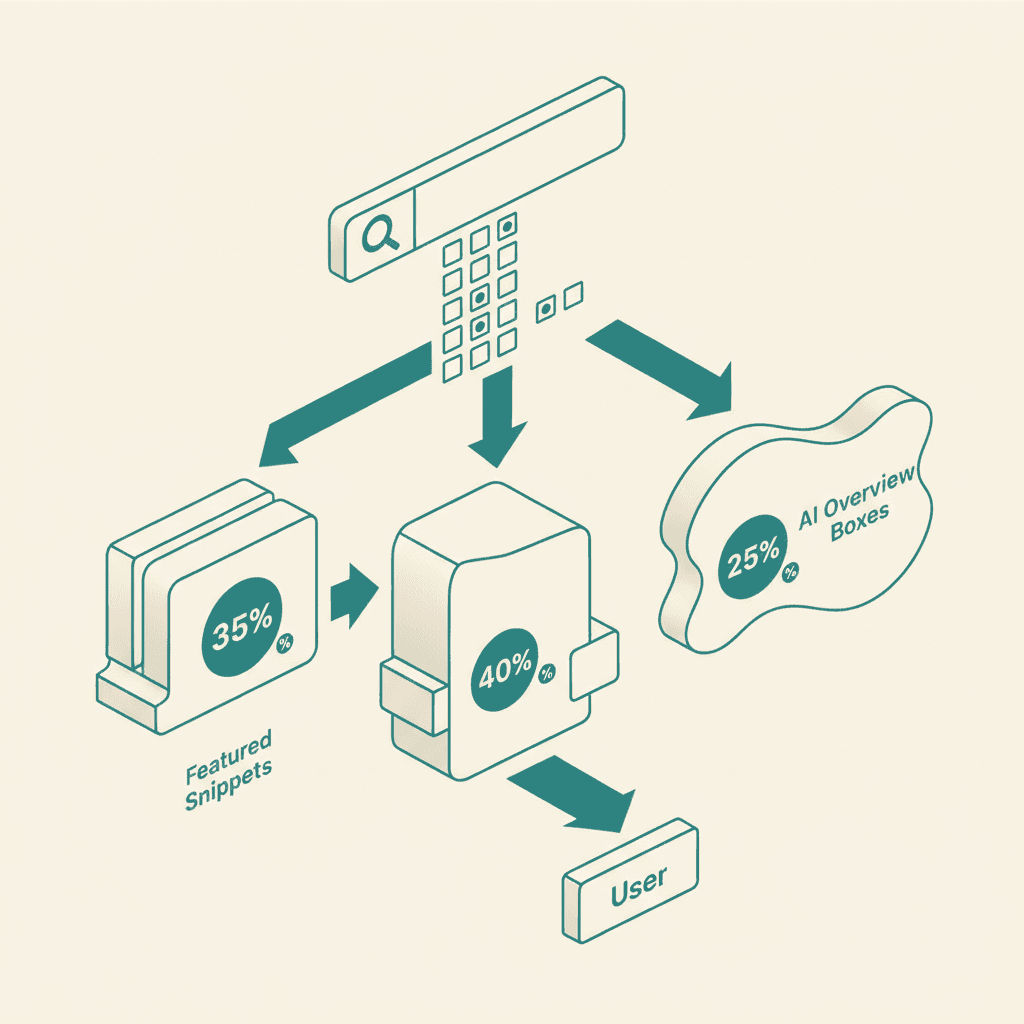
If Google is going to pull answers from your content and display them directly, you need to make extraction as easy as possible. This is where on-page SEO fundamentals evolve from good practice into survival strategy.
Question-Based Headings
Structure your H2 and H3 headings as explicit questions. Featured snippets and AI Overviews overwhelmingly favor content that mirrors the user's query in its heading structure. Instead of writing a heading like "Benefits of Schema Markup," write "What Are the Benefits of Schema Markup?"
This is not about dumbing down your content. It is about giving Google's extraction systems a clean signal for what each section answers.
The 40-60 Word Direct Answer
Immediately following each question-based heading, provide a concise, direct answer in 40 to 60 words. This is the sweet spot for featured snippet extraction. After the direct answer, expand with supporting detail, evidence, and nuance.
The pattern looks like this:
- H2/H3: Question the user is asking
- First paragraph: Direct, definitional answer (40-60 words)
- Subsequent paragraphs: Depth, examples, data, context
Schema Markup for Structured Answers
FAQ and HowTo schema markup remain critical signals for zero-click surfaces. While Google has reduced the visibility of FAQ rich results for many sites, the structured data still helps Google's systems understand the question-answer relationships in your content. This is especially true for AI Overviews, which draw on structured data to validate and source their synthesized responses.
A comprehensive AI-focused SEO approach includes schema markup as a baseline, not an afterthought.
Building Topical Authority in a Zero-Click World
When individual pages lose their ability to drive clicks on informational queries, the strategic response is to build topical depth that makes your domain indispensable as a source. This is the hub-and-spoke model in practice.
The Hub-and-Spoke Framework
Choose a core topic -- your hub -- and surround it with detailed, interlinked subtopic pages (spokes). Each spoke targets a specific long-tail query and links back to the hub. The hub provides comprehensive coverage and links out to each spoke.
This structure accomplishes two things:
- For Google's AI systems: It establishes your domain as a deep authority on the topic, increasing the likelihood of citation in AI Overviews
- For remaining click traffic: Users who do click through from a zero-click SERP feature land on a page that naturally guides them deeper into your content ecosystem
The goal is not to win one snippet. It is to own the topic cluster so thoroughly that Google cannot generate an authoritative answer in your niche without referencing your content.
Content Depth Over Content Volume
Publishing 50 thin articles on adjacent topics is less effective than publishing 15 deeply researched pieces that interlink into a coherent knowledge structure. Understanding the different types of SEO and how they intersect -- technical, content, off-page -- helps inform where depth investments will have the most compounding effect.
Rethinking Success Metrics
If 60% of searches produce no click, then click-based metrics tell an increasingly incomplete story. The shift toward visibility-first measurement is not optional.
Impressions Over Clicks
Google Search Console impression data becomes the primary performance indicator for informational queries. A page that earns 50,000 impressions per month but only 2,000 clicks is not failing -- it is generating significant brand exposure across zero-click results.
Brand Visibility as the New KPI
When your content appears in a featured snippet, an AI Overview citation, or a People Also Ask expansion, users see your brand even without clicking. Over time, this compounds into recognition and trust. The user who sees your domain cited five times across different queries eventually becomes the user who navigates directly to your site.
Tracking this requires evolving beyond traditional SEO reporting frameworks. Impression share by query cluster, SERP feature appearance rates, and brand mention tracking across AI Overviews are the metrics that matter now.
Complementing Organic with Paid Visibility
For queries where zero-click behavior makes organic traffic impractical, paid search provides a complementary lever. PPC campaigns targeting high-value zero-click queries can capture the attention of users who do scroll past the AI Overview or featured snippet. The key is using organic zero-click data to inform which queries justify paid investment.
Zero-Click Search and Philippine Businesses
The zero-click trend carries outsized implications for businesses operating in the Philippines. The country's internet population is overwhelmingly mobile-first, with smartphone-based search accounting for the vast majority of queries. Given that mobile users are 66% more likely to encounter zero-click results, Philippine businesses face higher exposure to this shift than markets with more balanced desktop-mobile splits.
Local Search Is Already Zero-Click
For Philippine businesses serving local markets, zero-click is not a future concern -- it is the present reality. When someone searches "best coworking space Makati" or "dentist near BGC," the Local Pack dominates the SERP. Users get the business name, rating, hours, and phone number without ever visiting the website.
This makes Google Business Profile optimization non-negotiable. Accurate NAP (name, address, phone), current business hours, recent photos, and active review management are the levers that determine visibility in zero-click local results. The principles of local SEO have always emphasized these fundamentals, but zero-click makes them the entire game for local queries.
Mobile-First Content Structure
Philippine audiences consuming search results on smaller screens have even less patience for scrolling past SERP features. Content structured for snippet extraction -- concise answers, clear headings, schema markup -- performs disproportionately well with this audience. Businesses that treat mobile content structure as a priority rather than a responsive design checkbox will capture more zero-click visibility.
Practical Playbook for 2026
Adapting to zero-click search is not about abandoning traditional SEO. It is about expanding the definition of what search visibility means and optimizing accordingly.
Audit Your Query Portfolio
Segment your target keywords into three buckets:
- Zero-click dominant: Informational queries where SERP features answer the query directly. Optimize for extraction and brand visibility.
- Click-viable: Queries where users still click through -- typically transactional, comparison, or complex informational queries. Prioritize traditional ranking and CTR optimization.
- Hybrid: Queries where SERP features exist but clicks still flow. Optimize for both snippet capture and compelling title/description copy.
Optimize for Citation, Not Just Ranking
For queries where AI Overviews dominate, the goal is to become a cited source within the generated answer. This requires:
- Clear, factual, well-structured content that AI systems can confidently extract from
- E-E-A-T signals (experience, expertise, authoritativeness, trustworthiness) that make your domain a preferred source
- Topical authority built through the hub-and-spoke model described above
Protect Your Click-Viable Traffic
Not all queries are going zero-click. Transactional and commercial investigation queries still produce healthy click-through rates. Identify these queries in your portfolio and invest in ranking, compelling meta descriptions, and conversion-optimized landing pages.
Monitor SERP Feature Evolution
The zero-click landscape changes quarterly. New SERP features emerge, AI Overviews expand into new query categories, and Google adjusts how it sources content. Building a monitoring cadence -- monthly SERP feature audits across your core queries -- ensures your strategy stays current.
Frequently Asked Questions
What is a zero-click search?+
A zero-click search is any Google search where the user gets the information they need directly on the results page and leaves without clicking through to any website. This happens through SERP features like featured snippets, Knowledge Panels, People Also Ask boxes, Local Packs, and AI Overviews that display answers inline.
How do I know if zero-click is affecting my traffic?+
Compare your Google Search Console impression data against click data for your top queries. If impressions are stable or growing but clicks are declining, zero-click behavior is the likely cause. Also check whether SERP features have appeared for queries that previously showed standard organic results. A declining CTR percentage across informational queries is the clearest signal.
Can I still get traffic from Google in 2026?+
Yes. While zero-click rates are high for informational queries, transactional, commercial investigation, and complex research queries still generate healthy click-through rates. The key is understanding which queries in your portfolio are click-viable and optimizing accordingly. Branded searches, comparison queries, and queries requiring depth beyond what a snippet can provide still drive meaningful traffic.
Should I optimize for zero-click or traditional SEO?+
Both. They are not mutually exclusive. Zero-click optimization -- structuring content for snippet extraction, building topical authority, earning AI Overview citations -- complements traditional ranking work. The best approach segments your keyword portfolio and applies the right strategy to each query type based on its SERP behavior.
How do AI Overviews affect zero-click rates?+
AI Overviews are the largest driver of zero-click growth in 2026. When an AI Overview appears on a query, the zero-click rate reaches 83%, and organic CTR drops by 61%. AI Overviews synthesize answers from multiple sources, satisfying the user's intent without requiring a click. However, being cited as a source within an AI Overview provides significant brand visibility and can still drive some referral traffic.