Answer Engine Optimization: How to Get Cited by AI in 2026
AEO is how you get your content cited by ChatGPT, Google AI Overviews, and Perplexity. Here's the complete guide for 2026.

Answer Engine Optimization (AEO) is the practice of structuring content so that AI-powered answer engines — ChatGPT, Google AI Overviews, Perplexity, Microsoft Copilot — retrieve it, trust it, and cite it when generating responses to user queries. While traditional SEO focuses on ranking in a list of links, AEO focuses on becoming the source that an AI system reaches for when it needs to give someone a direct answer.
The distinction matters because the way people find information has changed. ChatGPT now serves 883 million monthly users. Google AI Overviews appear in roughly 55% of searches. Gartner projects that 25% of organic search traffic will shift to AI chatbots by the end of 2026. When a quarter of your potential audience never sees a search results page, optimizing only for traditional rankings is leaving visibility on the table.
What AEO Actually Means
AEO is not a new technology or a separate channel. It is a lens through which to evaluate whether your content is positioned to be cited by AI answer engines.
The key word is cited. Modern AI answer systems use retrieval-augmented generation (RAG): the model retrieves documents from a live index, evaluates their quality, extracts useful information, and generates a synthesized answer with attribution links back to sources. To earn a citation, your content must survive every stage of that pipeline — retrieval, quality evaluation, extraction, and attribution.
This is different from gaming search rankings. The AI model evaluates content for clarity, factual accuracy, source quality, and structural accessibility. A page optimized purely for keyword matching may rank well in traditional search but fail at earning AI citations because the model cannot extract a clean answer from it.
How AEO Differs from SEO
AEO and SEO are complementary disciplines, not competitors. A strong foundation in search engine optimization remains essential because most AI answer engines pull from traditional search indices. If your content is not indexed by Google, it is invisible to Google AI Overviews. If your domain has weak authority signals, RAG systems will deprioritize your pages during retrieval.
The differences lie in what you optimize for once foundational SEO is in place:
- SEO optimizes for ranking position. Success means appearing in positions one through ten and earning clicks from users scanning that list.
- AEO optimizes for citation inside a generated answer. Success means the AI selects your content as a source and links users to your domain from within the answer panel.
- SEO rewards keyword-intent alignment and backlinks from authoritative domains.
- AEO rewards direct, extractable answers supported by evidence, structured in ways AI models can parse without ambiguity.
Content that performs well for both shares a common shape: clear definitions up front, logically organized sections, authoritative sourcing, and depth that demonstrates genuine expertise.
The relationship between these disciplines mirrors what is happening more broadly with AI and search optimization — practitioners are not replacing old skills but layering new ones on top.
The Six Pillars of AEO
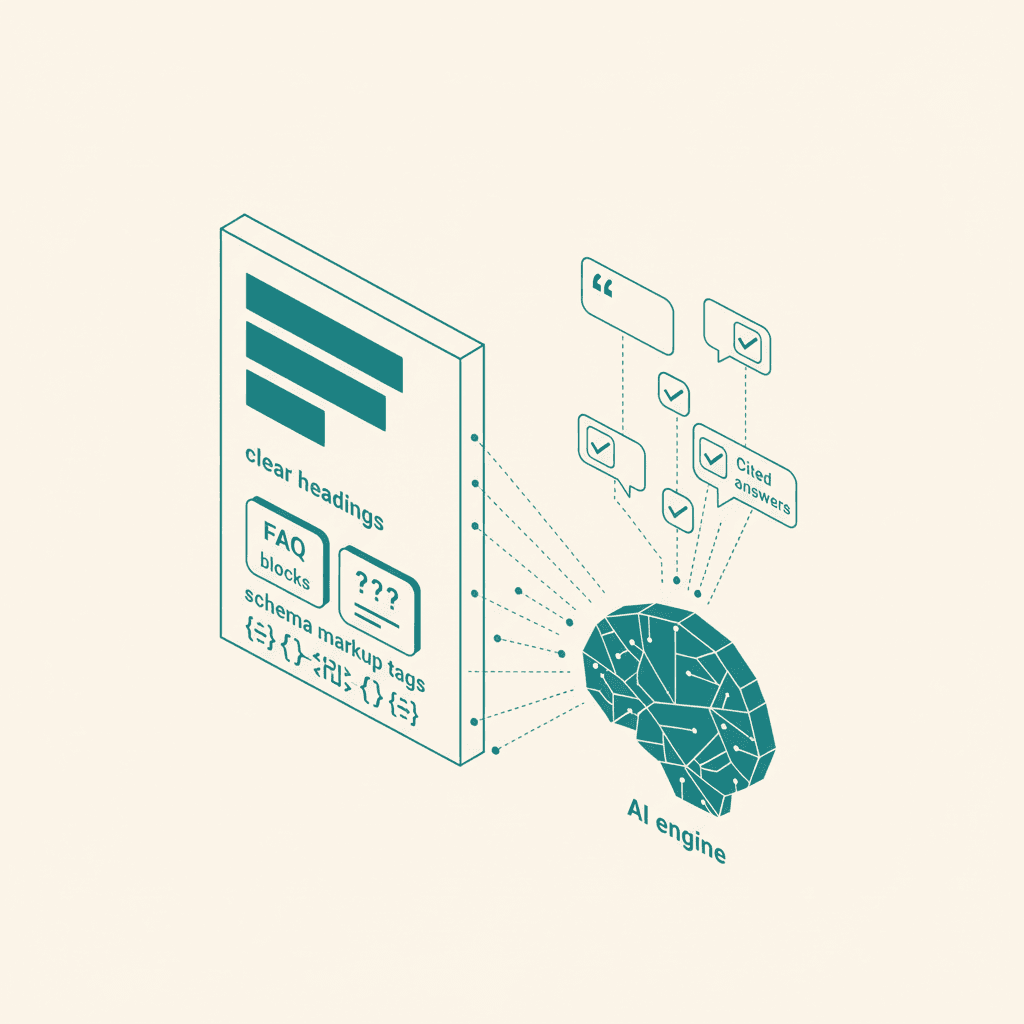
Effective AEO rests on six interconnected pillars. Weakness in any one of them reduces the likelihood of earning AI citations.
Content Structure
AI models parse content hierarchically. They look for heading structures that signal topic boundaries, lead paragraphs that state conclusions before supporting evidence, and sections that map cleanly to the sub-questions a user might ask.
The inverted pyramid — leading with the answer, then providing context and evidence — is the single most important structural principle for AEO. Journalists have used it for a century. It works for AI answer engines because RAG systems often truncate retrieved documents to fit context windows. If your answer is buried in paragraph eight, the model may never see it.
Strong on-page SEO fundamentals already push content in this direction, but AEO demands more precision. Every H2 section should be capable of standing alone as a complete answer to the question implied by its heading.
Answer Formatting
AI models prefer content formatted as direct, extractable statements. Compare: "There are many factors that go into making content work well with AI systems" versus "AI answer engines cite content that states facts directly, supports claims with evidence, and organizes information under descriptive headings." The second version is extractable. The AI can lift that sentence, paraphrase it, and attribute it with confidence. The first is padding no model will cite.
Lists, step sequences, and definition patterns also matter. When a query asks "what are the steps to X," a numbered list is far more likely to be cited than the same information buried in meandering prose.
Citation Quality
Pages that cite authoritative external sources — peer-reviewed studies, government statistics, industry reports — are treated as more trustworthy by RAG systems. The Princeton and Georgia Tech GEO research confirmed this directly: adding authoritative citations within content increased citation frequency in their experiments.
The mechanism is intuitive. An AI model evaluating competing sources on the same topic will favor the one that provides verifiable evidence over the one that makes unsupported assertions.
Schema Markup
Structured data helps AI models understand what your content is about and how its components relate to each other. The most relevant schema types for AEO in 2026 are:
- Article and BlogPosting: Identifies editorial content, authorship, and publication date for freshness and authority evaluation.
- FAQPage: Marks question-answer pairs for direct extraction by AI systems.
- HowTo: Structures step-by-step content, mapping directly to how-to query responses.
- Organization and Person: Builds entity identity, strengthening knowledge graph signals.
Schema is not a ranking factor in the traditional sense, but it is a disambiguation tool that reduces ambiguity when the AI model evaluates whether your page is a credible source. For implementation details, the schema markup guide covers the technical specifics.
Entity Recognition
AI models reason about entities — named, recognized things with defined relationships to other entities. If your brand, authors, or products are established entities in the model's knowledge graph, you have a structural advantage in citation selection.
Entity recognition is built through:
- Consistent brand and product naming across all owned and external content
- Presence in knowledge bases like Wikipedia and Wikidata
- Being cited by other recognized entities (publications, organizations, experts)
- Author pages with verifiable credentials and publication histories
A backlink from a low-quality directory does nothing for entity authority. A mention in an industry report or a quote in a reputable publication builds the kind of entity signal that AI models rely on.
Topical Authority
Sites that cover a topic comprehensively across multiple interlinked pages earn more AI citations than sites with isolated, one-off articles. This matters even more for AEO than traditional SEO because AI models can assess the breadth of a domain's coverage across their entire retrieval set.
Building topical authority means creating content clusters: a pillar page covering the broad topic supported by detailed pages on each subtopic, all internally linked.
How AEO Relates to GEO
Answer Engine Optimization and Generative Engine Optimization are closely related, and the industry is still working out the precise boundary between them.
In practice, GEO refers to the broader discipline — optimizing for AI-generated answer platforms holistically — while AEO emphasizes formatting content to be the cited answer. GEO includes entity building, brand authority in training data, and platform-specific optimization. AEO focuses on the content-level question: is this page structured so that an AI will cite it?
Teams practicing generative engine optimization alongside AEO find that both disciplines reinforce each other. Entity authority makes content more likely to be retrieved. Answer formatting makes it more likely to be cited once retrieved.
Which AI Engines to Optimize For
The four primary AI answer engines that matter for AEO in 2026 are:
- Google AI Overviews: The highest-volume surface, appearing in roughly 55% of searches and drawing from Google's own index. Optimizing for Google AI search is functionally the same as optimizing for AI Overviews.
- ChatGPT (with web browsing): Uses Bing's index and its own browsing capability. Tends to favor long-form, well-structured content with clear authorship.
- Perplexity AI: A search-first AI platform emphasizing citation transparency, showing sources prominently alongside answers.
- Microsoft Copilot: Uses Bing's index with similar content signals to ChatGPT.
Each platform has slightly different retrieval logic, but the fundamentals are consistent: structured content, authoritative sourcing, entity clarity, and answer-ready formatting.
Measuring AEO Performance
There is no equivalent to Google Search Console for AI citations — yet. In 2026, measurement relies on a combination of approaches:
- AI brand mention tracking: Tools like Ahrefs Brand Radar and DataForSEO's AI mentions API monitor whether your domain is being cited across AI platforms.
- Manual query auditing: Running target queries through ChatGPT, Perplexity, and Google to check for citations. This does not scale, but it reveals patterns.
- Referral traffic analysis: GA4 referral reports show traffic from AI platform domains (chatgpt.com, perplexity.ai, bing.com/chat). These numbers are often undercounted because many AI citations do not generate clicks.
- AI keyword research tools are beginning to show which queries trigger AI answers and which sources are cited. Early-stage AI keyword research tools provide some of this data, though coverage is limited.
AEO for Philippine Businesses
Philippine businesses competing in English-language search can earn AI citations against global competitors if their content is better structured and more authoritative on their topic. AI answer engines do not inherently favor large Western brands — they favor the best answer, regardless of domain size or location.
Key considerations for the Philippine market:
- Language: AI answer engines in the Philippines trigger primarily for English-language queries. Content in Filipino or Taglish is less likely to trigger AI Overviews currently, though this is expanding.
- Cost: AEO does not require expensive tools. Schema markup is free. Restructuring existing content is a time investment, not a financial one. The most impactful action — rewriting introductions to lead with direct answers — costs nothing beyond editorial effort.
- Local data: Citing Philippine-specific data from the Philippine Statistics Authority, DTI, and BSP builds localized authority that global competitors cannot easily replicate. AI models value specificity, and Philippines-focused data makes your content the best answer for Philippines-focused queries.
- Competition: The AEO landscape in the Philippines is still early. Most local competitors are not yet optimizing for AI citations, giving early movers a window to establish citation presence.
AI-driven approaches to search optimization now include AEO as a core competency for markets like the Philippines where English-language AI search adoption is accelerating.
Frequently Asked Questions
What is the difference between AEO and SEO?+
SEO optimizes content to rank in traditional search engine results pages — the list of ten blue links. AEO optimizes content to be cited by AI-powered answer engines like ChatGPT, Google AI Overviews, and Perplexity. Both require quality content and technical foundations, but AEO places greater emphasis on answer formatting, entity authority, and structured data than on backlink profiles and keyword density.
Which AI engines should I optimize for?+
The four primary platforms are Google AI Overviews (highest volume, roughly 55% of searches), ChatGPT (883 million monthly users), Perplexity AI (citation-transparent search), and Microsoft Copilot. Optimizing for all four simultaneously is feasible because they share core requirements: structured content, authoritative sourcing, schema markup, and clear answer formatting.
How do I know if my content is being cited by AI?+
Use AI brand mention tracking tools (Ahrefs Brand Radar, DataForSEO AI mentions API) for automated monitoring. Supplement with manual audits — run your target queries through ChatGPT, Perplexity, and Google to check for citations. Review GA4 referral traffic from AI platform domains. No single tool provides complete coverage yet, so a multi-source approach is necessary.
Is AEO replacing SEO?+
No. AEO is built on top of SEO, not instead of it. Most AI answer engines retrieve content from traditional search indices, so strong SEO foundations — indexability, crawlability, domain authority, content quality — are prerequisites for AEO success. The disciplines are complementary: SEO gets your content into the index, AEO gets your content cited in AI answers.
What schema markup helps with AEO?+
The most impactful schema types for AEO are FAQPage (marks question-answer pairs for direct extraction), HowTo (structures step-by-step content), Article and BlogPosting (provides editorial metadata including authorship and publication date), and Organization and Person (builds entity identity). Implementing these types reduces ambiguity for AI models evaluating your content.